
Peptide Warehouse: Best USA Research Sourcing Insights for 2026
2026 peptide warehouse sourcing demands batch COAs, lyophilized handling, and domestic fulfillment. See how Countrywide Peptides supports lab procurement.
📋 Table of Contents
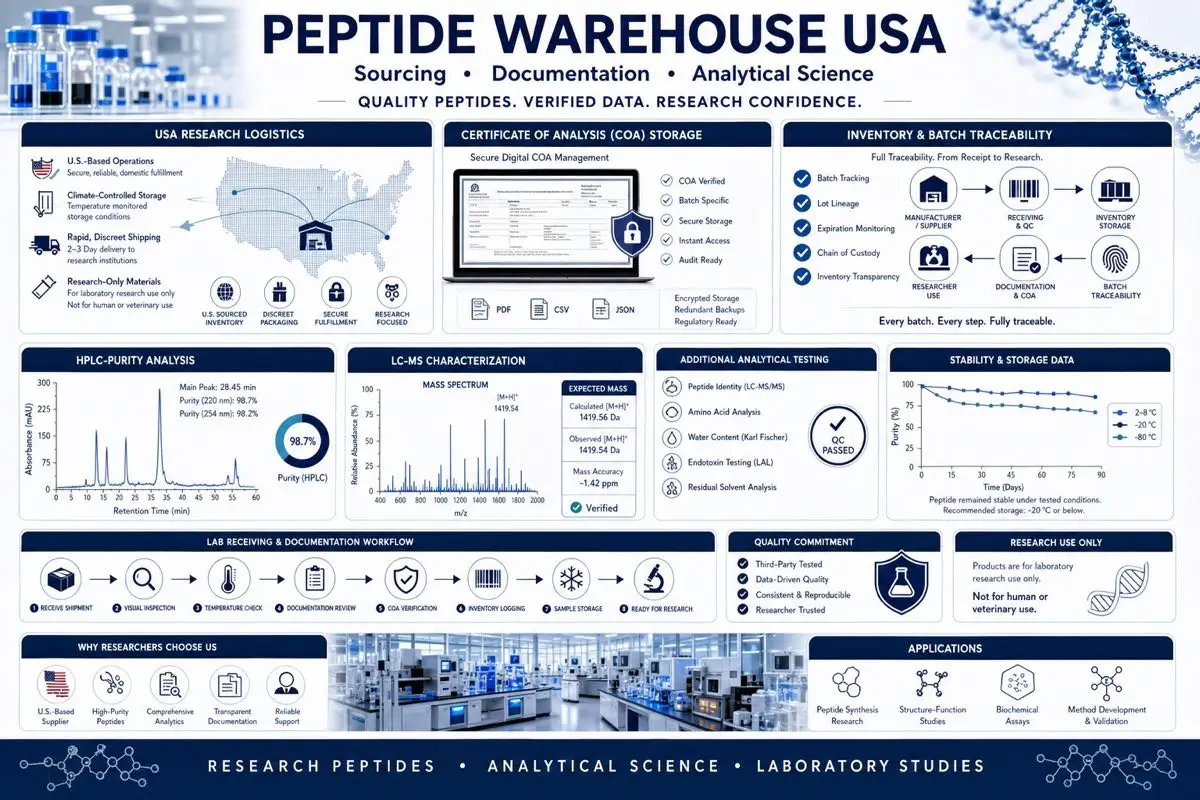
In 2026, a peptide warehouse should reduce procurement uncertainty for laboratory teams through domestic fulfillment, batch-level verification, public Certificates of Analysis, and lyophilized shipping practices. Countrywide Peptides, an American-owned research supplier in Sevierville, Tennessee, serves qualified researchers and institutions with research peptides, peptide blends, and bacteriostatic water for research use only.
Key takeaways
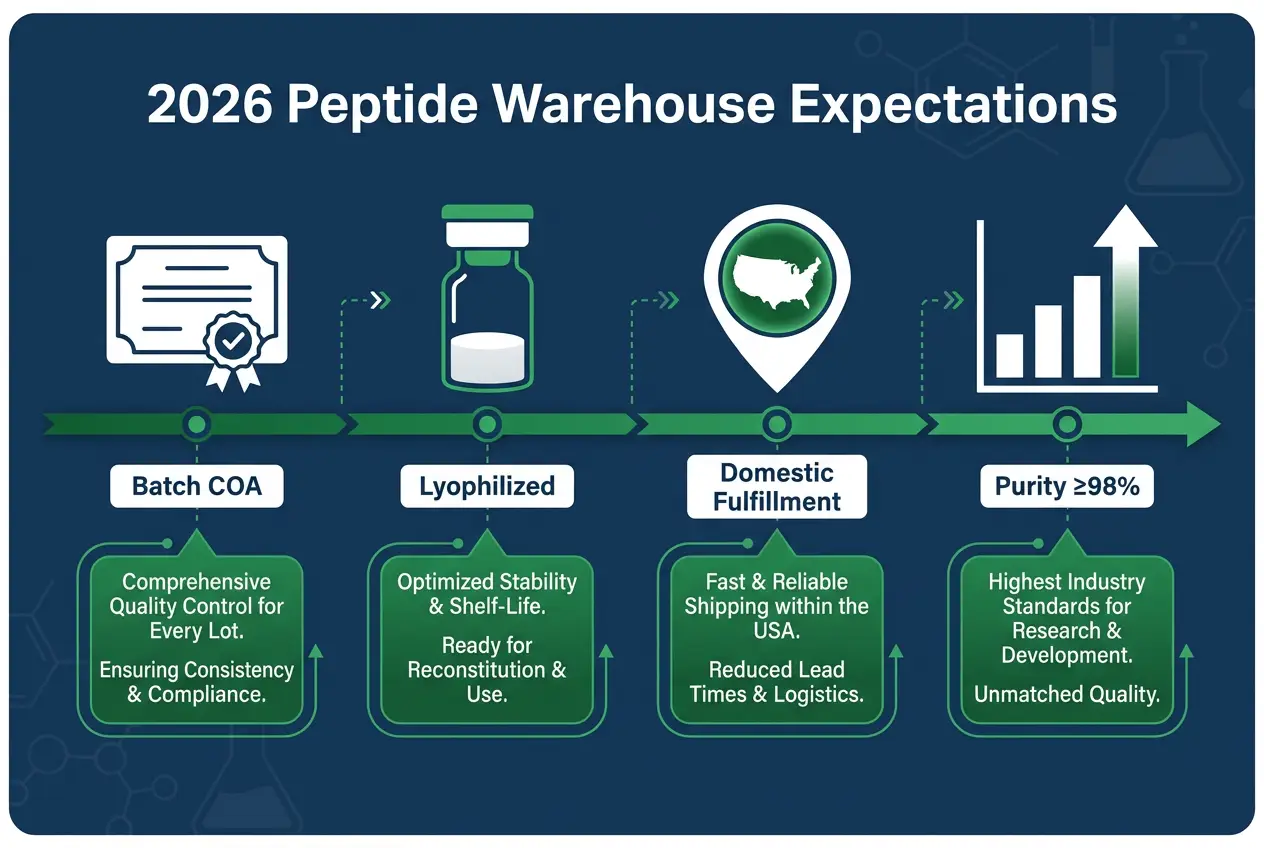
- For 2026, a peptide warehouse is useful when it reduces uncertainty with batch data, not only inventory depth.
- Public COAs and chromatograms make peptide warehouse screening faster for institutional review.
- Lyophilized format plus clear shipping practices supports controlled laboratory storage workflows.
- Research-only positioning keeps peptide warehouse procurement aligned with laboratory use boundaries.
- Domestic fulfillment and secure ordering reduce risk in 2026 procurement planning.
What Should Labs Expect from a Peptide Warehouse in 2026?
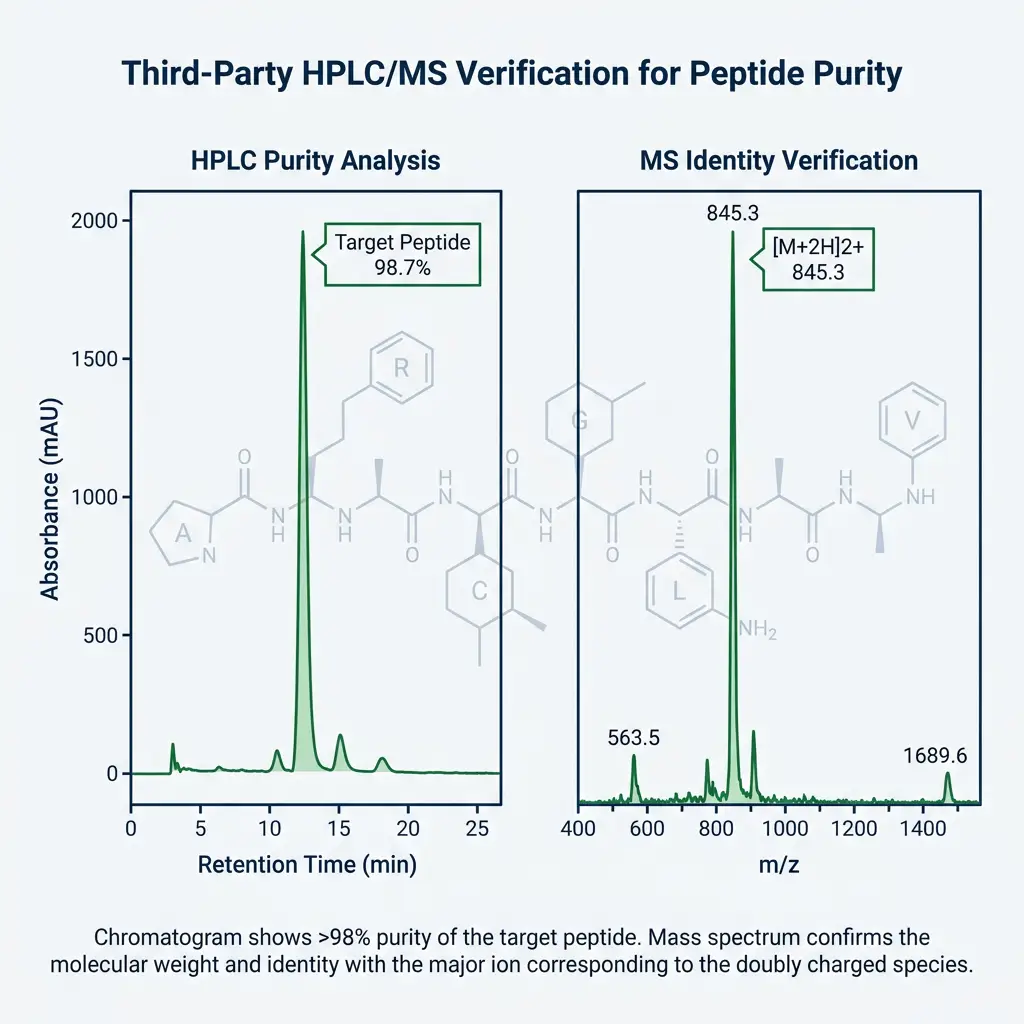
When you need a peptide warehouse in 2026, you are not just looking for inventory depth. You need a U.S. supplier that can provide batch-level verification, dependable shipping, and documentation your lab can review before you place an order. Countrywide Peptides is an American-owned research peptide supplier based in Sevierville, Tennessee, serving qualified researchers, laboratories, and institutions across the United States.
A peptide warehouse is only useful if it reduces uncertainty. In 2026, Countrywide Peptides pairs U.S.-based fulfillment with publicly accessible batch documentation, third-party testing, and rapid nationwide shipping. The listed business address gives research buyers a clear domestic point of contact instead of an anonymous offshore supply chain.
For research teams, that matters in practical ways. You can review Certificates of Analysis with chromatograms on product pages and via QR code, confirm purity data before purchase, and source from a peptide warehouse that presents itself as research-only rather than blurring channels. By 2026 standards, this documentation-first approach is what separates reliable domestic suppliers from less verifiable options.
Review lyophilized storage literature via PubMed results on lyophilized peptide storage stability, and compare documentation habits using our certificate of analysis resources when evaluating any research supplier.
| Scientific Snapshot | Details |
|—|—|
| Topic | Peptide warehouse sourcing for laboratory research |
| Primary Focus | Batch verification, COAs, domestic fulfillment |
| Material Format | Lyophilized research peptides and related lab supplies |
| Documentation | Third-party HPLC/MS and public Certificates of Analysis |
| Use Boundary | Laboratory research procurement education only |
A reliable peptide warehouse also communicates storage and handling expectations clearly. Lyophilized vials should arrive sealed, with batch identity intact, and with documentation that matches the shipment. For labs that manage multiple projects, this consistency reduces the need for internal re-verification before storage or use in experiments. The supplier’s research-only language further reinforces that all materials are intended for in vitro laboratory use, not for human or veterinary applications.
Why Does Batch-Level Documentation Matter in Peptide Warehouse Sourcing?
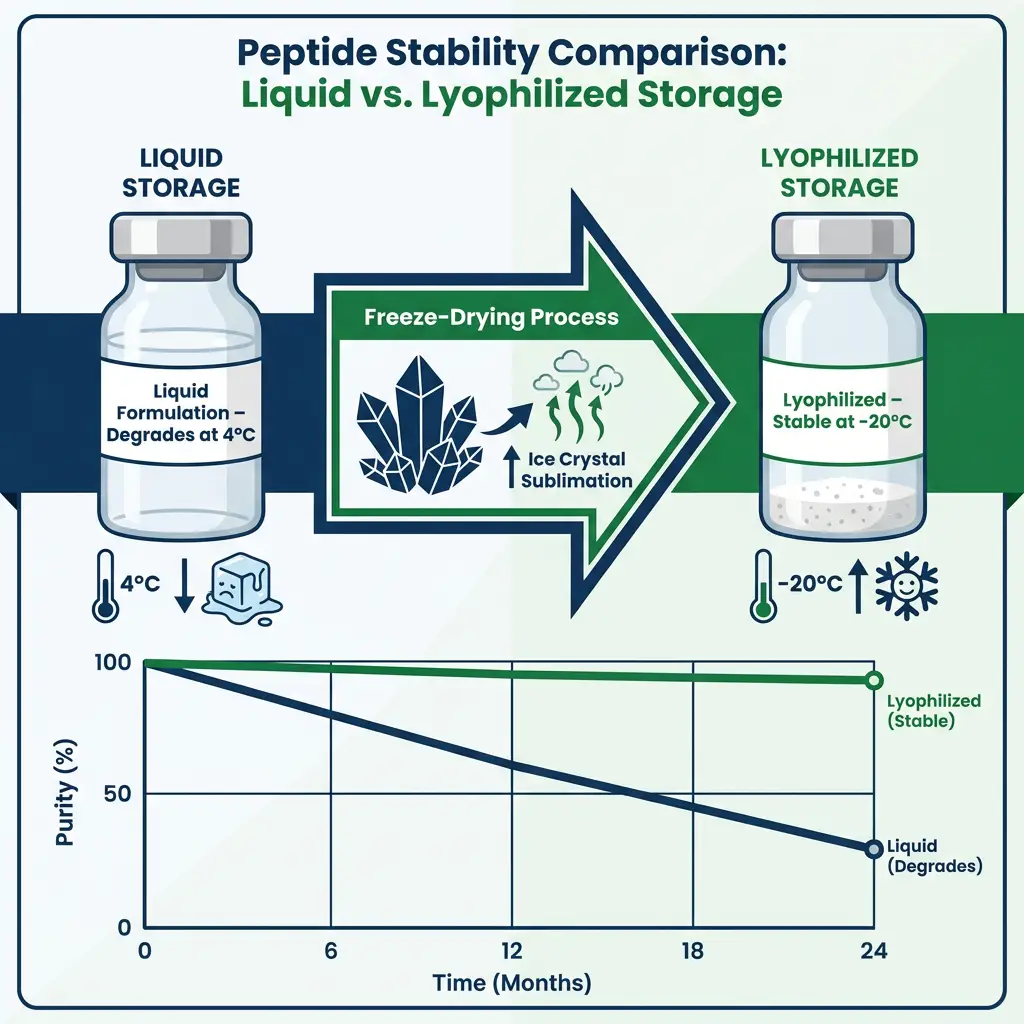
Documentation is where many suppliers become difficult to evaluate. A strong peptide warehouse in 2026 makes third-party testing central rather than an afterthought. Every peptide is described as undergoing third-party HPLC-MS and purity verification before release, with downloadable Certificates of Analysis accompanying each order.
That gives usable proof, not vague quality language. You can compare batches, review chromatograms, confirm the stated purity level, and keep records aligned with internal purchasing or lab documentation needs when working with a research supplier in 2026.
Countrywide Peptides also states that peptides are produced via solid-phase peptide synthesis, followed by HPLC purification to 99% or higher and mass spectrometry confirmation. For labs that care about analytical transparency in 2026, those process details clarify how material was made and how identity and purity were checked before a shipment leaves fulfillment.
This is also where a transparent peptide warehouse stands apart from suppliers that rely on thin labeling or private documentation. In environments where certificate and source documentation matter—especially when institutions review supply channels—public COAs are a practical advantage for 2026 procurement.
For deeper guidance on supplier evaluation, see Peptide Suppliers USA: How to Choose a Trusted Source.
💡 Key Takeaway: Why Does Batch-Level Documentation Matter in Peptide Warehouse Sourcing?
Batch-level documentation turns a purchase into a verifiable transaction. Labs that archive COAs and chromatograms can demonstrate sourcing diligence during audits, grant reviews, or internal protocol checks. Without this paper trail, a peptide warehouse is just a vendor; with it, the supplier becomes a documented procurement partner.
💡 Key Takeaway: Why Does Batch-Level Documentation Matter in Peptide Warehouse Sourcing?
How Does Third-Party HPLC/MS Testing Support Peptide Warehouse Verification?
A disciplined peptide warehouse treats third-party analytical testing as a core verification step. In 2026, Countrywide Peptides supplies research peptides described as manufactured under strict GMP-compliant conditions and verified by independent analytical laboratories.
The stated workflow includes solid-phase peptide synthesis, HPLC purification to 99% or higher, and mass spectrometry confirmation. Those details matter because they explain how identity and purity were established before a batch is released for laboratory procurement in 2026.
Batch paperwork and COA checklists help laboratories evaluate a peptide warehouse with measurable documentation. You can download Certificates of Analysis from product pages or scan QR codes to review chromatograms for the exact batch you intend to order. For 2026 research budgets, this reduces the need for redundant in-house verification.
For institutional buyers, this level of transparency supports internal review processes. Instead of relying on a supplier’s verbal assurance, your team can archive the actual analytical data tied to the lyophilized material you receive. That is a 2026 procurement best practice.
You can also compare documentation habits across sources by reviewing Nationwide Peptides Reviews | Countrywide Peptides.
Third-party HPLC/MS testing adds an independent layer of confidence. When a supplier states that an outside laboratory verified purity and identity, the claim becomes testable rather than promotional. Labs can request the specific batch COA, confirm the chromatogram peaks, and store that evidence alongside the material for traceability. This practice aligns with good laboratory documentation standards and reduces procurement risk over multiple orders.
What Research Materials Does a Peptide Warehouse Typically Supply?
A focused research catalog helps teams order materials without sorting through unclear categories or incomplete documentation. Countrywide Peptides supplies individual research peptides, peptide blends, and bacteriostatic water for U.S. laboratories and institutions in 2026.
Here is what laboratories commonly source from this peptide warehouse model:
- Research peptides: Lyophilized compounds manufactured under strict GMP-compliant conditions and verified by independent analytical laboratories.
- Peptide blends: Multi-compound research options for labs managing defined project requirements.
- Lab supplies: Bacteriostatic water to support laboratory handling workflows.
That focus helps simplify procurement. Instead of spreading sourcing across multiple vendors, teams can centralize core peptide purchases with one research-only supplier that publishes batch data, maintains secure encrypted ordering, and offers bulk pricing for long-term 2026 projects.
If your lab runs recurring studies or staged purchasing schedules, budgeting becomes easier with free U.S. shipping on orders over $200 and pricing support for larger or ongoing orders through domestic fulfillment. This 2026 sourcing model reduces administrative overhead.
A defined catalog also means fewer surprises. When a peptide warehouse clearly lists research peptides, blends, and bacteriostatic water, you avoid the ambiguity of mixed-use product lines. Every item carries the same research-use-only boundary, which keeps procurement conversations straightforward for institutional purchasing offices and compliance reviewers.
Why Is Lyophilized Format Important for Peptide Warehouse Storage?
Storage and handling affect whether a shipment remains useful when it reaches your facility. A research-focused peptide warehouse supplies lyophilized peptides, which aligns with common academic handling practices for longer-term stability. In 2026, lyophilized format remains the default for research peptides shipped domestically.
Published peptide-handling guidance supports lyophilized storage and low-temperature conditions for extended storage, and it also emphasizes careful preparation before reconstitution to limit moisture exposure. That means your supplier choice affects more than convenience in 2026.
When lyophilized material ships with documentation and clear batch identity, your team starts from a format that supports controlled storage workflows in the lab. Sealed lyophilized vials illustrate how peptide warehouse fulfillment supports controlled laboratory storage workflows. For 2026 procurement, this reduces the risk of degradation during transit.
A strong peptide warehouse also communicates storage expectations clearly. Countrywide Peptides frames its lyophilized research peptides as research-use-only materials, which keeps laboratory handling aligned with 2026 research-use boundaries.
You can cross-check general storage guidance with National Center for Biotechnology Information resources, and compare supplier practices through Peptide Research Education: Evidence Boundaries & Documentation (2026).
Lyophilized format also simplifies inventory management. Dry, sealed vials occupy less controlled storage space than reconstituted solutions and can be stored under standard laboratory freezer conditions until use. When a batch arrives with its COA and chromatogram attached, the entire chain from synthesis to storage becomes auditable. This is a practical advantage for labs that need to track material stability across multiple freeze-thaw cycles or long-term study arms.
💡 Key Takeaway: Why Is Lyophilized Format Important for Peptide Warehouse Storage?
How Does Domestic Fulfillment Reduce Peptide Warehouse Procurement Risk?
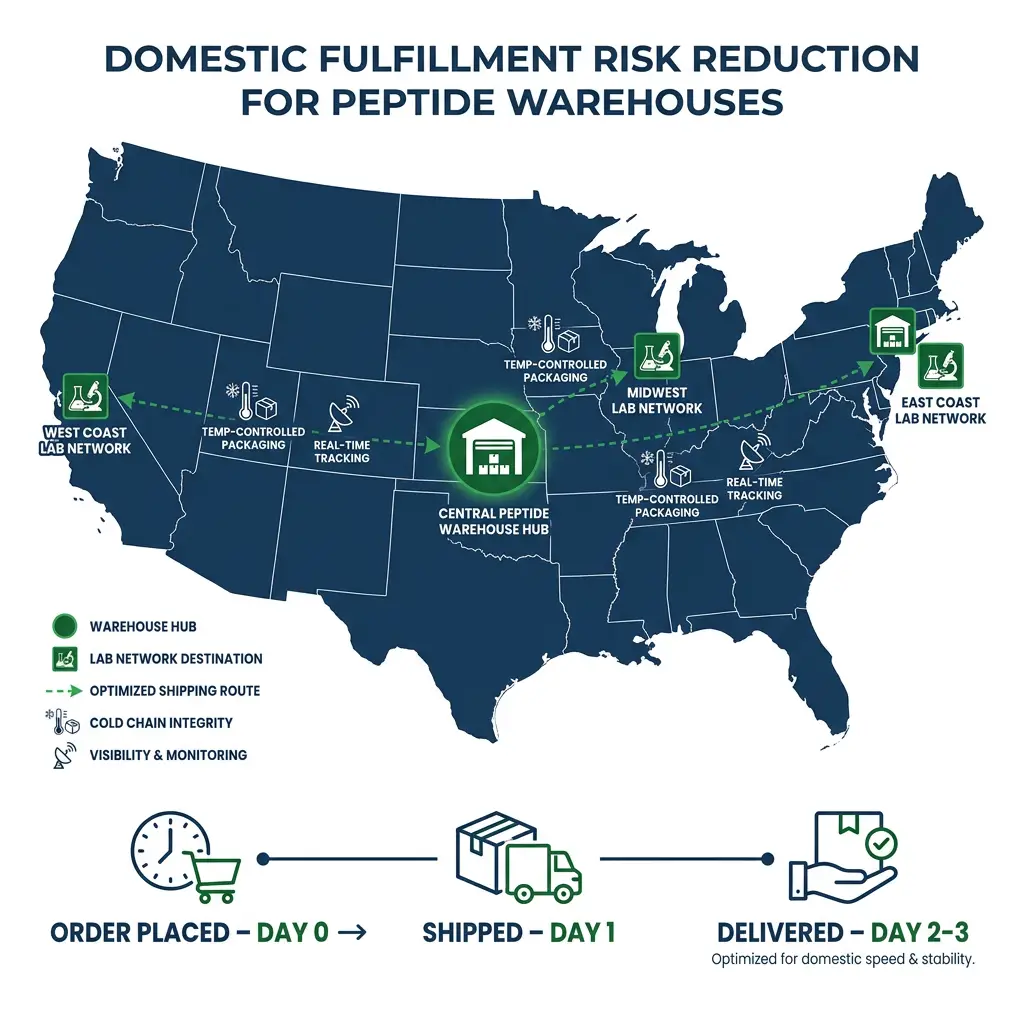
Domestic fulfillment changes the risk profile of peptide warehouse sourcing. When a supplier ships from a U.S. location, laboratories avoid international customs delays, unpredictable transit conditions, and unclear import documentation. In 2026, domestic fulfillment is a baseline expectation for research peptide procurement.
Countrywide Peptides operates from Sevierville, Tennessee, and provides rapid nationwide shipping. That means your order moves through a domestic carrier network with tracking and delivery windows that are easier to plan around. For 2026 lab calendars, this predictability supports scheduled experiments.
Free U.S. shipping on orders over $200 further reduces procurement friction. Bulk pricing and secure encrypted ordering add another layer of practical benefit for labs managing recurring 2026 supply needs.
When documentation, shipping, and ordering systems align, a peptide warehouse becomes a repeatable procurement channel rather than a one-off risk. That is the standard researchers should apply in 2026.
Domestic fulfillment also shortens the feedback loop for issue resolution. If a shipment is delayed or a vial arrives damaged, a U.S.-based supplier can respond within business days, not weeks. For labs with tight grant timelines or shared equipment schedules, that responsiveness matters. It also simplifies returns or replacements, since the logistics stay within domestic carrier networks.
When Is a Peptide Warehouse the Right Fit for Your Lab?
A peptide warehouse is the right fit when your lab needs lyophilized research peptides with batch-level verification and domestic fulfillment. If your institution requires public COAs, third-party HPLC/MS data, and research-only sourcing, then a supplier like Countrywide Peptides matches those 2026 requirements.
Labs that run recurring studies benefit from centralized ordering, free shipping thresholds, and bulk pricing. Labs that need documentation for grant reporting or internal audits benefit from downloadable COAs and QR-accessible chromatograms. In 2026, these features save time and reduce compliance friction.
If your current supplier does not provide public batch data or ships from an unknown overseas origin, switching to a domestic peptide warehouse may reduce procurement uncertainty. The 2026 evaluation standard is simple: verifiable data beats marketing claims.
Compare your options using the internal review checklist in the next section, and see Nationwide Peptides Reviews | Countrywide Peptides for direct supplier comparisons.
Consider the following fit test for your lab:
- Does your procurement policy require a U.S. supplier address?
- Do you need COAs with chromatograms before purchase approval?
- Do you store lyophilized peptides under controlled freezer conditions?
- Does your institution prohibit human-use language in supply orders?
If you answered yes to two or more, a research-only domestic peptide warehouse is likely the correct channel. If you answered no to all, a general chemical supplier may suffice, but you will still need to verify batch documentation independently.
Which Documentation Practices Should Labs Verify Before Ordering from a Peptide Warehouse?
Before ordering from any peptide warehouse in 2026, verify five documentation practices. First, confirm that the supplier publishes Certificates of Analysis with chromatograms for each batch, not just a single sample COA. Second, check that third-party HPLC/MS testing is stated and that the workflow includes solid-phase peptide synthesis and purification to 99% or higher.
Third, confirm that the supplier states lyophilized format and research-use-only positioning. Fourth, review shipping and fulfillment details: domestic origin, tracking, free shipping threshold, and secure encrypted ordering. Fifth, compare the supplier’s documentation habits with peers using Peptide Suppliers USA: How to Choose a Trusted Source.
This five-point checklist works for any peptide warehouse in 2026. Countrywide Peptides meets each point through public COAs, QR-code access, lyophilized research peptides, Sevierville-based fulfillment, and research-only language.
Create a simple verification table for your own records:
| Checklist Item | Verification Question | Countrywide Peptides Status |
|—|—|—|
| Public COAs | Are chromatograms downloadable per batch? | Yes, via product pages and QR codes |
| Third-party testing | Is HPLC/MS verification stated? | Yes, third-party HPLC-MS and purity verification |
| Lyophilized format | Are peptides shipped dry and sealed? | Yes, lyophilized research peptides |
| Domestic fulfillment | Is the supplier U.S.-based? | Yes, Sevierville, Tennessee |
| Research-only boundary | Is human use explicitly excluded? | Yes, in vitro research use only |
This table turns subjective supplier evaluation into a pass/fail exercise. Keep a copy for each supplier you screen, and attach it to your procurement file for audit readiness.
💡 Key Takeaway: Which Documentation Practices Should Labs Verify Before Ordering from a Peptide Warehouse?
How Should Labs Compare Peptide Warehouse Options in 2026?
Comparing peptide warehouse options in 2026 requires scoring suppliers on documentation, format, fulfillment, and use boundaries. Create a simple table with columns for COA availability, HPLC/MS verification, lyophilized shipping, domestic origin, free shipping threshold, and research-only positioning.
For each supplier, mark yes or no and attach notes. Countrywide Peptides scores yes across all columns: public COAs with chromatograms, third-party HPLC-MS, lyophilized format, Sevierville fulfillment, free U.S. shipping over $200, and research-use-only statements.
Weight the columns according to your lab’s needs. If batch verification matters most, double the COA and HPLC/MS scores. If storage stability is critical, weight lyophilized format higher. This 2026 comparison method turns subjective supplier selection into a repeatable scoring exercise.
You can also review National Science Labs Peptides: A Researcher’s Guide for a parallel example, but keep your scoring criteria consistent.
To make the comparison practical, use a 0–3 scale for each column, where 0 means no evidence and 3 means public, batch-specific evidence. Then sum the scores. A supplier with public COAs, third-party verification, lyophilized format, domestic shipping, free shipping over $200, and research-only language scores 18. A supplier missing two of those items drops to 12 or lower. This numeric threshold helps procurement committees justify supplier choices without relying on anecdotal preference.
Why Does Research-Only Positioning Keep Peptide Warehouse Procurement Aligned?
Research-only positioning keeps every transaction inside laboratory use boundaries. When a peptide warehouse states that all products are for in vitro research only, not for human or veterinary use, the procurement conversation stays compliant. In 2026, this clarity protects both the supplier and the purchasing institution.
This boundary is not a marketing detail; it is a structural safeguard. It prevents accidental misclassification of research peptides as therapeutic or supplement products. It also simplifies institutional review, because purchasing offices can see immediately that the supplier does not operate in human-use channels. For labs that receive federal or institutional funding, that distinction matters during audits and protocol reviews.
Countrywide Peptides consistently uses research-use-only language across product pages, documentation, and order communications. This consistency means a lab never has to interpret ambiguous wording or guess at intended use. Every material arrives with the same boundary statement, which supports clean recordkeeping and clear internal training for lab staff.
When every supplier in your comparison table is research-only, the decision shifts to verifiable quality and logistics—not to parsing marketing language. That is the procurement posture labs should maintain for lyophilized peptides, peptide blends, and bacteriostatic water.
FAQ
What should I check first when evaluating a peptide warehouse?
Start with documentation. Confirm that the supplier publishes batch-specific Certificates of Analysis with chromatograms, states third-party HPLC/MS verification, and describes solid-phase peptide synthesis with purification to 99% or higher. Then check domestic fulfillment and lyophilized format. Countrywide Peptides meets these points through public COAs, QR-code access, and Sevierville-based shipping.
Does Countrywide Peptides ship lyophilized peptides only?
Yes, Countrywide Peptides supplies lyophilized research peptides, peptide blends, and bacteriostatic water. The lyophilized format aligns with common academic storage guidance and reduces degradation risk during domestic transit. Each vial ships sealed with batch identity and supporting documentation.
Is there a minimum order for free shipping?
Countrywide Peptides offers free U.S. shipping on orders over $200. For larger or recurring orders, bulk pricing and secure encrypted ordering are available. This threshold helps labs budget for staged purchasing schedules without unexpected freight costs.
Are the products for human or veterinary use?
No. All products are sold strictly for in vitro laboratory research purposes only. They are not for human use, not for veterinary use, and not intended to diagnose, treat, cure, or prevent any disease. Purchasers must be 21 or older and qualified researchers or institutions.
How can I verify a batch before ordering?
You can download Certificates of Analysis from product pages or scan QR codes to review chromatograms for the exact batch. Countrywide Peptides states that every peptide undergoes third-party HPLC-MS and purity verification before release, with the COA accompanying each order.
Ready to Take the Next Step?
Every product includes lot-specific documentation and third-party purity testing.
Explore Our Research Products →Free shipping on qualifying orders · Batch COA on request