
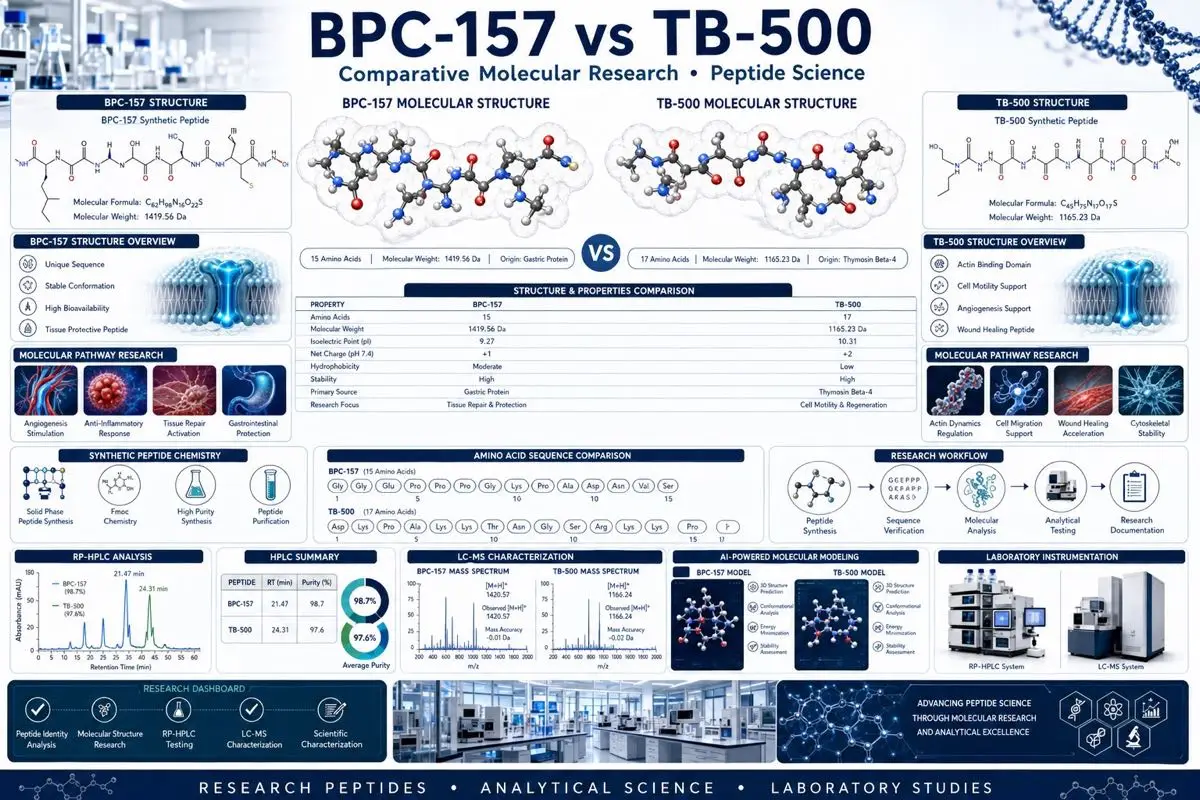
BPC-157 vs TB-500: Comparative Notes for Assay Planners
bpc 157 vs TB-500: 7 proven assay planning notes for research labs. Compare pathway focus, shared handling, side-by-side tips, and documentation.
📋 Table of Contents
Assay planners comparing bpc 157 and TB-500 should separate the two by primary research question: bpc 157 workstreams typically emphasize cellular signaling and tissue-model assay development, while TB-500 workstreams emphasize cytoskeletal and migration-oriented models. This comparative note set is for laboratory research literacy only and is not medical advice or intended for human use. Use each SKU to answer one clearly stated in vitro question, never as interchangeable reagents.
Key takeaways
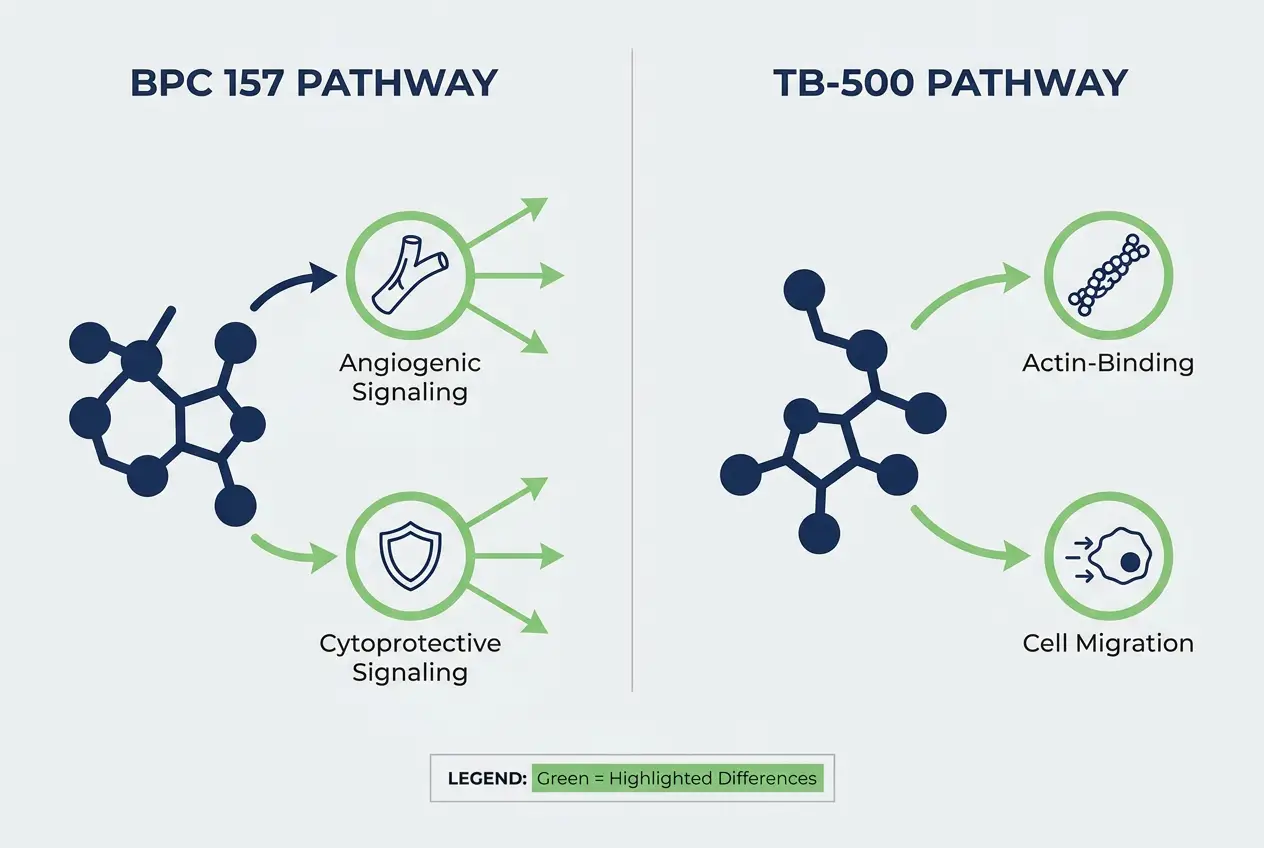
- bpc 157 is usually framed for cellular signaling and tissue-model assay development; TB-500 is framed for cytoskeletal and migration-oriented models.
- Both peptides require research-only custody with lot logging, validated reconstitution, and pilot plates before scale-up.
- Never assume interchangeable concentrations across SKUs; keep separate aliquot boxes, pipettes, and tools.
- Document each lot independently in the laboratory binder and request clear research labeling and lot paperwork from the supplier.
- State in every protocol which in vitro question each SKU is answering.
What Is the Core Research Question When Comparing bpc 157 and TB-500?
The first planning step is not to ask which peptide is more potent. The first step is to name the assay endpoint and the pathway you expect to perturb. The original catalog-level guidance is direct: bpc 157 workstreams frequently emphasize cellular signaling and tissue-model assay development, while TB-500 workstreams more often emphasize cytoskeletal and migration-oriented models. Write that distinction into the protocol header before any reconstitution.
A well-formed research question for bpc 157 might read: ‘Does this test article change signaling marker output in a stressed fibroblast monolayer over 24 hours?’ A parallel TB-500 question might read: ‘Does this test article alter migration distance or cytoskeletal filament organization in a scratch assay?’ The two questions do not share the same positive control, plate map, or acceptance criteria.
Because assay planners often inherit legacy protocols, the comparison notes below help teams audit whether a given SKU is being used to answer the right question. If a protocol cannot state the expected pathway, the experiment is not yet ready for scale-up.
Why Pathway Framing Matters for bpc 157 Assays
For bpc 157, pathway framing usually centers on signaling cascades and tissue-model outputs. This does not mean every assay must measure a kinase or a transcription factor. It means the protocol should record which cellular process is being interrogated: viability under stress, matrix deposition, junction integrity, or another defined readout.
TB-500 framing, by contrast, often centers on actin dynamics, migration, and cytoskeletal remodeling. Mixing these framings in a single plate without separate annotations is a common source of irreproducible data. Keep the two workstreams in separate binders and separate freezer boxes.
How Do Laboratories Separate bpc 157 and TB-500 Workstreams?
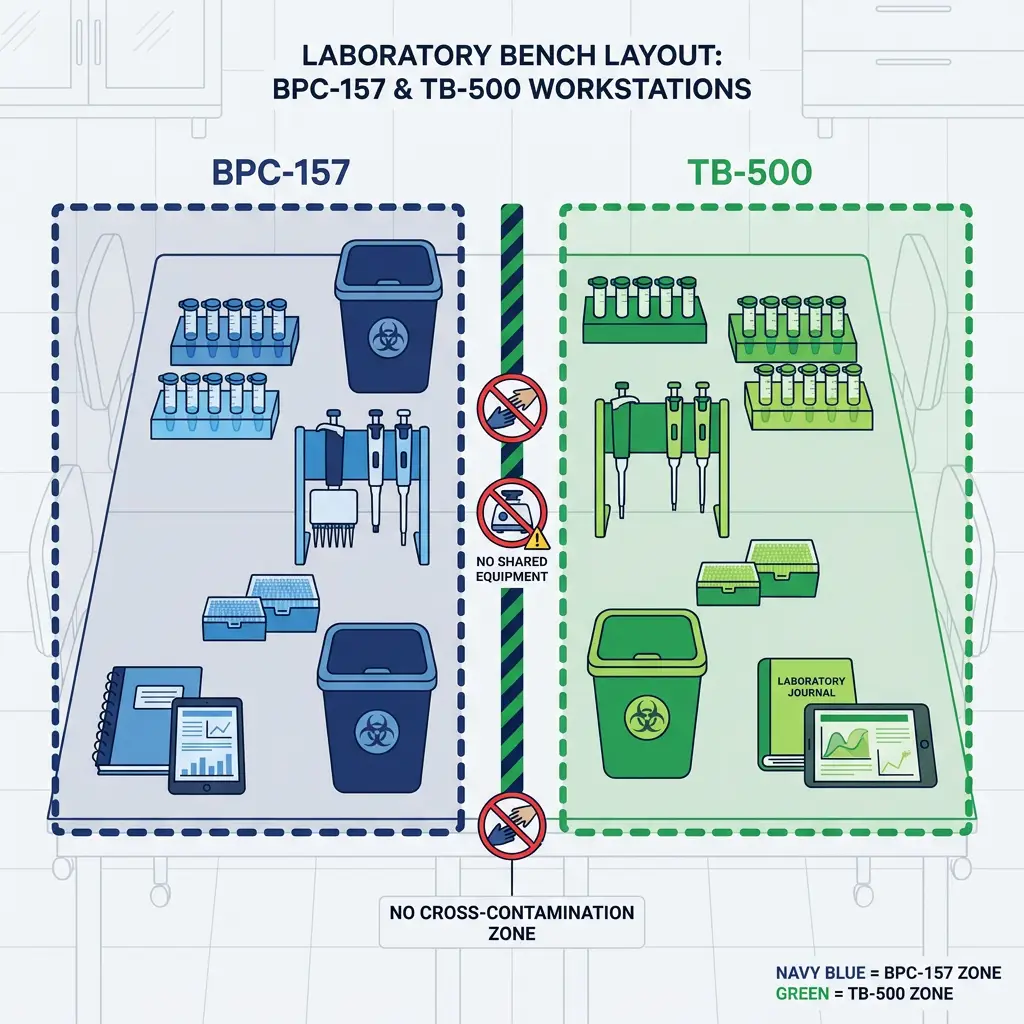
The original note is simple: BPC-157 workstreams frequently emphasize cellular signaling and tissue-model assay development; TB-500 workstreams more often emphasize cytoskeletal and migration-oriented models. To put that into daily practice, assign different color-coded labels, different aliquot boxes, and different pipette sets.
Many laboratories use a two-column planning table. The left column lists the bpc 157 question, the right column lists the TB-500 question. Under each column, the planner records the model system, the timepoint, the expected readout, and the lot number. This table prevents a researcher from reaching for the wrong stock when two peptides sit in the same -20°C rack.
| Planning element | bpc 157 workstream | TB-500 workstream |
|—|—|—|
| Primary framing | Cellular signaling and tissue-model assay development | Cytoskeletal and migration-oriented models |
| Typical readout focus | Signaling markers, matrix or junction outputs | Migration distance, filament organization |
| Positive control | Defined per tissue-model protocol | Defined per migration protocol |
| Aliquot box | Separate, labeled for bpc 157 only | Separate, labeled for TB-500 only |
| Binder | Independent lot log | Independent lot log |
Do not assume that a concentration used for bpc 157 will transfer to TB-500. Even when both peptides are reconstituted in the same solvent, the working range for one SKU is not automatically valid for the other. Each SKU needs its own pilot dilution series.
💡 Key Takeaway: How Do Laboratories Separate bpc 157 and TB-500 Workstreams?
What Pathway Differences Should Assay Planners Record for bpc 157?
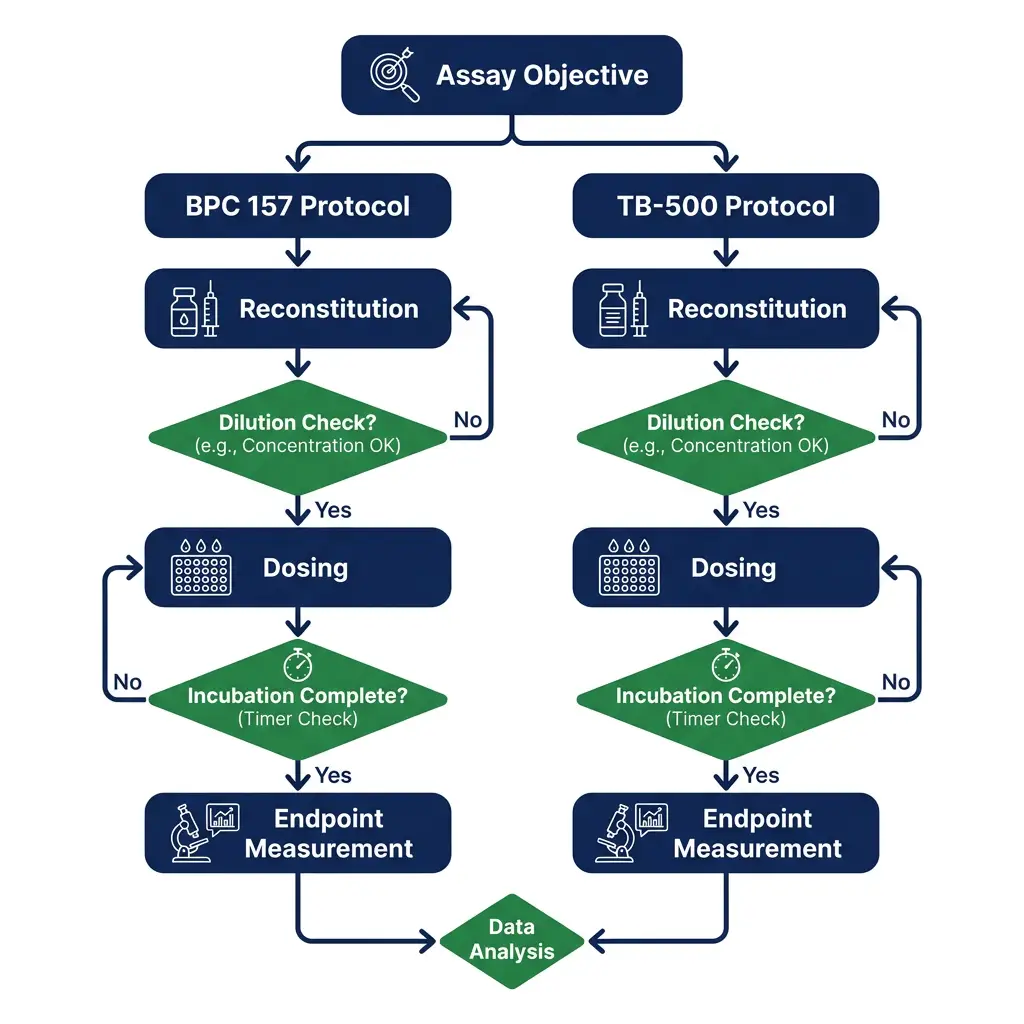
For bpc 157, the assay planner should record the tissue-model system, the cell type, the passage number, the seeding density, and the stressor used to create the model. The original note emphasizes cellular signaling and tissue-model assay development, so the documentation should include the signaling marker or structural endpoint being measured.
A simple table can hold these fields:
| Field | Example entry for bpc 157 |
|—|—|
| Model system | Stressed fibroblast monolayer |
| Stressor | Serum reduction or scratch |
| Readout | Marker expression or matrix deposition |
| Timepoint | 6, 24, or 48 hours |
| Lot number | Recorded from supplier COA |
This level of documentation supports pilot plate interpretation. Without it, a null result cannot be assigned to the peptide, the model, or the handling step.
How Does This Differ from TB-500 Pathway Recording?
For TB-500, the planner records migration distance, wound closure percentage, or cytoskeletal filament organization. The model system may be the same cell type, but the readout and the expected direction of change differ. Keeping separate recording sheets prevents cross-contamination of interpretive language.
If a team runs both peptides on the same day, use separate plate maps and separate analysis templates. This is not redundant; it is the minimum needed to keep the two research questions distinct.
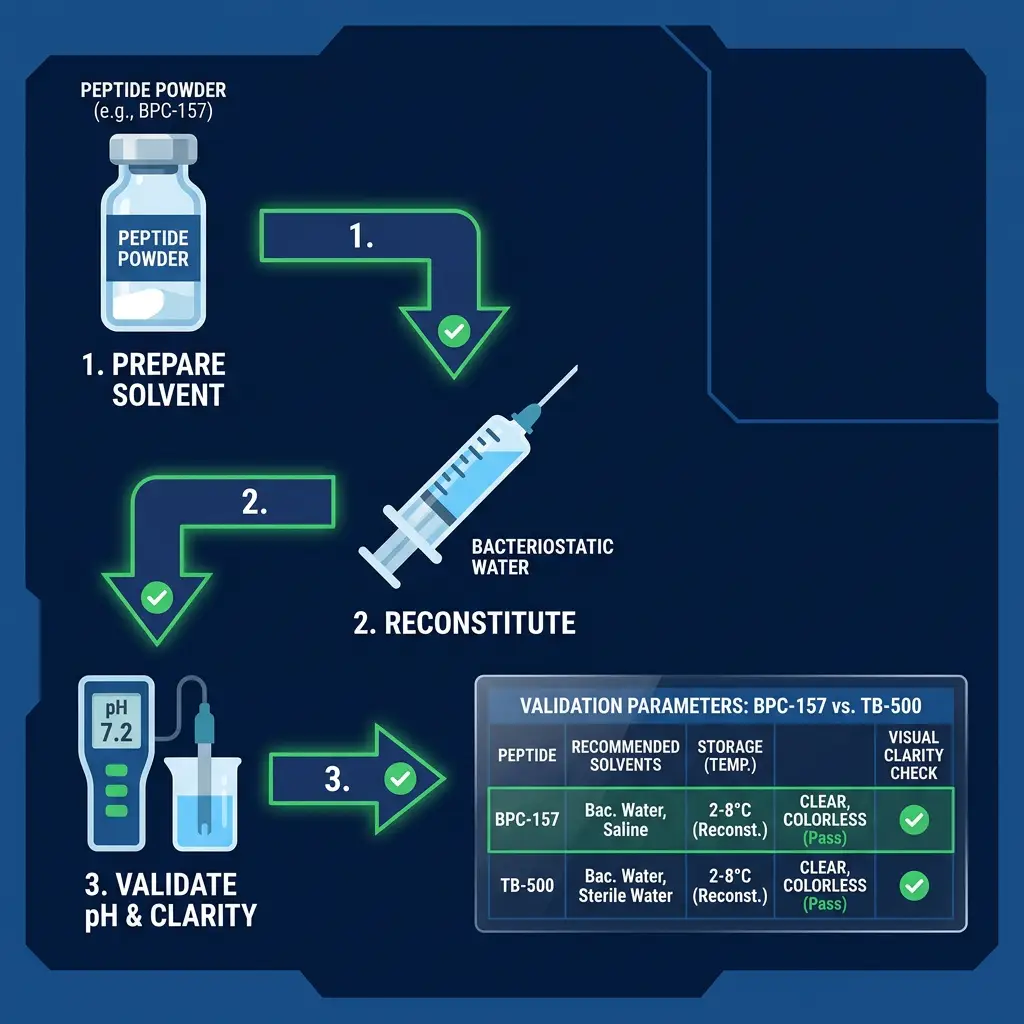
How Do You Validate Reconstitution for bpc 157 and TB-500?
Validated reconstitution starts with a written protocol that names the solvent, the target concentration, the mixing method, and the storage conditions after reconstitution. For bpc 157 and TB-500, the same validation logic applies, but the working concentrations and pilot ranges are determined independently for each SKU.
A validation run should include a clarity check, a pH or solubility note if required by the supplier paperwork, and a small pilot plate before the full assay. The person who performs the first reconstitution should sign and date the lot log, and a second person should review the entry.
| Validation step | bpc 157 | TB-500 |
|—|—|—|
| Solvent recorded | Yes | Yes |
| Target concentration recorded | Yes | Yes |
| Mixing method documented | Yes | Yes |
| Clarity check performed | Yes | Yes |
| Pilot plate completed | Yes | Yes |
If the reconstitution protocol changes between lots, record the change and run a new pilot. Do not carry forward a previous lot’s pilot result as validation for a new lot.
💡 Key Takeaway: How Do You Validate Reconstitution for bpc 157 and TB-500?
Which Side-by-Side Study Tips Prevent Cross-Contamination?
The original side-by-side tips are concise: do not assume interchangeable concentrations across SKUs, keep separate aliquot boxes and tools, and document each lot independently in the binder. Each tip deserves a short expansion.
1. Do not assume interchangeable concentrations across SKUs. Even if two peptides share a supplier, a catalog format, or a storage temperature, the working concentration must be determined per SKU. Use a pilot dilution series for each new lot.
2. Keep separate aliquot boxes and tools. Dedicate pipettes, tips, tubes, and freezer boxes to bpc 157 and TB-500. If shared equipment is unavoidable, clean surfaces between uses and record the cleaning step.
3. Document each lot independently in the binder. A shared binder with mixed entries invites errors. Use one sheet per lot per peptide, with fields for receipt, reconstitution, pilot result, and final plate result.
A Quick Pre-Run Checklist
- [ ] Separate aliquot boxes labeled for bpc 157 and TB-500
- [ ] Separate pipette sets or documented cleaning step
- [ ] Independent lot log for each SKU
- [ ] Pilot dilution series completed for each new lot
- [ ] Protocol states which question each SKU is answering
How Should You Structure a Comparison Protocol for bpc 157 and TB-500?
A comparison protocol should have two parallel arms, not a mixed plate. For the bpc 157 arm, define the tissue-model system, the signaling readout, the timepoints, and the positive control. For the TB-500 arm, define the migration or cytoskeletal readout and its own positive control.
The protocol header should include a sentence such as: ‘This experiment compares bpc 157 in a stressed fibroblast tissue model with TB-500 in a scratch migration model; the two arms are not intended to be concentration-matched.’ This sentence prevents downstream misinterpretation.
Each arm needs its own sample size and its own acceptance criteria. Do not pool replicates across peptides, even if the same cell line is used. The statistical plan should be written before data collection, not after.
Example Protocol Skeleton
| Section | bpc 157 arm | TB-500 arm |
|—|—|—|
| Model | Stressed fibroblast monolayer | Scratch migration assay |
| Readout | Signaling marker or matrix output | Migration distance or filament organization |
| Positive control | Defined in pilot work | Defined in pilot work |
| Timepoints | 6, 24, 48 hours | 0, 12, 24 hours |
| Pilot requirement | Yes, per lot | Yes, per lot |
This skeleton keeps the two questions separate while allowing the same laboratory notebook to hold both arms.
What Documentation Must an Assay Planner Keep?
For bpc 157, the binder should include the supplier’s certificate of analysis, the lot number, the date of receipt, the storage conditions, and the reconstitution record. If the supplier offers lot paperwork, file it with the raw data, not in a separate folder.
The original catalog support note says to specify either SKU through Countrywide Peptides when you need clear research labeling and lot paperwork. Clear labeling means the vial, the aliquot box, and the binder entry all show the same lot number and the same research-use-only designation.
A documentation checklist for bpc 157:
- [ ] Certificate of analysis or lot paperwork on file
- [ ] Lot number recorded in the binder
- [ ] Reconstitution date, solvent, and volume recorded
- [ ] Pilot plate result recorded before full run
- [ ] Storage location and temperature recorded
This level of documentation supports later troubleshooting. If a result cannot be reproduced, the first place to look is the lot log, not the assay protocol.
💡 Key Takeaway: What Documentation Must an Assay Planner Keep?
How Do Catalog-Level Differences Affect Sourcing?
Catalog-level differences matter because bpc 157 and TB-500 are not interchangeable SKUs. When ordering, specify each SKU separately and request research labeling and lot paperwork. The original note states that you should specify either SKU through Countrywide Peptides when you need clear research labeling and lot paperwork.
For sourcing guidance, review Peptide Suppliers USA: How to Choose a Trusted Source. That guide covers the questions to ask about certificates of analysis, lot traceability, and research-use-only documentation. A trusted source should provide the same paperwork for bpc 157 that it provides for TB-500.
Do not accept a shared COA that covers multiple peptides. Each SKU needs its own lot-specific document. If the supplier cannot provide separate paperwork, treat that as a red flag for assay reproducibility.
What Are Common Planning Errors When Comparing bpc 157 and TB-500?
The most common error is concentration carryover. A researcher runs a pilot for bpc 157, finds a working range, and then assumes TB-500 will work at the same range. The original side-by-side tip explicitly warns against this. Each SKU needs its own pilot.
A second error is shared tools. Even a single shared pipette can transfer trace material between aliquots. Keep separate tools or document a validated cleaning step. The binder should record which pipette set was used for each peptide.
A third error is mixed documentation. When both peptides appear on the same page, lot numbers can be transposed. Use independent sheets for bpc 157 and TB-500, and file them in separate sections of the binder.
A fourth error is running a comparison without a stated question. If the protocol does not say which question each SKU is answering, the data cannot be interpreted. Write the question before the first reconstitution.
How Can You Use Lot Paperwork to Strengthen Assay Reproducibility?
Lot paperwork is not a formality; it is the first reproducibility checkpoint. When a new lot of bpc 157 arrives, compare the lot number and storage conditions against the previous lot. If the supplier changed the formulation or the storage recommendation, note that before running pilot plates.
The original note lists lot logging as a shared handling expectation. For bpc 157, lot logging should include the date the vial was opened, the number of aliquots prepared, and the freeze-thaw count. This information helps identify whether variability comes from the material or the handling.
For broader evidence boundaries, see Peptide Research Education: Evidence Boundaries & Documentation (2026). That resource explains how to keep research documentation within laboratory evidence limits and avoid clinical language.
A Lot Paperwork Review Table
| Check | bpc 157 lot A | bpc 157 lot B |
|—|—|—|
| COA received | Yes/No | Yes/No |
| Lot number matches vial | Yes/No | Yes/No |
| Storage temperature recorded | Yes/No | Yes/No |
| Reconstitution validated | Yes/No | Yes/No |
| Pilot plate completed | Yes/No | Yes/No |
💡 Key Takeaway: How Can You Use Lot Paperwork to Strengthen Assay Reproducibility?
Which Pilot Plate Strategy Works for These Peptides?
Pilot plates should be small, preplanned, and lot-specific. For bpc 157, a pilot plate might include three concentrations, a vehicle control, and a positive control in the tissue-model system. The goal is to confirm the material produces the expected signal in your hands, not to generate publishable data.
For TB-500, the pilot plate might include the same three concentrations but a migration readout. Do not run the two pilot plates on the same physical plate unless the plate map clearly separates the two zones and the tools are dedicated.
A pilot plate result should be recorded in the binder before the full experiment is committed. If the pilot shows no signal, troubleshoot the handling and the model before scaling up. The original note lists pilot plates before scale-up as a shared expectation, and this applies equally to bpc 157 and TB-500.
Why Is Research-Use-Only Custody Critical for bpc 157?
Research-use-only custody means the material is handled as a laboratory reagent, not as a therapeutic or dietary ingredient. The original note states that both materials require research-only custody. For bpc 157, this means no human use, no in vivo extrapolation without proper institutional approval, and no clinical language in the laboratory notebook.
Custody also includes physical security. Keep bpc 157 in a locked or access-controlled freezer, with a sign-out log if multiple researchers share the space. The log should record who removed the vial, when, and for which protocol.
This custody standard protects the integrity of the assay data. If a vial is left out, refrozen, or used without documentation, the resulting data cannot be trusted. Research-use-only framing also keeps the laboratory in compliance with supplier terms and institutional policies.
How Do You Write a Clear bpc 157 Assay Question in the Protocol?
A clear assay question has four parts: the test article, the model system, the readout, and the expected direction. For bpc 157, the question might be: ‘In a stressed fibroblast monolayer, does bpc 157 change the expression of [marker] compared with vehicle at 24 hours?’ The expected direction should be stated as a hypothesis, not a conclusion.
If the protocol cannot fill in all four parts, the assay is not ready. The original note says your protocol should state which question each SKU is answering. This is the single most important planning sentence in the document.
Write the question in the protocol header and repeat it on the plate map. This prevents a researcher from running the plate and later deciding what the data mean. The question is fixed before the experiment begins.
💡 Key Takeaway: How Do You Write a Clear bpc 157 Assay Question in the Protocol?
What Internal and External References Support bpc 157 Assay Planning?
For external evidence, use peer-reviewed search tools rather than marketing pages. PubMed is the standard starting point for laboratory research literacy. You can search for bpc 157-related publications at PubMed and for TB-500-related cytoskeletal work at PubMed. The National Center for Biotechnology Information (NCBI) also hosts sequence and literature resources.
For internal planning comparisons, see GHK-Cu vs BPC-157 for In Vitro Programs: Planning Differences. That article covers how to separate another peptide comparison using the same research-only framework. For supplier vetting, revisit Peptide Suppliers USA: How to Choose a Trusted Source.
Keep external references in a separate section of the binder, with the date accessed and the search string used. This supports reproducibility of your literature review, just as lot logs support reproducibility of the bench work.
FAQ
Is bpc 157 interchangeable with TB-500 in a research assay?
No. The original comparative note is explicit: bpc 157 workstreams frequently emphasize cellular signaling and tissue-model assay development, while TB-500 workstreams more often emphasize cytoskeletal and migration-oriented models. They answer different research questions and should not be substituted without a new pilot.
What handling steps are shared by bpc 157 and TB-500?
Both require research-only custody, lot logging, validated reconstitution, and pilot plates before scale-up. These steps apply to every new lot and every new researcher on the project.
Should I use the same concentration for bpc 157 and TB-500?
No. The original side-by-side tips warn against assuming interchangeable concentrations across SKUs. Each peptide needs its own pilot dilution series, even if the supplier uses similar catalog formats.
What documentation should I keep for bpc 157?
Keep the certificate of analysis, lot number, receipt date, storage conditions, reconstitution record, and pilot plate result. File each lot independently in the binder, separate from TB-500 records.
Can bpc 157 or TB-500 be used for human research?
No. This content is for laboratory research literacy only. Both materials are research-use-only and are not for human use, not medical advice, and not intended for diagnostic or therapeutic applications.
Where can I get clear research labeling and lot paperwork for bpc 157?
Specify the SKU through Countrywide Peptides when you need clear research labeling and lot paperwork. Contact the documentation team for questions about certificates of analysis and lot traceability.
Ready to Take the Next Step?
Every product includes lot-specific documentation and third-party purity testing.
Explore Our Research Products →Free shipping on qualifying orders · Batch COA on request