
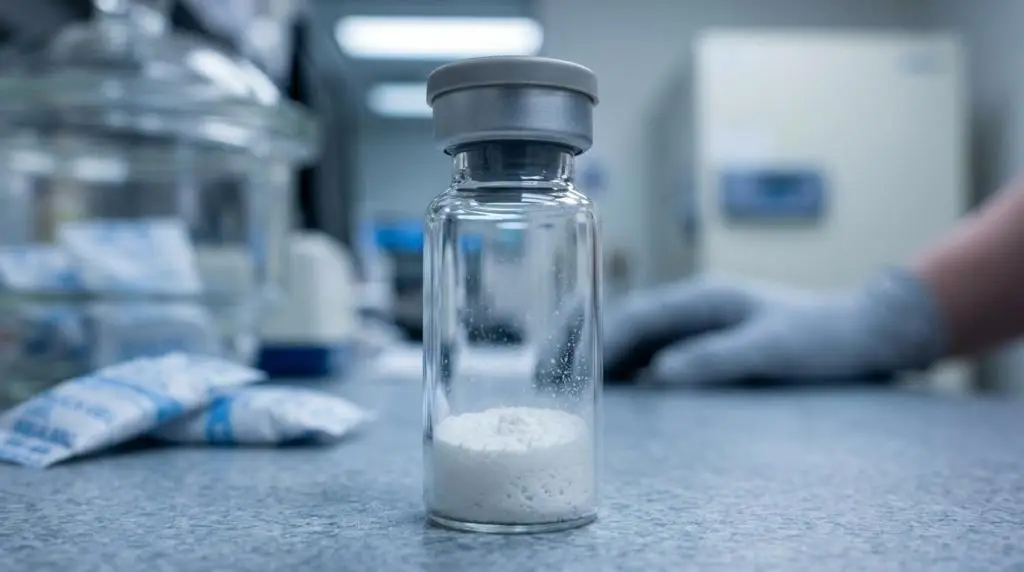
How Lyophilized Peptides Affect Storage and Stability
Lyophilized peptides storage and stability: 7 proven rules for moisture control, cold storage, and freeze-thaw handling in research labs. FDA and PMC data inside.
📋 Table of Contents
Lyophilized peptides improve storage and stability by removing water through sublimation and desorption, which slows hydrolysis and other degradation pathways. However, stability still depends on residual moisture, temperature control, freeze-thaw handling, and light protection. This guide explains how lyophilized peptides behave under different storage conditions and which handling steps preserve their research-use-only integrity.
Key takeaways
- Lyophilized peptides retain stability longer than reconstituted solutions because the dry state minimizes water-driven degradation.
- Residual moisture, temperature fluctuations, and repeated freeze-thaw cycles are the main threats to stability in lyophilized peptides.
- Allow sealed vials to reach room temperature in a desiccator before opening to prevent condensation and moisture uptake.
- Cold, stable, dry storage with light protection is the preferred baseline for lyophilized peptides.
- FDA guidance treats lyophilization as a quality process; poor drying or storage can still compromise research material.
What Are Lyophilized Peptides and How Does the Lyophilization Process Work?
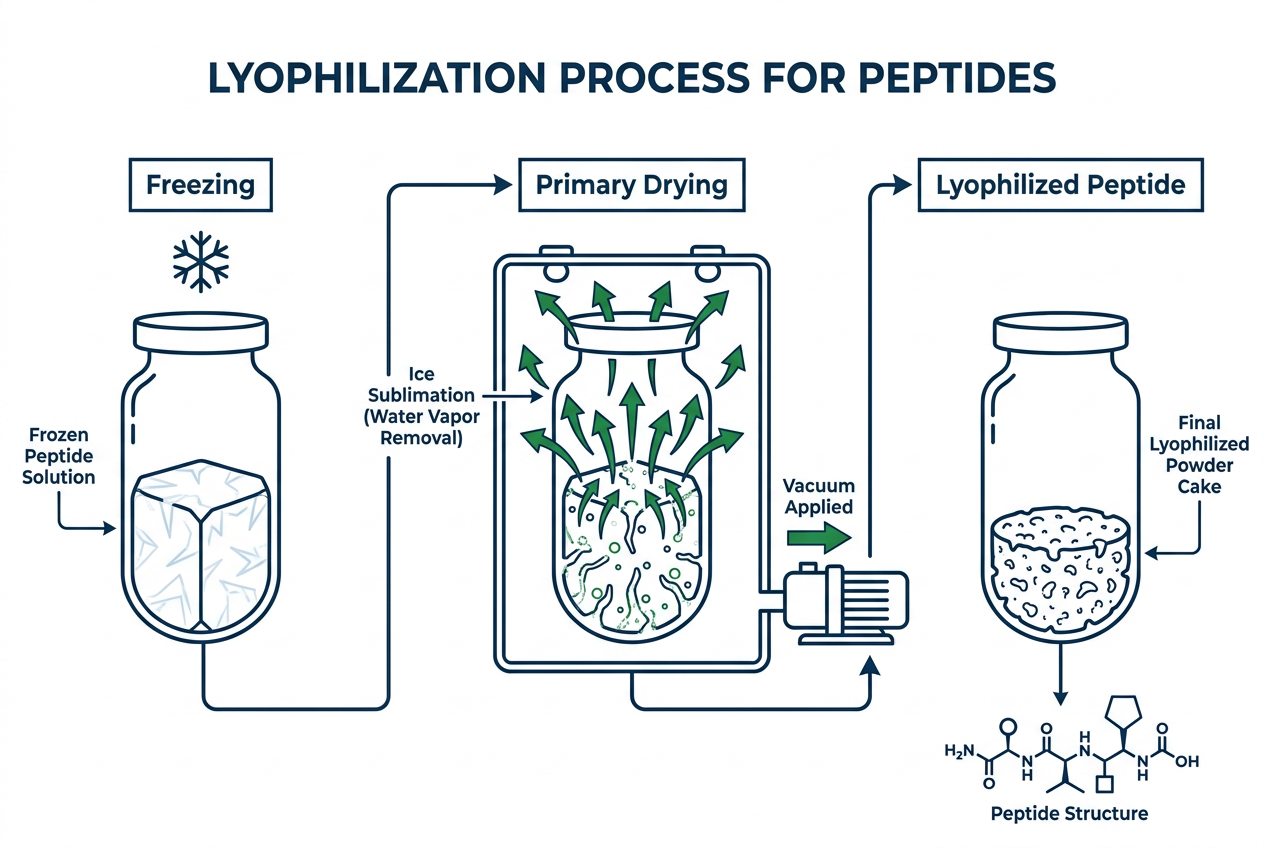
Lyophilized peptides are research-use-only materials that have undergone freeze-drying to remove water and solvent through sublimation and desorption. The U.S. Food and Drug Administration describes lyophilization as a drying process intended to limit biological and chemical reactions at the selected storage temperature. For lyophilized peptides, this dry state reduces the conditions that support hydrolysis, which is why they are generally preferred for longer holding times and more predictable handling.
The lyophilized form shifts the storage picture in a favorable direction by removing water from the formulation. That dry state reduces the conditions that support hydrolysis and other degradation pathways. When a project requires longer holding times and more predictable handling, lyophilized peptides are usually the better choice over solution storage.
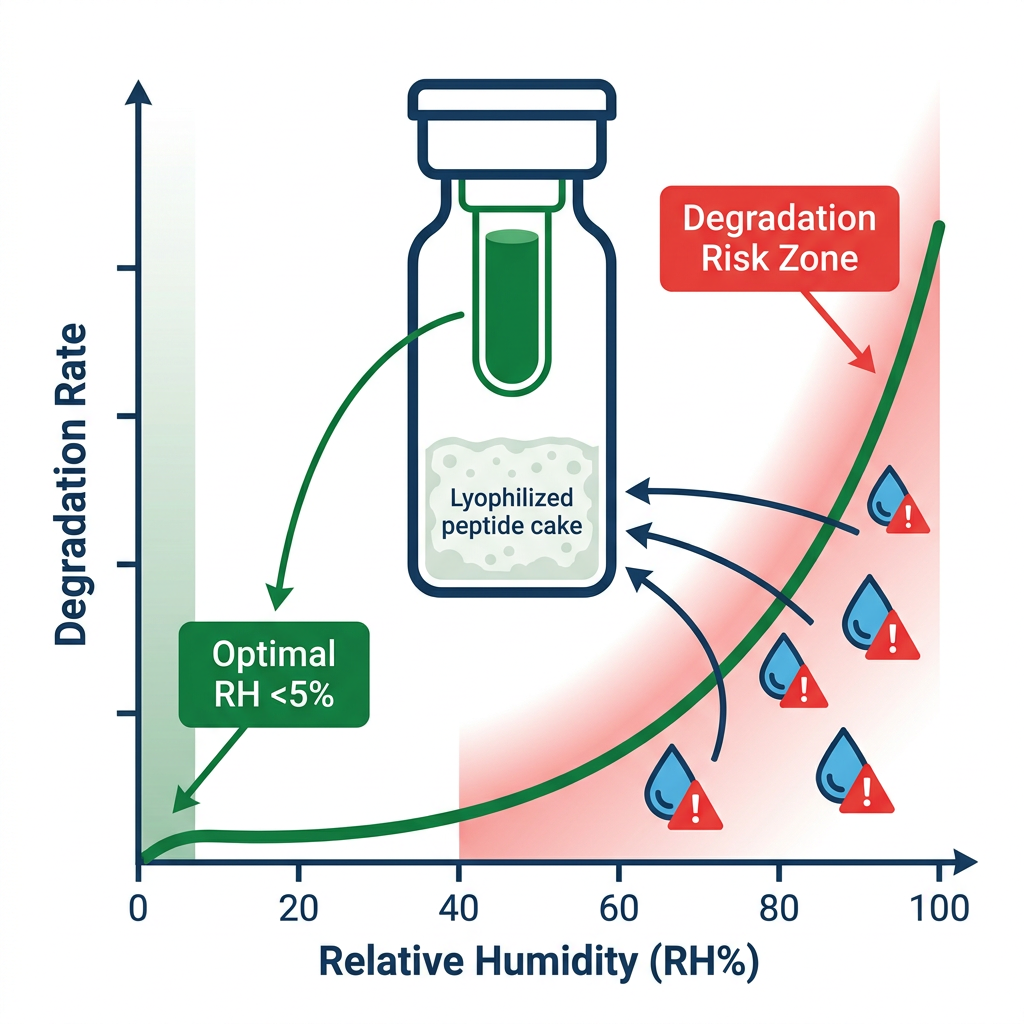
Residual moisture is the detail that often decides whether a dry peptide behaves like a stable material or a fragile one. A lyophilized cake may look intact and still carry enough residual water to shorten shelf life, especially if it is later exposed to humid air, light, or temperature changes. That dry state is the reason storage planning should start at the unopened vial, not at reconstitution.
What Does Lyophilization Change in Peptide Storage?
The FDA’s inspection guidance makes clear that drying quality matters, because poor process control can lead to potency, sterility, and stability problems. That means storage performance begins long before a vial reaches a freezer. FDA guidance on lyophilization frames lyophilization as both a manufacturing process and a stability strategy. For lyophilized peptides, water removal by sublimation and desorption is intended to suppress the reactions that continue in wetter systems.
A well-dried peptide stored badly can degrade. A poorly dried peptide stored carefully may still present avoidable risk. Stability is rarely the result of one good decision. It is usually the result of several compatible decisions, starting with low residual moisture and continuing through cold storage, sealed containment, and limited handling. This is especially true for lyophilized peptides used across long research timelines.
The dry state is the reason storage planning should start at the unopened vial. For lyophilized peptides, the unopened vial represents the highest-stability point in the product lifecycle. Once the seal is broken and the material is exposed to ambient air, the clock starts on moisture uptake, condensation, and handling variability.
💡 Key Takeaway: What Does Lyophilization Change in Peptide Storage?
Why Does Moisture Control Matter for Lyophilized Peptide Stability?
Published data support the value of moisture protection very clearly. In a 2017 study indexed on PubMed, lyophilized CSP7 formulations remained stable for up to 10 months at 5 °C when protected from moisture. The same work also examined chemical stability under different storage temperatures, agitation, and freeze-thaw handling. The message is straightforward: lyophilization helps, but moisture exposure can still undo much of that benefit for lyophilized peptides.
A separate 2016 study available through PMC adds a practical handling detail that is easy to miss. Before reconstituting peptides, the authors recommend allowing the lyophilized powder to reach room temperature in a desiccator. That step helps prevent water absorption by unused material when the vial is opened. In busy lab settings, that small precaution can be the difference between a clean dry handling event and a vial that immediately begins taking on atmospheric moisture. For lyophilized peptides, this warm-before-opening rule is one of the cheapest stability safeguards available.
Moisture control is not just about long-term storage. It affects day-one consistency, reconstitution behavior, and repeatability across aliquots from the same batch. Researchers who treat lyophilized peptides as moisture-sensitive materials tend to see fewer unexplained shifts in assay results.
After that point, a few habits tend to make the biggest difference for lyophilized peptides:
- Warm before opening: Bring the sealed vial to room temperature in a desiccator to reduce condensation risk.
- Keep the seal intact: Limit the time the vial spends open to ambient air.
- Control humidity: Dry storage conditions help preserve the benefit created by lyophilization.
- Watch residual water: Small amounts of retained moisture can still affect stability over time.
How Should You Compare Lyophilized Peptide Storage Versus Solution Storage?
The most useful comparison is not dry powder versus liquid in abstract terms, but how each form behaves during a real project. Lyophilized peptides are usually better suited to extended storage because the major driver of many degradation pathways, water, has been greatly reduced. Once reconstituted, the peptide enters a much less forgiving environment. Even when stored cold, solution handling usually comes with a shorter working window and tighter controls around thawing, light, and timing.
That does not mean solution storage is poor practice. It means solution storage is best treated as a near-term working format, while the lyophilized vial remains the preferred reserve format. For labs that manage multiple peptide projects, keeping lyophilized peptides as the reserve stock and using small reconstituted aliquots for active work reduces risk across the board.
| Storage factor | Lyophilized peptide | Reconstituted peptide solution | Why it matters |
|—|—|—|—|
| Water exposure | Minimal when sealed and dry | Constant | Many degradation pathways proceed more readily in liquid |
| Long-term stability | Generally stronger under cold, low-moisture conditions | Typically shorter | Dry form reduces chemical activity during storage |
| Freeze-thaw sensitivity | Lower before reconstitution | Higher after repeated cycling | Thaw events can introduce variability and instability |
| Handling risk | Humidity and condensation during opening | Timing, thaw count, and contamination risk | Each format has different control points |
| Light sensitivity | Still relevant | Still relevant, often more time-sensitive | Protection from light supports consistency |
The published literature behind this pattern is consistent with ordinary lab experience: dry, cold, protected storage supports stability better than keeping lyophilized peptides in solution for extended periods.
How Does Temperature Affect Lyophilized Peptide Stability?
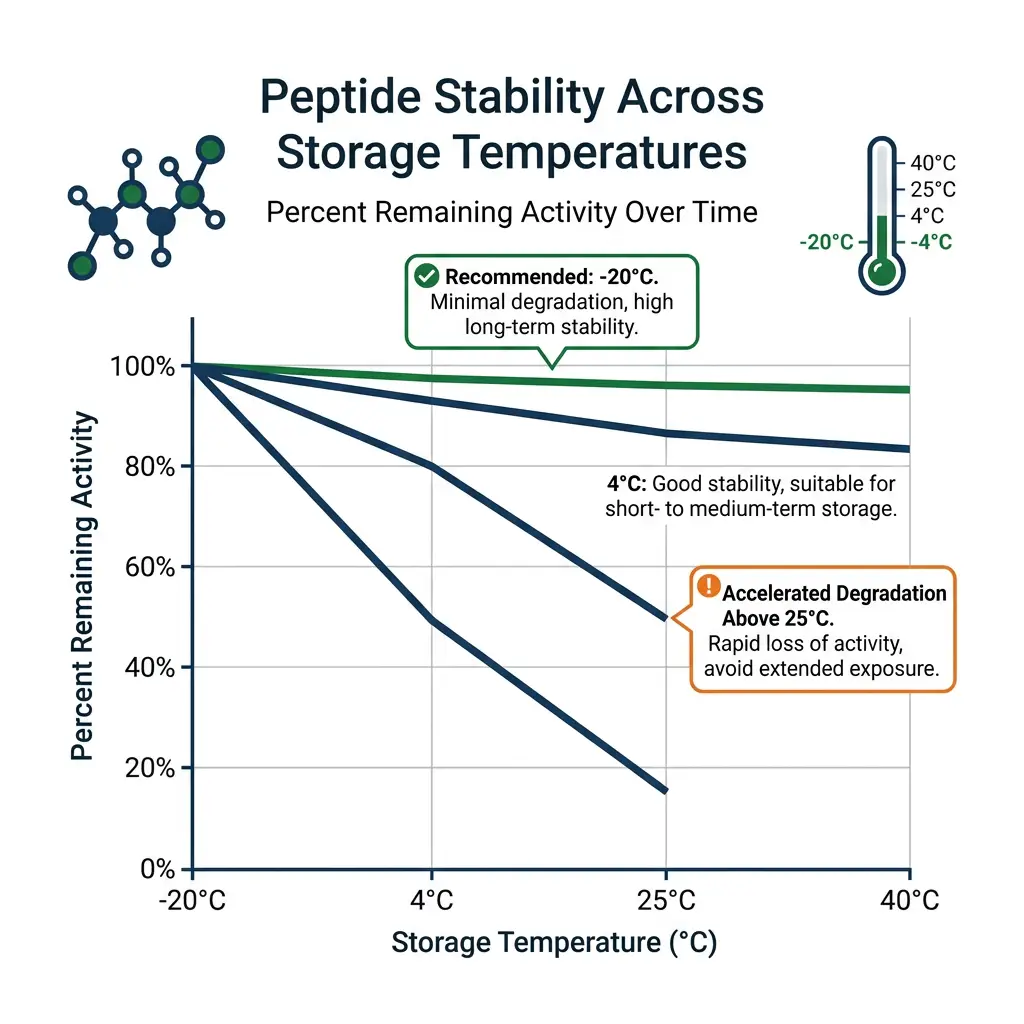
Temperature still matters even after a peptide has been freeze-dried. The same PubMed study on CSP7 compared lyophilized cakes stored at 5 °C and 25 °C over four weeks as part of chemical stability testing, and the longer-term result was especially notable at the cooler condition when moisture was controlled. Lower temperatures reduce reaction rates, which gives the dry state more room to do its job. For lyophilized peptides, cold storage is not an optional add-on; it is a core stability control.
A practical reading of those data is that lyophilization is not a substitute for cold storage. It works best in combination with cold storage. Researchers who treat lyophilized peptides as stable at room temperature simply because they are dry often encounter avoidable variability. The 2017 CSP7 data show that cooler storage conditions, combined with moisture protection, produce the longest stable window for lyophilized peptides.
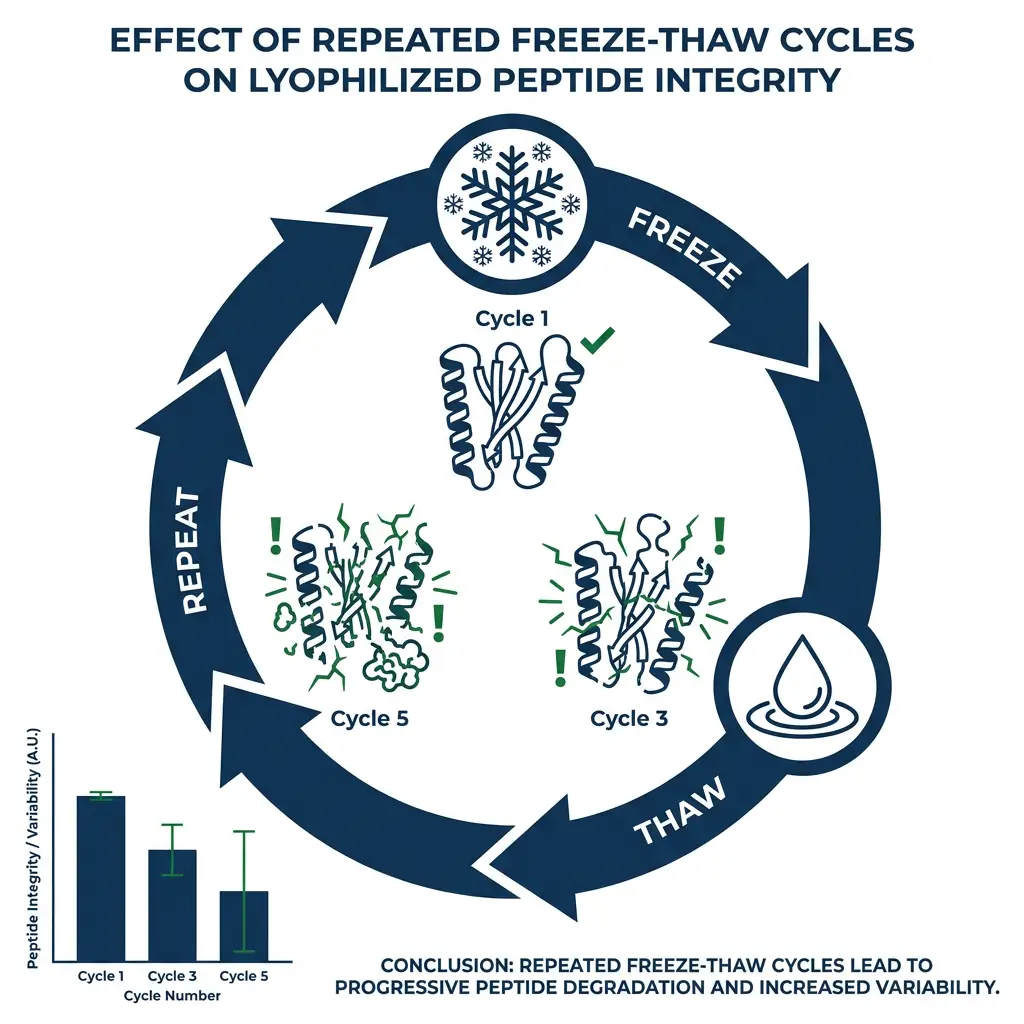
The PMC study points in the same direction from a different angle. For most peptides examined, peak-area variability was lower under freezer storage than under other storage conditions, while variability was highest after ten freeze-thaw cycles. That does not mean every peptide responds identically, but it does support a conservative storage model: cold, consistent, and dry is generally better than cool one day, warm the next, and repeatedly thawed in between. PMC peptide storage study supports this hierarchy for lyophilized peptides.
When labs set storage priorities, the hierarchy is usually simple:
- Low temperature
- Stable temperature
- Dry environment
- Light protection
For lyophilized peptides, this four-part hierarchy translates into freezer or refrigerator storage with desiccant, sealed vials, and amber or opaque containers where possible.
💡 Key Takeaway: How Does Temperature Affect Lyophilized Peptide Stability?
Why Do Freeze-Thaw Cycles Increase Variability in Lyophilized Peptides?
Freeze-thaw handling is one of the easiest ways to lose consistency without realizing it. Each thaw event can expose the peptide to temporary warming, local concentration changes, container surface effects, and extra time in solution. Over multiple cycles, those small stresses add up. The PMC study reported the highest variability after ten freeze-thaw cycles, which gives a clear experimental basis for minimizing repeated cycling of lyophilized peptides.
The CSP7 work also evaluated freeze-thaw stress and agitation as part of chemical stability testing. That detail matters because instability is not caused by temperature alone. Movement, repeated handling, and the time spent outside ideal storage conditions can all contribute to unwanted change in lyophilized peptides.
A few procedural choices can cut that risk sharply for lyophilized peptides:
- Single-use portions: Prepare aliquots sized to the assay plan when the protocol allows.
- Minimize thaw events: Return material to controlled storage only when repeated warming can be avoided.
- Reduce handling stress: Limit unnecessary agitation during storage and preparation.
This is one of the clearest cases where operational discipline improves data quality without changing the peptide itself. For lyophilized peptides, the freeze-thaw lesson is straightforward: fewer cycles, smaller aliquots, and calmer handling.
What Does FDA Guidance Suggest About Lyophilized Peptide Quality?
The FDA’s guidance is useful because it frames lyophilization as both a manufacturing process and a stability strategy. Water removal by sublimation and desorption is intended to suppress the reactions that continue in wetter systems, but the agency also warns that poor control can compromise quality. For lyophilized peptides, this means that the dry state is only as good as the process that created it and the storage that maintains it.
That perspective is valuable in research procurement and storage planning. A well-dried peptide stored badly can degrade. A poorly dried peptide stored carefully may still present avoidable risk. Stability is rarely the result of one good decision. It is usually the result of several compatible decisions, starting with low residual moisture and continuing through cold storage, sealed containment, and limited handling. This is the foundation for any reliable lyophilized peptides program.
What Practical Storage Priorities Should Labs Use for Lyophilized Peptides?
For many labs, the strongest baseline approach is to keep peptides in the lyophilized state until a project actually requires reconstitution. That reduces time in solution and cuts down the number of variables that can affect repeatability. When a vial is needed, allowing it to warm to room temperature in a desiccator before opening is the single most important handling step for these dry peptide materials.
The following checklist consolidates the storage priorities from the FDA guidance and the published studies:
- Store unopened lyophilized peptides at low, stable temperature with desiccant.
- Warm sealed vials to room temperature in a desiccator before first opening.
- Reconstitute only the amount needed for immediate use.
- Aliquot remaining solution into single-use portions when the protocol allows.
- Protect all forms from light, especially reconstituted solution.
- Avoid repeated freeze-thaw cycles; plan thaw events in advance.
- Document storage conditions, lot numbers, and handling events for traceability.
For researchers who buy from multiple suppliers, this checklist should be paired with supplier documentation. The quality of lyophilized peptides depends partly on the manufacturer’s drying process and partly on how the material is handled after receipt. Resources like Peptide Suppliers USA: How to Choose a Trusted Source can help labs evaluate whether a vendor provides the residual moisture data and storage documentation needed to support this checklist.
💡 Key Takeaway: What Practical Storage Priorities Should Labs Use for Lyophilized Peptides?
How Do Documentation Checks Support Lyophilized Peptide Stability?
Documentation is the unsung variable in peptide stability. A lyophilized peptide may arrive with excellent drying quality, but if the receiving lab does not record storage conditions, lot numbers, or reconstitution dates, the stability picture becomes guesswork. For lyophilized peptides, documentation checks should cover certificate of analysis, residual moisture content where available, storage temperature requirements, and any supplier-specific handling notes.
Many stability failures are not chemical; they are procedural. A vial left on a benchtop overnight, a freezer door left open, or a missing aliquot label can turn a stable batch into an outlier. The 2016 PMC recommendation to warm in a desiccator is a documentation-friendly step because it creates a defined pre-opening condition that can be noted in a log. Labs that treat lyophilized peptides as controlled inventory rather than consumables tend to produce more repeatable data.
For further guidance on evidence boundaries and documentation standards, researchers can review Peptide Research Education: Evidence Boundaries & Documentation (2026). This resource outlines how to separate supplier claims from peer-reviewed data and how to maintain research-use-only documentation.
Which Published References Support Lyophilized Peptide Storage Practices?
The two published studies referenced throughout this guide provide the core evidence for lyophilized peptide storage. The 2017 PubMed study on CSP7 demonstrated stability up to 10 months at 5 °C with moisture protection, and it evaluated chemical stability under different storage temperatures, agitation, and freeze-thaw handling. The 2016 PMC study added the desiccator-warming recommendation and reported that peak-area variability was lowest under freezer storage and highest after ten freeze-thaw cycles. Together, these references support a cold, dry, low-handling model for lyophilized peptides.
The FDA’s lyophilization inspection guidance provides the regulatory context. It describes sublimation and desorption as the core water-removal mechanisms and warns that poor process control can compromise potency, sterility, and stability. For lyophilized peptides, this guidance is not a storage protocol by itself, but it explains why residual moisture and drying quality matter before the vial ever reaches a research freezer.
How Can Researchers Apply These Findings to Long-Term Lyophilized Peptide Programs?
Long-term programs benefit from a simple rule: treat the lyophilized vial as the master stock and the reconstituted solution as a working stock with a short clock. This approach minimizes the total time that lyophilized peptides spend in solution and reduces the number of freeze-thaw events per vial. It also makes it easier to compare results across experiments because the starting material remains in a consistent dry state.
The storage factor table earlier in this guide shows that lyophilized peptides have lower freeze-thaw sensitivity before reconstitution and minimal water exposure when sealed. Those advantages disappear quickly once the material is reconstituted. Therefore, the best long-term strategy is to open a lyophilized vial only when needed, warm it correctly, aliquot the reconstituted solution immediately, and return the remaining dry material to cold storage as quickly as possible.
Researchers who handle multiple peptide sequences should also consider supplier consistency. Different manufacturers may use different lyophilization cycles, residual moisture specifications, and vial closure systems. Comparing supplier practices through resources like Nationwide Peptides Reviews | Countrywide Peptides can help labs identify vendors whose documentation and drying quality align with the storage practices described here.
💡 Key Takeaway: How Can Researchers Apply These Findings to Long-Term Lyophilized Peptide Programs?
What Common Mistakes Shorten Lyophilized Peptide Shelf Life?
Several routine mistakes reduce the useful life of lyophilized peptides even when the initial drying quality is high. Opening a cold vial directly in a humid room causes condensation on the cake, which reintroduces water exactly where lyophilization removed it. Repeatedly warming and cooling the same vial creates thermal stress that can accelerate degradation. Leaving vials on benchtops under bright light adds photodegradation risk. Each of these errors is avoidable with a short standard operating procedure.
Another common mistake is treating all lyophilized peptides as identical. Different sequences have different sensitivity profiles, but the general hierarchy of cold, dry, stable, and dark storage remains the safest default. Assuming that a dry powder is automatically stable at room temperature ignores the residual moisture and temperature data from the CSP7 and PMC studies. The better approach is to apply the conservative storage model until sequence-specific data say otherwise.
How Does Light Exposure Affect Lyophilized Peptides?
Light protection is often overlooked because lyophilized peptides look inert in their dry state. However, light can still drive photochemical reactions that alter sensitive residues or excipients in the cake. The original storage factor table notes that light sensitivity remains relevant for both lyophilized and reconstituted forms, though the solution form is often more time-sensitive. For lyophilized peptides, amber vials, opaque secondary containers, or dark storage drawers provide a simple, low-cost safeguard.
When a lyophilized vial is reconstituted, light exposure becomes more critical because the peptide is now mobile in solution and can encounter reactive species generated by light. This does not mean every peptide is equally photosensitive, but it does mean that consistent light protection supports consistency across experiments. A lab that stores lyophilized peptides in clear vials on open shelving may see variability that disappears once dark storage is implemented.
How Should Researchers Document Storage Events for Lyophilized Peptides?
A minimal documentation set for lyophilized peptides should include the date received, lot number, storage temperature, date first opened, reconstitution date, aliquot count, and any freeze-thaw events. This log does not need to be complex; a shared spreadsheet or bound notebook works. The key is that every storage event is recorded at the time it happens, not reconstructed later from memory.
Documentation also helps labs troubleshoot unexpected results. If a batch of lyophilized peptides shows unusual variability, the storage log can reveal whether a freezer door was left open, a vial was left out too long, or a thaw count exceeded the planned number. The PMC and CSP7 studies both emphasize freeze-thaw and agitation as variables, which means those events should be tracked. A well-kept log turns storage from an assumption into a controlled variable.
💡 Key Takeaway: How Should Researchers Document Storage Events for Lyophilized Peptides?
FAQ
What is the single most important storage rule for lyophilized peptides?
Keep lyophilized peptides dry and cold in a sealed vial, and allow the vial to reach room temperature in a desiccator before opening. This prevents condensation and moisture uptake, which are the main threats to stability after lyophilization.
How long can lyophilized peptides remain stable?
Published data show that lyophilized CSP7 formulations remained stable for up to 10 months at 5 °C when protected from moisture. Stability depends on residual moisture, storage temperature, light exposure, and handling, so this figure should be treated as a study-specific result rather than a universal guarantee.
Why should lyophilized powder be warmed in a desiccator before opening?
Warming in a desiccator allows the sealed vial to reach room temperature without exposing the cold cake to humid ambient air. If a cold vial is opened directly, condensation can form on the lyophilized cake and reintroduce water, reducing the stability benefit created by lyophilization.
Are lyophilized peptides stable at room temperature?
No, the CSP7 study showed that cooler storage conditions with moisture protection produced longer stability windows than warmer conditions. Lyophilization reduces water-driven degradation, but it does not eliminate temperature sensitivity. Cold, stable storage remains the recommended baseline.
How many freeze-thaw cycles are acceptable for lyophilized peptides?
The PMC study reported the highest variability after ten freeze-thaw cycles, but even fewer cycles can introduce measurable change. The safest approach is to minimize thaw events by aliquoting reconstituted solution into single-use portions and planning experiments so each aliquot is thawed only once.
Ready to Take the Next Step?
Every product includes lot-specific documentation and third-party purity testing.
Explore Our Research Products →Free shipping on qualifying orders · Batch COA on request