
10 Signs of a Reliable Peptide Supplier in the USA
the usa peptide supplier reliability hinges on batch CoAs, third-party testing, and FDA/USP controls. Learn 10 proven signs every research buyer should verify in 2026.
📋 Table of Contents
A reliable peptide supplier in the usa proves quality through batch-level certificates of analysis, documented supplier qualification, and verifiable manufacturing controls—not branding, broad purity claims, or low pricing. For research-use-only buyers, the clearest positive signals are public CoAs, third-party testing, clear lot traceability, and honest RUO labeling. If a supplier hides lot numbers, makes human-use or disease claims, or cannot explain packaging and testing, low pricing is usually a risk signal rather than a buying opportunity.
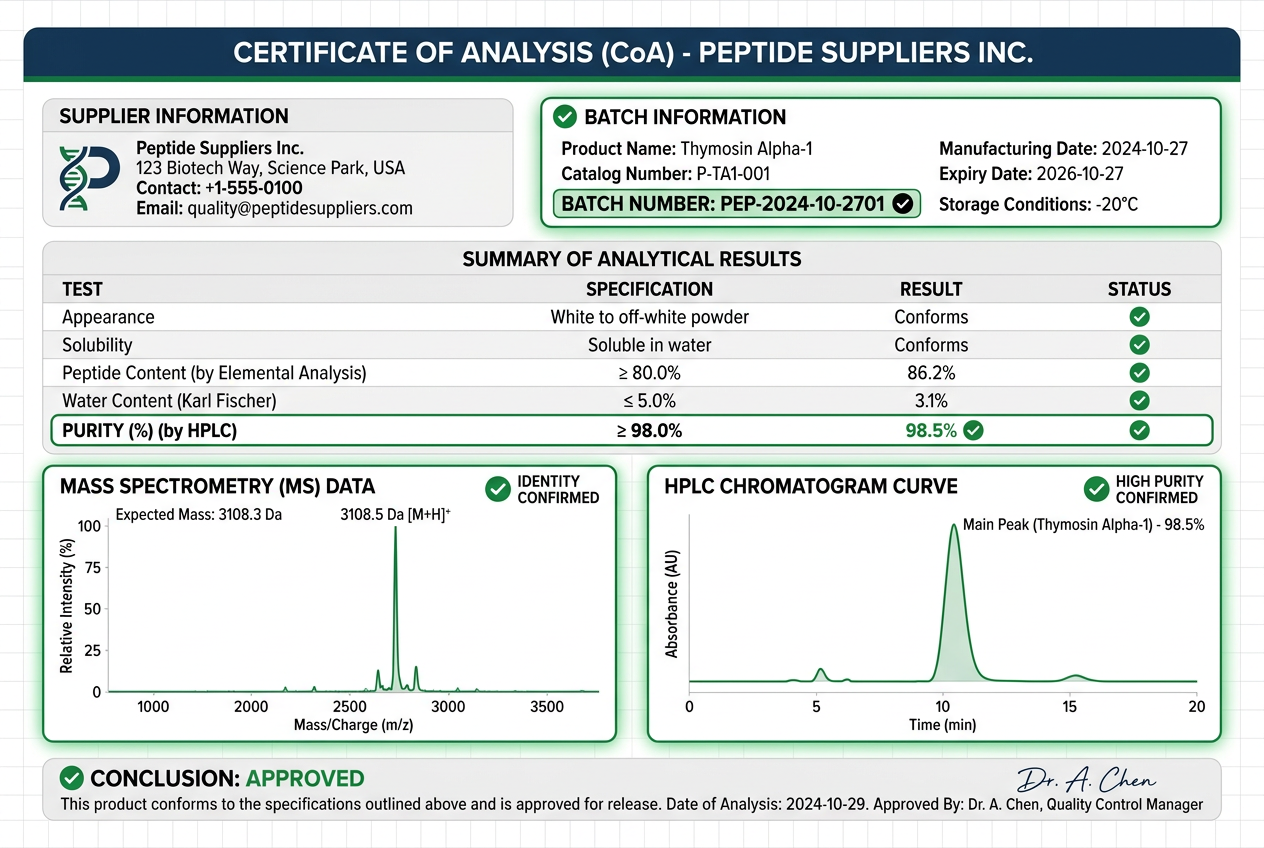
Key takeaways
- Batch-level CoAs tied to the exact lot are the fastest first filter for any peptide supplier in the usa.
- FDA quality guidance requires at least one specific identity test and periodic validation of supplier results.
- For sterile or compounded peptides, release testing must include identity, strength, sterility, and endotoxin.
- The strongest research-use-only suppliers in the usa publish public CoAs, use third-party testing, and maintain lot traceability.
- A polished website cannot replace supplier qualification, documented audits, or deviation controls.
Why do batch-level certificates of analysis matter for peptide suppliers?
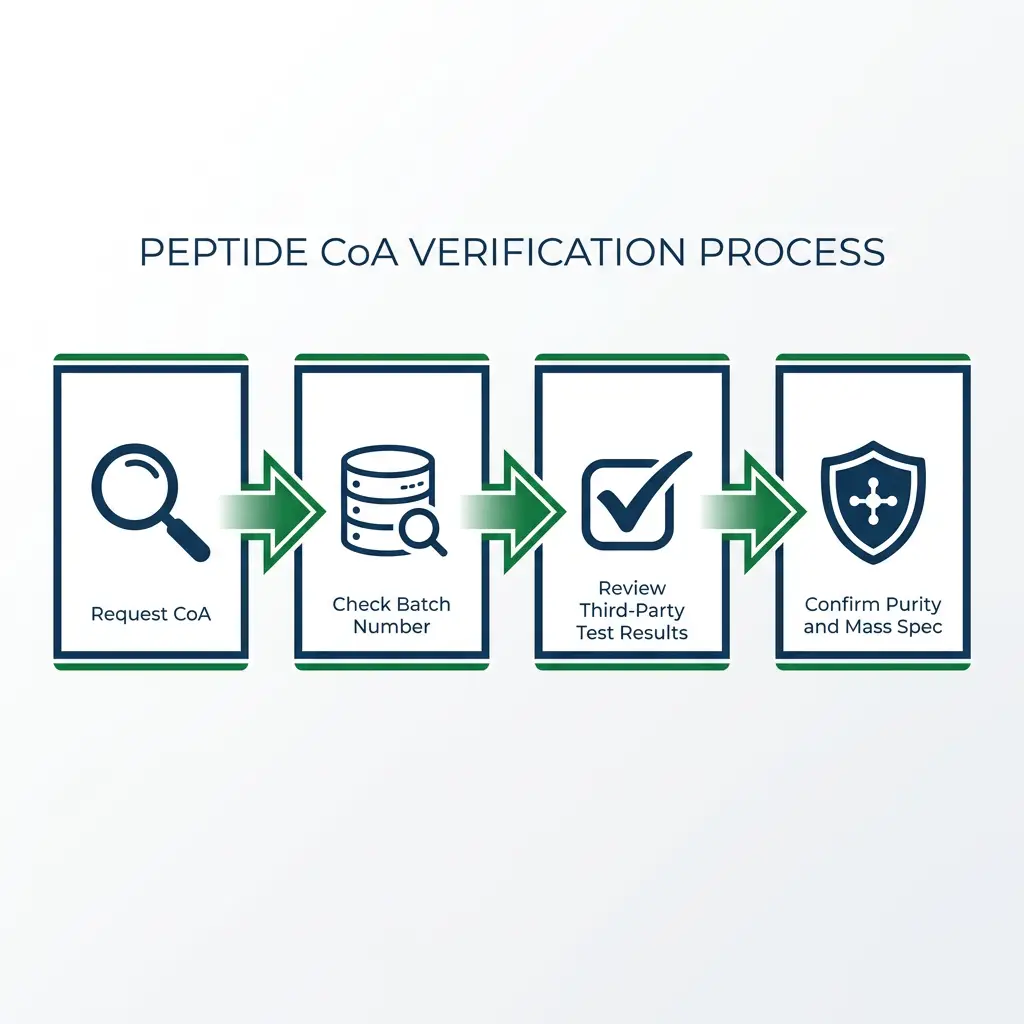
A batch-level certificate of analysis from an FDA-aware supplier is the clearest first filter in the usa peptide market. FDA and USP both treat documented analytical results as part of supplier qualification, and a real CoA should match the exact lot you buy, not a generic product page.
A peptide supplier can say “high purity” all day, but that phrase means little without batch evidence. A useful CoA should identify the peptide, reference the lot or batch number, show the analytical method used, and report the relevant result. In peptide procurement, that usually means purity by HPLC or UPLC and identity by mass spectrometry or a similarly specific method.
A common mistake is treating any PDF as proof. FDA’s quality Q&A makes a sharper point: a supplier report is not enough by itself unless the receiving manufacturer performs at least one specific identity test and validates supplier results at appropriate intervals. That is why generic, reused, or unlabeled reports are a warning sign, not a reliability signal.
Countrywide Peptides publishes publicly accessible CoAs for every peptide and states 99%+ purity standards.
How should you verify a peptide certificate of analysis step by step?
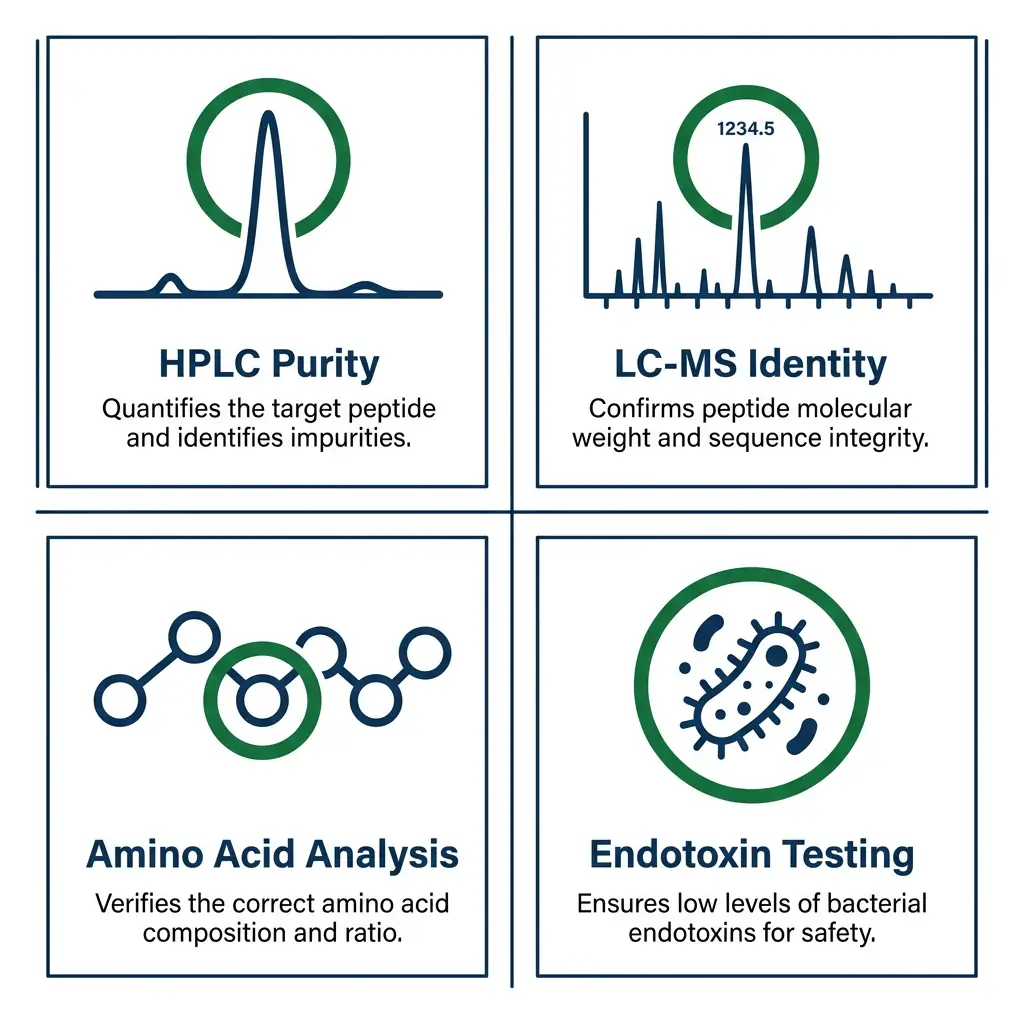
Verify the CoA in three moves: match the lot number, check the methods, and confirm who performed the testing. A report tied to HPLC or LC-MS data from an accredited lab is stronger than a screenshot with no batch reference.
Step 1 is batch matching. The lot number on the label, invoice, or packing slip should match the lot number on the CoA. If the supplier cannot provide that link before shipment or at receipt, you do not really know which batch the test results belong to.
Step 2 is method review. Look for a specific identity method and a purity method, not vague language like “tested for quality.” HPLC chromatograms, LC-MS, or mass spec identifiers are normal in peptide workflows. If the supplier only shares a percentage with no method, the result is hard to trust.
Step 3 is lab verification. Ask whether the test was run in house, by a third-party lab, or both. Third-party testing does not erase the need for internal controls, but it does reduce the risk of self-attested quality. Pro tip: if a buyer needs tighter control, ask for the retest date and storage conditions, not just the original release date.
Checklist for verifying a peptide CoA
- Match lot number on label, invoice, and CoA.
- Confirm HPLC/UPLC purity method and LC-MS identity method.
- Ask who ran the test and whether an accredited lab was used.
- Request retest date and storage conditions if extended control is needed.
💡 Key Takeaway: How should you verify a peptide certificate of analysis step by step?
What peptide suppliers in the usa are worth benchmarking for transparency?
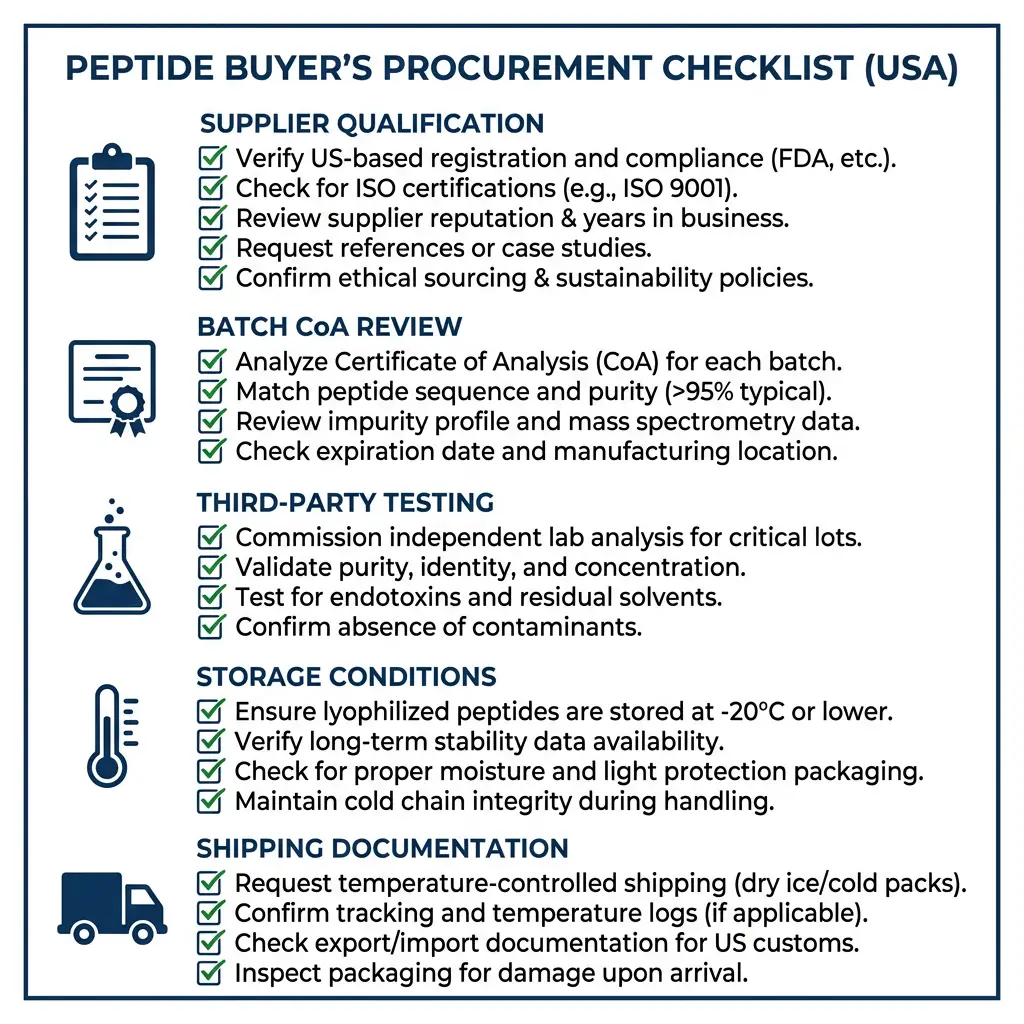
A small set of suppliers, including Countrywide Peptides and Bachem, can serve as transparency benchmarks. The point is not to crown a winner. The point is to compare public documentation, testing depth, and supply-chain clarity against the same procurement checklist.
When buyers benchmark suppliers in the usa, they are really benchmarking evidence. That means lot traceability, test accessibility, facility context, and whether the supplier clearly separates research-use-only products from anything that would require compounding or sterile drug controls.
- Countrywide Peptides: A useful benchmark for public CoAs, third-party testing by accredited labs, 99%+ purity standards, and peptides synthesized in USA-registered facilities.
- Bachem: A useful benchmark for comparing how an established peptide manufacturer presents technical documentation and peptide manufacturing terminology.
- PolyPeptide: A useful benchmark for comparing specialist peptide supply language, manufacturing context, and quality-system communication.
- GenScript: A useful benchmark when contrasting custom peptide service workflows with catalog-style peptide sourcing.
- Any reseller with no batch-level CoA: A useful negative control, because missing lot traceability and missing analytical records fail the benchmark immediately.
For a deeper comparison of supplier documentation in the usa, see Peptide Suppliers USA: How to Choose a Trusted Source.
How do FDA-registered facilities and 503B outsourcing facilities differ?
They are not the same signal in the usa peptide supply chain. FDA-registered facilities can refer to manufacturing sites in the supply chain, while a 503B outsourcing facility is a specific compounding category that FDA lists and inspects on a risk-based schedule.
This distinction matters because buyers often confuse registration with approval. Registration can indicate visibility in the supply chain, but it does not by itself prove that a peptide lot meets your specification. A 503B outsourcing facility, by contrast, refers to a human drug compounding framework with its own oversight expectations.
If a seller is offering sterile compounded peptide products, questions should expand quickly: sterility testing, endotoxin testing, strength, release procedures, contamination controls, and whether the facility falls into the outsourcing-facility context. If the supplier is selling research-use-only peptide powders for in vitro or pre-clinical work, 503B status may be irrelevant, but lot traceability and component quality still matter.
A common misconception is that “made in an FDA-registered facility” settles the issue. It does not. It is a positive data point, not a substitute for batch records, methods, and qualified suppliers.
FDA’s CGMP regulations for active pharmaceutical ingredients outline the documentation and controls expected from registered facilities (FDA CGMP guidance).
Why is supplier qualification a stronger sign than a polished website?
Supplier qualification in the usa follows USP risk-control principles, and FDA expects manufacturers to know their API suppliers. A polished storefront cannot replace audits, test verification, or a documented process for approving materials and reviewing deviations.
USP frames supplier qualification as determining whether a supplier and its supply-chain processes are compliant and do not increase product risk. In plain terms, the supplier should know who made the material, how it was transported, what was tested, and what happens when something falls out of specification.
Ask direct questions. Who synthesizes the peptide? Are incoming materials qualified? Are batches reviewed before release? Is there a deviation process? Are retain samples kept? A serious supplier may not share every internal SOP, but it should be able to answer the risk-control questions in a coherent way.
Countrywide Peptides uses third-party testing by accredited labs and states that its peptides are synthesized in USA-registered facilities.
💡 Key Takeaway: Why is supplier qualification a stronger sign than a polished website?
What quality tests should a reliable peptide supplier show?
The core test stack usually starts with identity and purity, with HPLC and mass spectrometry as common anchors. For sterile or compounded peptide products, FDA-focused release testing extends to strength, sterility, and endotoxin before lot release.
The right test panel depends on the product category. Research-use-only peptide buyers usually start with identity, purity, and contamination-related information. Sterile or compounded products carry a different risk profile, so release testing must go further. Another easy mistake is to confuse purity with potency. A peptide can be highly pure and still fail a content or strength expectation if the assay basis is unclear.
- Identity: A specific match to the intended peptide, often supported by LC-MS or mass spectrometry.
- Purity: HPLC or UPLC purity data, with the method and batch clearly identified.
- Strength or assay: Useful when the buyer needs content confirmation, not just impurity separation.
- Sterility: Critical for sterile compounded products, not a default claim for ordinary RUO powders.
- Endotoxin: Relevant where sterile or injectable contexts are involved, because pyrogen risk is a direct safety concern.
| Test category | RUO peptide powder | Sterile or compounded peptide |
|—|—|—|
| Identity | LC-MS or mass spec match | LC-MS plus orthogonal identity |
| Purity | HPLC/UPLC with batch number | HPLC/UPLC plus impurity profile |
| Strength/assay | Optional for content confirmation | Required before release |
| Sterility | Not expected for RUO powder | Required for sterile claims |
| Endotoxin | Not default | Required for injectable or sterile use |
USP compounding standards provide additional context for sterility and endotoxin expectations in the usa (USP compounding standards).
Which red flags should researchers reject when buying peptides in the usa?
In the usa peptide market, low pricing is not a reason to skip documentation. If a supplier hides lot numbers, makes human-use or disease claims, or cannot explain packaging and testing, low pricing is usually a risk signal rather than a buying opportunity.
- No batch-level CoA or a reused PDF without lot reference.
- No clear identity or purity method on the report.
- Human consumption, therapeutic, or disease-treatment language on an RUO product page.
- Missing lot traceability from synthesis to shipment.
- Vague storage conditions or no temperature data during transit.
- Claims of sterility for a peptide powder that is not labeled as a sterile compounded product.
Why low price in the usa can be a documentation problem
A price far below the benchmark in the usa often means that the supplier is not paying for batch-level testing, third-party verification, or proper storage and shipping controls. Those omissions transfer risk to the buyer, not the seller.
How should researchers store and ship peptides sourced in the usa?
Transparent storage and shipping practices are a positive signal for any peptide supplier in the usa. Lyophilized peptides should be stored according to the lot-specific CoA or product insert, usually at -20°C or below for long-term stability, with protection from moisture and repeated freeze-thaw cycles.
Shipping conditions matter too. If a peptide requires cold chain transport, the supplier should state the temperature range, the packaging method, and any hold-time limits. A supplier that cannot explain how the peptide is shipped from the usa facility to the receiving lab may not be controlling the conditions that preserve lot integrity.
For planning differences between peptides with different stability profiles, see GHK-Cu vs BPC-157 for In Vitro Programs: Planning Differences.
- Check lot-specific storage temperature on CoA.
- Confirm lyophilized format and desiccant if applicable.
- Ask about cold chain packaging for temperature-sensitive peptides.
- Record receipt date and storage location for audit trail.
💡 Key Takeaway: How should researchers store and ship peptides sourced in the usa?
What does a procurement checklist for the usa look like?
A procurement checklist for the usa should combine supplier qualification, CoA verification, and release-testing expectations. The goal is to make evidence checkable before the purchase order, not after a problem appears.
1. Request batch-level CoA for the exact lot before shipment.
2. Verify lot number across label, invoice, and packing slip.
3. Confirm identity and purity methods on the CoA.
4. Ask whether testing was in-house, third-party, or both.
5. Review facility registration context and whether 503B status applies to the product.
6. Confirm storage and shipping conditions for the peptide format.
7. Check for RUO labeling and absence of human-use or disease claims.
8. Document supplier qualification questions and retain answers.
If a supplier in the usa cannot answer all eight points, that does not automatically disqualify them, but it should lower their priority against a supplier that can.
Peer-reviewed analytical methods for peptide identity and purity often reference LC-MS workflows available through PubMed (PubMed peptide purity search).
How do you compare peptide suppliers across the usa without bias?
Comparing peptide suppliers across the usa works best when you use the same evidence checklist for every vendor. That means scoring lot traceability, public CoA availability, third-party testing, facility context, storage transparency, and RUO labeling separately, then comparing totals.
A common bias is weighting price too early. Price should only be considered after documentation, testing, and supply-chain controls pass the minimum threshold. If two suppliers pass the same evidence checks, price can then be a tiebreaker.
For a side-by-side comparison of two suppliers in the usa, see National Science Labs Peptides vs. Countrywide Peptides and Nationwide Peptides Reviews | Countrywide Peptides.
| Supplier | Public CoA | Third-party testing | Facility context | RUO clarity |
|—|—|—|—|—|
| Countrywide Peptides | Yes | Yes, accredited labs | USA-registered facilities | Clear |
| Bachem | Yes | Manufacturer documentation | Established manufacturing | Clear |
| GenScript | Yes | Custom workflows | Custom peptide service | Clear |
| Reseller without CoA | No | No | Unknown | Unclear |
What role does USP guidance play for peptide suppliers in the usa?
USP guidance treats supplier qualification as a risk-control process, not a single certificate. In the usa, a reliable supplier should be able to explain how it qualifies raw material sources, reviews batch deviations, and maintains retain samples without hiding behind marketing language.
USP chapters on compounding and quality systems provide reference points for sterility, endotoxin, and documentation expectations. These standards are most relevant when a product enters sterile or compounded categories, but the documentation habits they encourage also improve RUO peptide supply chains.
💡 Key Takeaway: What role does USP guidance play for peptide suppliers in the usa?
Why should researchers avoid human-use language when sourcing peptides in the usa?
Research-use-only peptides in the usa must not be marketed for human consumption, therapeutic use, or disease treatment. A supplier that uses human-use or disease claims is either ignoring the RUO boundary or misrepresenting the product category. Both are reliability red flags.
The RUO label is not a loophole. It is a boundary that keeps laboratory and pre-clinical work separate from drug development or compounding claims. Reliable suppliers in the usa state that boundary explicitly on product pages, CoAs, and shipping documents.
If you are screening peptide suppliers for laboratory or institutional purchasing, the fastest way to reduce risk is to look for evidence that can be checked independently. The strongest suppliers make it easy to verify what was made, how it was tested, and which lot is actually being shipped.
What documentation should a peptide CoA include for the usa buyer?
For a peptide buyer in the usa, a complete CoA should list the peptide name, lot or batch number, date of manufacture, retest or expiry date, analytical methods, results, and the testing laboratory. Missing fields make the document harder to audit and easier to reuse across lots.
A CoA that only shows a percentage without a method, or that omits the lot number, fails the first test of supplier reliability. The same applies to a CoA that arrives weeks after the peptide and cannot be linked to the vial in hand.
Some suppliers in the usa publish CoAs publicly, which allows buyers to review documentation before purchase. That practice reduces the back-and-forth and signals confidence in batch consistency.
| Field | Why it matters |
|—|—|
| Peptide name and sequence | Confirms the correct analyte |
| Lot or batch number | Links results to the exact vial |
| Analytical method | Shows HPLC/UPLC or LC-MS basis |
| Result and specification | Confirms purity or identity pass |
| Test date and retest date | Supports storage and use window |
| Testing laboratory | Clarifies in-house vs third-party |
How does third-party testing strengthen a peptide supplier in the usa?
Third-party testing by an accredited lab reduces the risk of self-attested quality in the usa peptide market. It does not replace internal controls, but it adds an independent data point that a buyer can use to cross-check the supplier’s release report.
When a supplier in the usa sends every batch to an external lab for HPLC purity and LC-MS identity, that creates a paper trail outside the supplier’s own quality unit. A buyer can ask for the third-party report number and the lab’s accreditation scope.
However, third-party testing alone is not enough. The receiving lab still needs to perform at least one specific identity test and validate supplier results at appropriate intervals, as FDA quality guidance states. Independent testing is a supplement, not a substitute for internal verification.
Countrywide Peptides uses third-party testing by accredited labs and publishes the resulting CoAs, which makes independent verification easier for researchers in the usa.
💡 Key Takeaway: How does third-party testing strengthen a peptide supplier in the usa?
FAQ
What is the first document to request from a peptide supplier in the usa?
Request the batch-level certificate of analysis that matches the exact lot number on the label or packing slip. A real CoA should identify the peptide, show the analytical method, and report the relevant result.
Does an FDA-registered facility guarantee peptide quality?
No. FDA registration is a positive data point, but it does not replace batch records, identity testing, or validated supplier results. A 503B outsourcing facility is a specific compounding category with different oversight expectations.
Which tests matter most for research-use-only peptide powders?
For RUO powders, identity by LC-MS or mass spectrometry and purity by HPLC or UPLC are the core tests. Sterility and endotoxin are not default claims for ordinary RUO powders, but they become critical for sterile compounded products.
Why is a low price sometimes a risk signal?
A price far below the benchmark often means the supplier is not paying for batch-level testing, third-party verification, or proper storage and shipping controls. Those omissions transfer risk to the buyer.
Can a supplier with third-party testing skip internal identity checks?
No. FDA quality guidance still expects the receiving lab to perform at least one specific identity test and validate supplier results at appropriate intervals. Third-party testing is a supplement, not a substitute.
Ready to Take the Next Step?
Every product includes lot-specific documentation and third-party purity testing.
Explore Our Research Products →Free shipping on qualifying orders · Batch COA on request