
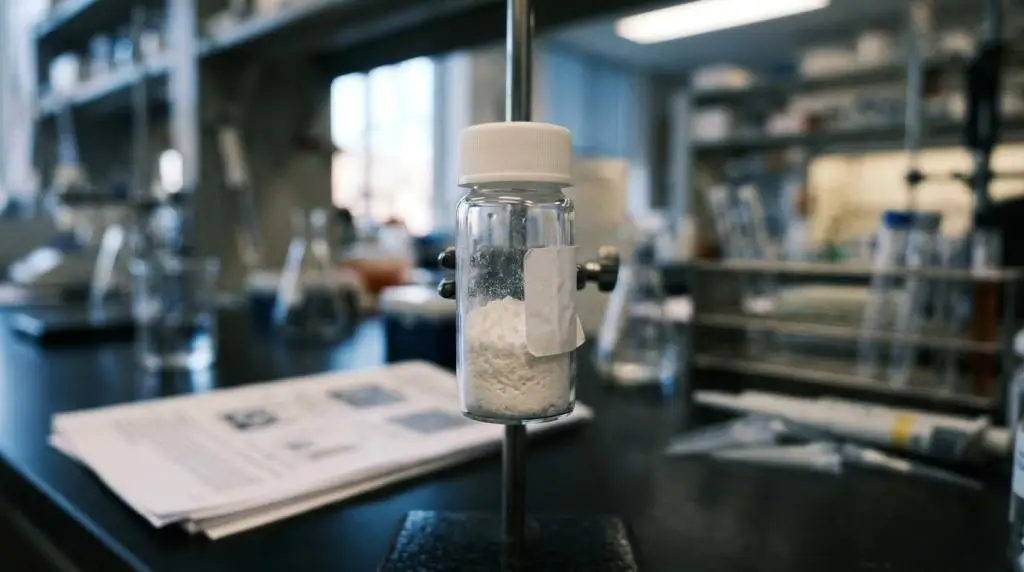
7 Questions Before You Buy PT 141 for Research Labs
141 peptide sourcing demands batch COA, HPLC/MS data, and research-use-only labeling. Learn 7 proven checks labs must apply before purchasing 141 peptide.
📋 Table of Contents
Before purchasing 141 peptide for any laboratory program, researchers must confirm that the material is sold strictly for research use only, with a batch-specific Certificate of Analysis, third-party HPLC and Mass Spectrometry data, and clear labeling that separates it from the FDA-approved drug VYLEESI. A qualified 141 peptide supplier documents identity, purity, chain of custody, and storage format without implying human-use equivalence. This guide answers the seven most important questions labs should ask before they buy 141 peptide.
Key takeaways
- 141 peptide is the research name for bremelanotide; the FDA-approved human drug VYLEESI is a separate finished product first approved in 2019.
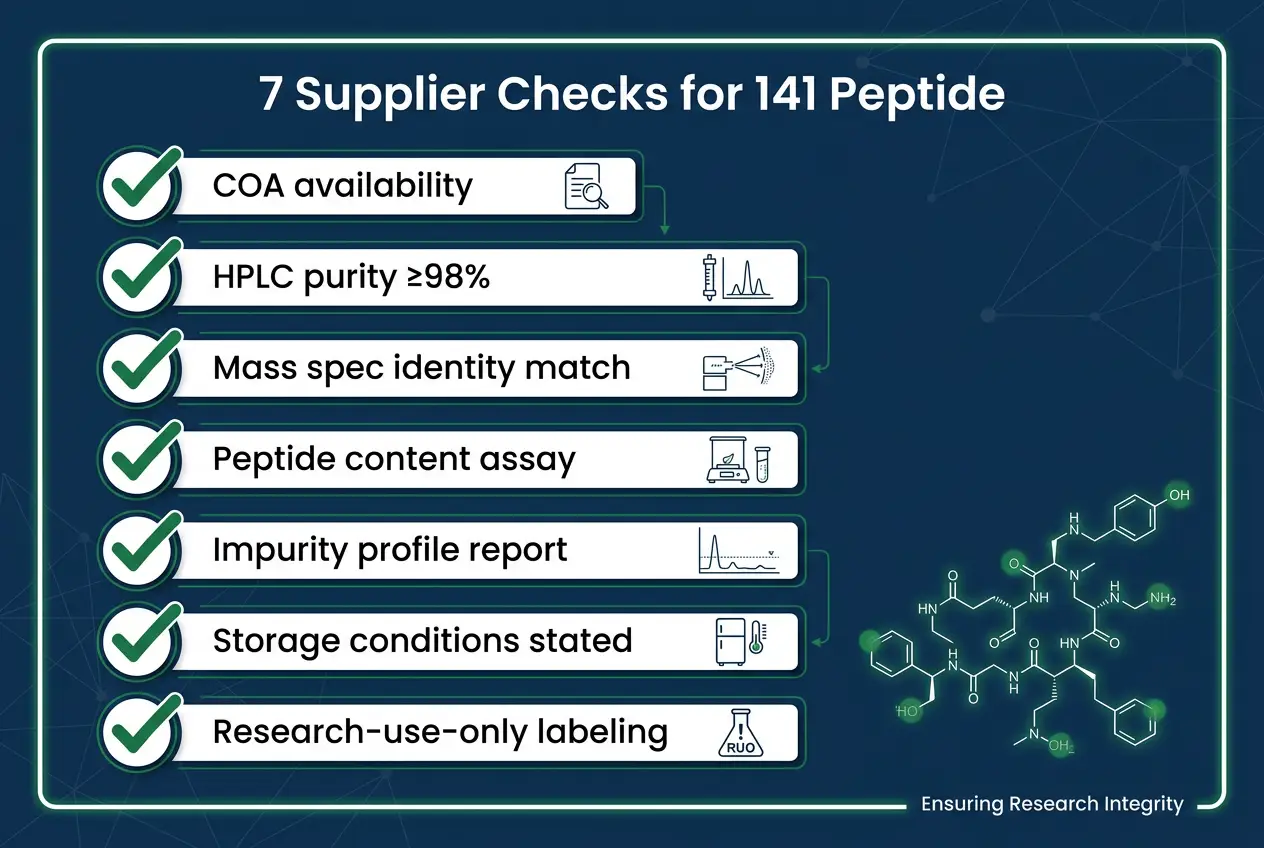
- Always require a lot-linked COA with HPLC and MS identity data, ideally ≥99% purity when claimed, and no fillers or additives.
- Verify research-use-only labeling and avoid any supplier that positions 141 peptide for human administration or therapy.
- Storage guidance: lyophilized form, protect from light and moisture; retain records with lot files for inspection readiness.
- Compare impurity reporting across lots, not just headline purity, before choosing a 141 peptide source.
What does "141 peptide" actually mean in a research lab context?
PT-141 is the common research name, while DailyMed identifies the approved human drug product as VYLEESI bremelanotide injection. Those are related entities, but they are not interchangeable purchase categories. In laboratory procurement, 141 peptide usually refers to a research peptide sold in lyophilized form for investigational work. In government labeling, bremelanotide appears as a finished drug product with approved human labeling, packaging, administration instructions, and safety language.
A common mistake is treating the chemical identity alone as proof that two products carry the same regulatory status. That matters because FDA-approved labeling attaches to VYLEESI, not automatically to a research-supplier vial labeled 141 peptide. If a seller presents the 141 peptide as suitable for therapy, diagnosis, or human administration, that is a red flag for a research lab.
For procurement teams, the practical rule is simple: verify identity and documentation first, then verify intended use language. Research peptides should be purchased only for lawful laboratory use and not for human consumption. Countrywide Peptides states 141 peptide is sold for research use only and not for human use, with a Certificate of Analysis and third-party testing references.
How is research-grade 141 peptide different from VYLEESI bremelanotide injection?
Research-grade 141 peptide and VYLEESI share the bremelanotide molecule, but VYLEESI is the FDA-labeled human drug product. A research vial is not the approved injectable product. DailyMed states that VYLEESI is a bremelanotide injection for subcutaneous use with an initial U. S. approval date of 2019. The label also includes use restrictions, contraindications for uncontrolled hypertension or known cardiovascular disease, and warnings about transient increases in blood pressure and reductions in heart rate.
Those facts are relevant because they show how tightly the approved product is framed by regulators. A research supplier, by contrast, should not imply equivalence to that finished drug product. The appropriate standard is documentation, not therapeutic positioning. If a lab sees approved-drug language used to sell a research vial of 141 peptide, it should ask whether the seller is accurately separating research material from approved clinical products.
You can review the official VYLEESI label on DailyMed to understand the regulatory framing, but that label does not validate a research-supplier vial.
💡 Key Takeaway: How is research-grade 141 peptide different from VYLEESI bremelanotide injection?
What are the 7 most important supplier checks before you buy 141 peptide?
The best 141 peptide supplier checks are documentation checks. A qualified lab should review the record trail before reviewing the price. Countrywide Peptides lists 141 peptide as research-only material and states batch documentation, third-party HPLC/MS testing, and public Certificates of Analysis.
Research-use-only labeling: the listing should clearly state not for human use and not FDA approved for medical, therapeutic, or diagnostic use.
Batch-specific COA: confirm the Certificate of Analysis matches the exact lot, not a generic template.
Identity methods: HPLC and Mass Spectrometry are stronger than a purity percentage shown without test methodology.
Form and composition: lyophilized 141 peptide with no fillers or additives is easier to assess than vague blended formulations.
Chain of custody: U.S. manufacturing details, custody records, or batch traceability reduce uncertainty.
Support quality: research-focused support should answer technical documentation questions without drifting into human-use discussions.
Price still matters, but it should come after these checks. The lowest-cost vial can become the highest-cost procurement error if the COA is missing, the lot is unclear, or the seller uses noncompliant language. For additional supplier comparisons, review Peptide Suppliers USA: How to Choose a Trusted Source.

How should a lab verify a 141 peptide Certificate of Analysis step by step?
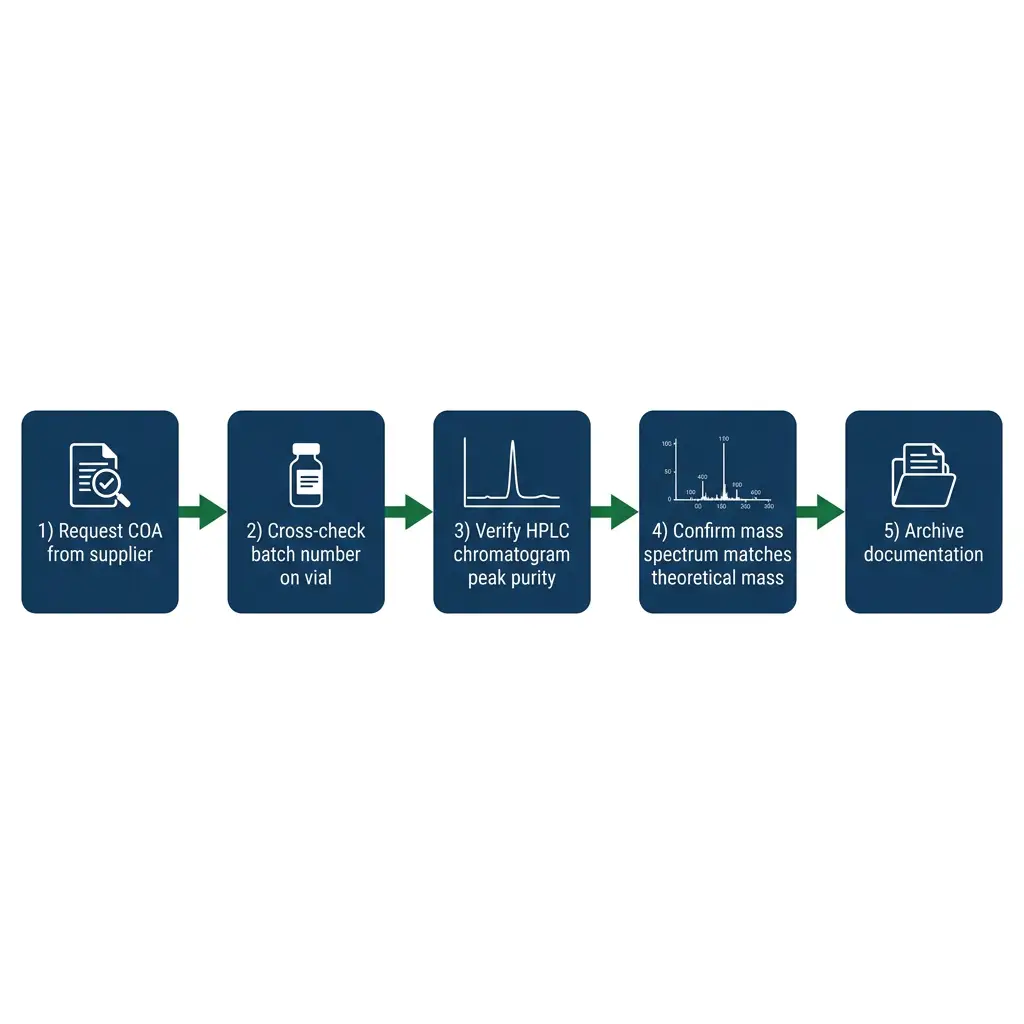
A 141 peptide COA should be checked against the lot, methods, and identity markers before purchase. HPLC and Mass Spectrometry are the first two methods most labs look for. Step 1 is identity matching. Confirm that the product label, vial lot, and COA lot number are the same. If the seller cannot provide a lot-linked document, treat the listing as undocumented.
Step 2 is method review. Look for the analytical method named on the document, not just a purity percentage. HPLC can support chromatographic purity, while Mass Spectrometry helps verify molecular identity. Some suppliers also cite amino acid analysis. A common misconception is that “99% pure” means little unless the method and batch are visible.
Step 3 is document quality review. The COA should show test dates, lot information, and a format consistent with controlled laboratory records. Public COA access is useful because it lets procurement staff pre-screen records before initiating institutional purchase steps. Countrywide Peptides emphasizes publicly accessible Certificates of Analysis and independent HPLC and Mass Spectrometry verification for 141 peptide batches.
One practical tip is to compare more than one batch document from the same supplier when evaluating 141 peptide. Consistent formatting, lot linkage, and method disclosure across multiple COAs indicate a documentation-first operation. If the COA for 141 peptide varies unpredictably or omits method details, consider that a procurement risk.

Which documentation habits reduce risk when you buy 141 peptide?
Before you buy 141 peptide, confirm the listing is research-use-only and not positioned as a human-use substitute. After you buy 141 peptide, retain identity and purity records with the lot file. If collaborators buy 141 peptide for related assays, align on the same acceptance criteria first. Teams that buy 141 peptide regularly should track labeling language and COA fields across shipments.
Clear intake notes explain why you buy 141 peptide from a documentation-focused supplier rather than the lowest anonymous quote. Countrywide Peptides supports investigators who buy 141 peptide strictly for laboratory and preclinical research contexts. Re-check packaging and storage guidance whenever you buy 141 peptide for a new study. Those habits reduce ambiguity each time you buy 141 peptide and keep records inspection-ready.
Qualified buyers who buy 141 peptide should compare impurity reporting, not only headline purity. It is reasonable to buy 141 peptide only when COA fields match your assay needs. If a quote cannot support those fields, do not buy 141 peptide from that source. Prefer suppliers that help you buy 141 peptide with repeatable lot documentation.
That standard is how Countrywide Peptides expects teams to buy 141 peptide for research-use-only programs. Keep the same checklist the next time you buy 141 peptide.

💡 Key Takeaway: Which documentation habits reduce risk when you buy 141 peptide?
What purity and identity data should a 141 peptide COA include?
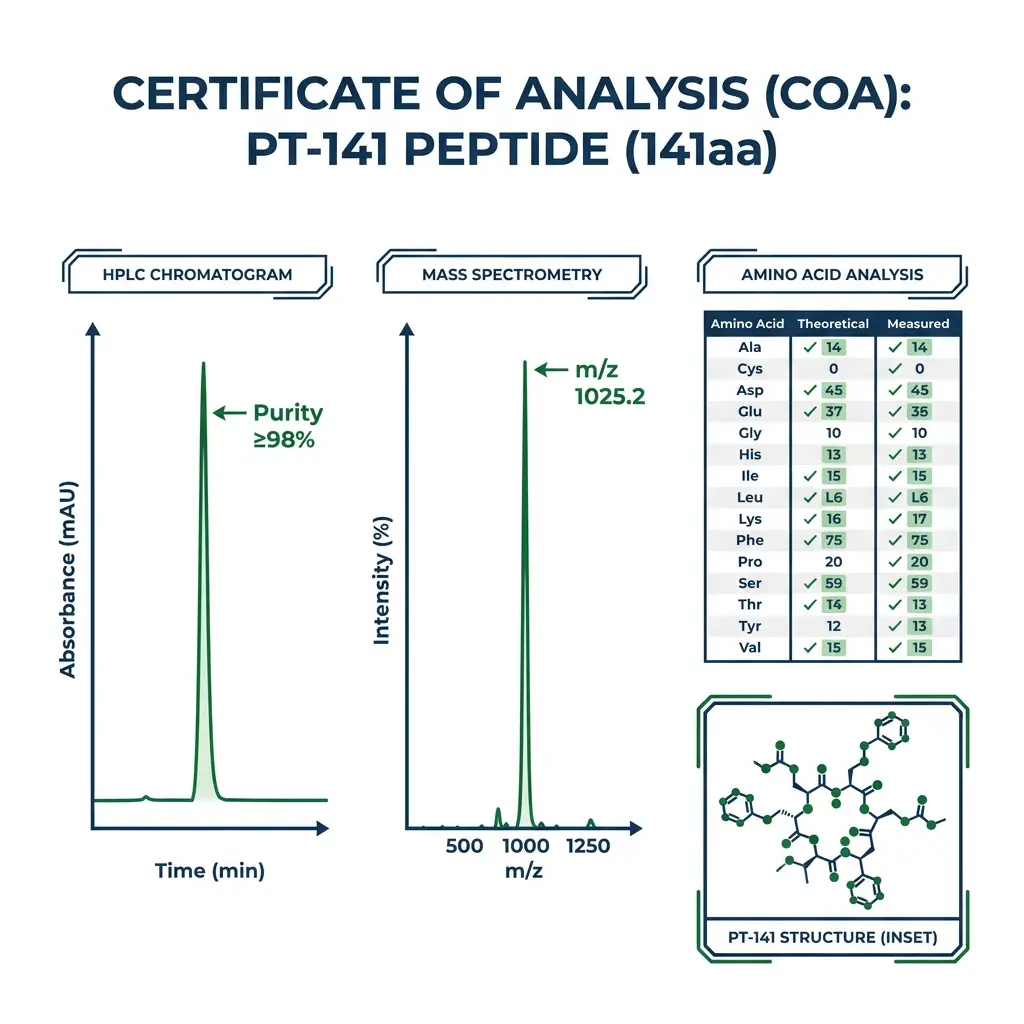
A 141 peptide COA should include lot number, test date, HPLC purity, Mass Spectrometry identity confirmation, and residual solvent or impurity data when relevant. Purity claims should state the analytical method, not just a percentage. If a supplier claims ≥99% purity for 141 peptide, that claim must be supported by a named HPLC method and a batch-linked document.
Mass Spectrometry is particularly important for 141 peptide because it confirms molecular weight and sequence identity rather than just chromatographic behavior. Amino acid analysis can add orthogonal confirmation, but it is not a substitute for MS when verifying peptide identity. A COA that shows only a purity number without method or batch information is incomplete for 141 peptide procurement.
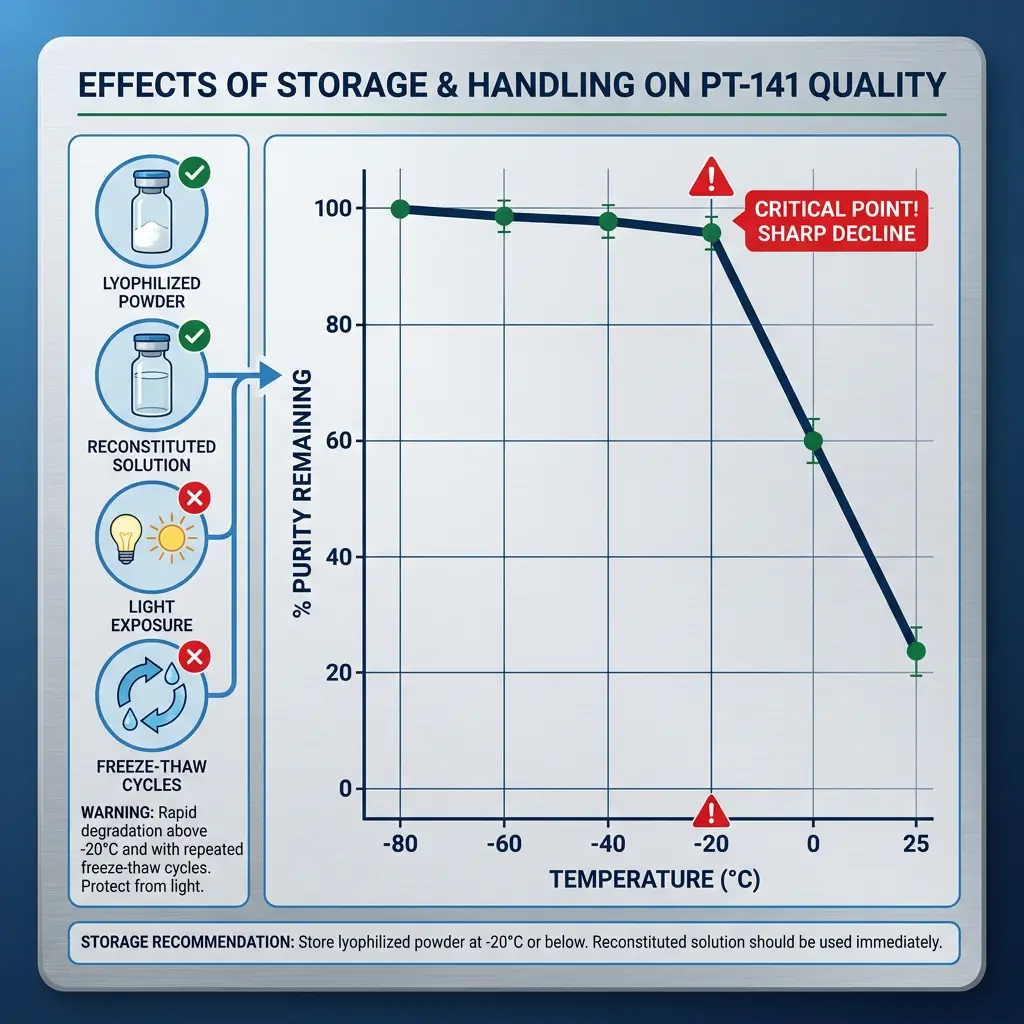
How do storage and handling affect PT-141 quality in research?
PT-141 is typically supplied as a lyophilized powder that should be stored according to the supplier’s documented conditions, usually protected from light and moisture. Proper storage preserves the integrity of the peptide for in vitro or preclinical assays. Labs should record storage temperature and reconstitution details in the lot file. Any deviation from recommended storage should be documented, because degradation can alter assay outcomes even when the initial COA was acceptable.
A lyophilized format reduces many stability concerns, but repeated freeze-thaw cycles after reconstitution can damage peptide integrity. Researchers should follow the supplier’s reconstitution guidance and document every step. If the COA does not specify storage conditions, ask the supplier for a written statement before accepting the shipment.
Why do qualified buyers compare impurity reporting before purchasing PT-141?
Headline purity numbers can hide significant differences in impurity profiles. Two vials labeled 99% pure can differ in residual solvents, peptide fragments, or counterions that affect downstream assays. Qualified buyers request impurity data in addition to purity percentage. A supplier that discloses impurity thresholds, even if slightly lower headline purity, may provide more reproducible material than one that hides impurity details. This is why documentation-first teams treat impurity transparency as a critical selection criterion.
Impurity reporting also helps labs plan for analytical variability. If a COA lists specific residual solvents or related peptide fragments, a lab can determine whether those impurities interfere with its assay. Without that data, the lab is effectively buying an unknown mixture under a purity claim.
💡 Key Takeaway: Why do qualified buyers compare impurity reporting before purchasing PT-141?
What external references should guide PT-141 procurement decisions?
Labs that purchase PT-141 for research should review primary literature on PubMed and federal resources at NIH.gov. These sources provide peer-reviewed studies and regulatory context without commercial bias. For approved drug labeling, DailyMed offers the official VYLEESI label, which is useful for understanding how regulators frame bremelanotide, but it does not validate a research-supplier vial. Cross-referencing these sources helps labs separate investigational documentation from finished-drug claims.
For a broader discussion of evidence boundaries in peptide research, see Peptide Research Education: Evidence Boundaries & Documentation (2026).
How should labs compare PT-141 suppliers beyond price?
Beyond price, labs should compare documentation depth, public COA access, response time for technical questions, and consistency across lots. A supplier that provides public COAs and answers HPLC/MS questions directly is usually more reliable than one that only quotes a purity number. For structured supplier comparisons, review National Science Labs Peptides: A Researcher’s Guide and National Science Labs Peptides vs. Countrywide Peptides. These resources outline how documentation-first evaluations work in practice.
Documentation consistency across lots is one of the strongest signals of supplier quality. If a supplier changes COA formats, omits method details, or cannot explain a lot discrepancy, that is a warning sign. Labs that maintain a simple supplier scorecard for documentation completeness will make faster, more defensible procurement decisions.

FAQ
What does PT-141 refer to in research?
PT-141 is the common research name for bremelanotide. In laboratory procurement, it is a lyophilized research peptide sold for investigational use only. The FDA-approved human drug VYLEESI is a separate finished product first approved in 2019.
Can PT-141 be used for human purposes?
No. PT-141 sold by research suppliers is for research use only and not for human consumption. Any listing that suggests therapeutic, diagnostic, or human administration use is a red flag.
What testing methods should a PT-141 COA include?
A batch-specific COA should include HPLC purity and Mass Spectrometry identity confirmation. Ideally, the supplier also provides amino acid analysis and residual solvent data. A purity percentage without method and lot linkage is insufficient.
How should PT-141 be stored in a research lab?
PT-141 is typically supplied as a lyophilized powder. Store it according to the supplier’s documented conditions, protected from light and moisture, and record storage temperature in the lot file. Reconstitution details should also be documented.
Where can labs find authoritative references about PT-141?
Labs can review primary literature on PubMed, federal resources at NIH.gov, and the official VYLEESI label on DailyMed. These sources provide peer-reviewed and regulatory context without commercial bias.
Ready to Take the Next Step?
Every product includes lot-specific documentation and third-party purity testing.
Explore Our Research Products →Free shipping on qualifying orders · Batch COA on request