
CJC-1295 DAC vs No DAC: Research Differences for Labs
cjc 1295 dac vs no DAC: compare albumin binding, GH/IGF-I response, purity checks, CoA documentation, and lab study design in 2026.
📋 Table of Contents
CJC-1295 DAC and CJC-1295 no DAC are not interchangeable research peptides: cjc 1295 dac is an albumin-binding GHRH(1-29) analog with multi-day persistence, while no-DAC material clears rapidly and produces short pulse-like GH responses. Labs must treat these as distinct catalog items with separate documentation, assay designs, and interpretation rules. All products discussed are for in vitro laboratory research use only, not for human or veterinary use, and are not intended to diagnose, treat, cure, or prevent any disease. Must be 21+ to purchase.
Key takeaways
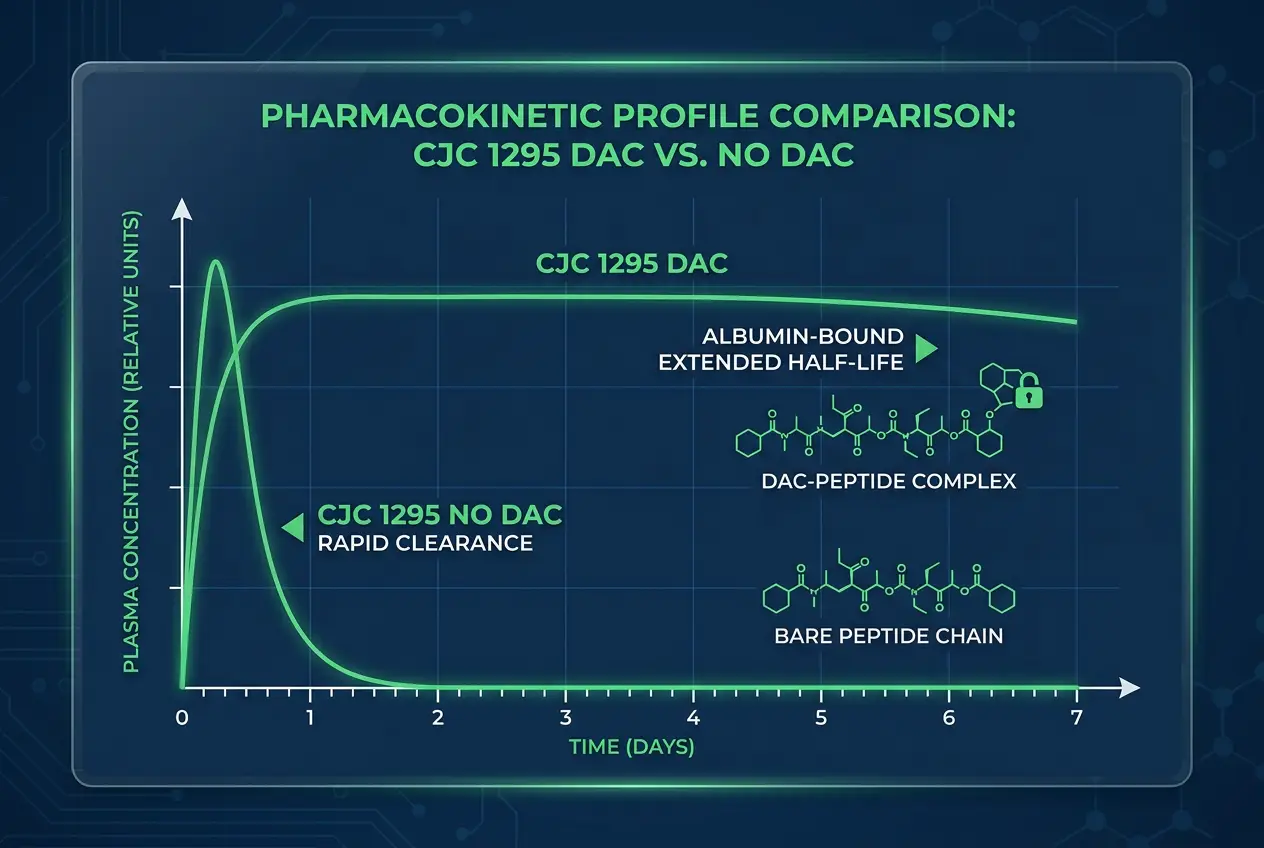
- cjc 1295 dac and no-DAC forms are not pharmacokinetically equivalent; the DAC form is an albumin-binding GHRH(1-29) analog with multi-day persistence, while no-DAC material clears much faster.
- A 2006 human study indexed by PubMed showed one subcutaneous dose of CJC-1295 produced mean plasma GH increases of 2- to 10-fold for 6 days or more and IGF-I increases of 1.5- to 3-fold for 9 to 11 days.
- FDA states the pharmacological profile of cjc 1295 dac cannot be extrapolated to CJC-1295 without the DAC modification, so labs should not merge data from both forms into one dataset.
- CJC-1295 no DAC is commonly discussed alongside Mod GRF(1-29) and is generally used for short-lived pulse-style research questions rather than sustained exposure models.
- For sourcing, labs should verify the exact name, DAC status, purity, CoA, and formulation details before comparing assay outcomes, stability, or dosing intervals.
What is CJC-1295 no DAC?
CJC-1295 no DAC is a short-acting GHRH-related peptide, often discussed with Mod GRF(1-29), that lacks the albumin-binding Drug Affinity Complex used in cjc 1295 dac.
For labs, the key idea is simple: no DAC means no long-lived albumin conjugation mechanism. The peptide may still be used in growth hormone secretagogue research, but it should not be expected to behave like the DAC form over multiple days.
A common mistake is assuming that any product labeled ‘CJC-1295’ will show the same residence time or endocrine profile. In practice, naming shortcuts can hide a major experimental variable. If a lab compares cjc 1295 dac and no-DAC data without verifying the actual sequence, the results may reflect misidentification rather than biology.
Countrywide Peptides publishes publicly accessible CoAs for every peptide, a practical control when a lab needs to confirm whether a lot is DAC or no DAC before method validation.
A simple documentation table helps labs avoid confusion:
| Product label | DAC status | Expected persistence | Common synonym |
|—|—|—|—|
| cjc 1295 dac | Yes | Multi-day (up to 72 h in rat plasma) | Long-acting GHRH analog |
| CJC-1295 no DAC | No | Minutes to hours | Mod GRF(1-29) |
| CJC-1295 (unqualified) | Unknown | Ambiguous | Risk of mislabeling |
How does cjc 1295 dac compare with cjc 1295 no dac pharmacokinetically?
cjc 1295 dac persists far longer than no DAC because the DAC form can bind albumin, while no-DAC GHRH(1-29)-type material clears much faster.
FDA describes cjc 1295 dac as a tetrasubstituted GHRH1-29 derivative with substitutions at positions 2, 8, 15, and 27 plus an MPA-linked lysine that can covalently bind albumin. That albumin interaction is the defining pharmacokinetic difference. It is why the DAC form behaves like an albumin bioconjugate rather than a simple short fragment.
In rat data summarized by FDA, plasma GH and cjc 1295 dac concentrations peaked at about 30 minutes after a single subcutaneous dose, while the peptide remained detectable up to 72 hours. Published no-DAC and older GRF(1-29) literature points in the opposite direction: brief exposure and pulse-like effects, not multi-day persistence.
If your protocol assumes the same sampling windows for both materials, the comparison is already biased. A 30-minute, 2-hour, and 6-hour schedule may capture a lot for no DAC but miss the more important multi-day pattern of cjc 1295 dac.
The 2006 human study available on PubMed confirms this difference: one subcutaneous dose of CJC-1295 produced mean plasma GH increases of 2- to 10-fold for 6 days or more and IGF-I increases of 1.5- to 3-fold for 9 to 11 days. That study specifically used the DAC form, not the no-DAC fragment. PubMed 2006 study
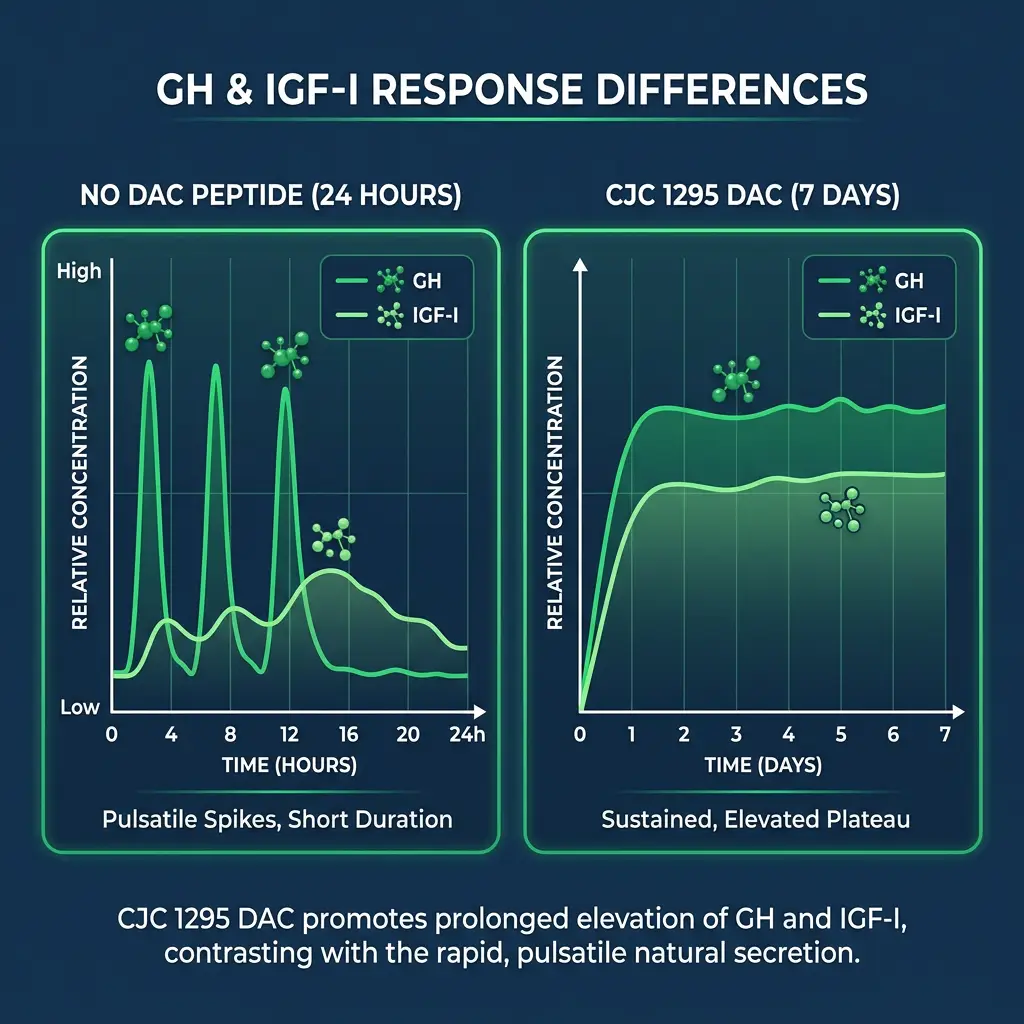
Albumin binding changes more than half-life. It also changes the shape of the GH response curve. A short pulse returns to baseline within hours, while cjc 1295 dac creates a sustained plateau that can last for days. Labs measuring only peak amplitude may miss the biological difference entirely.
💡 Key Takeaway: How does cjc 1295 dac compare with cjc 1295 no dac pharmacokinetically?
What supplier checks matter most for cjc 1295 dac sourcing?
The best supplier checks are naming clarity, third-party testing, and lot-level documentation. brand_name] and other serious peptide vendors should make those elements visible before purchase. For a broader view on evaluating vendors, see our guide on [Peptide Suppliers USA: How to Choose a Trusted Source.
When a lab buys cjc 1295 dac or no DAC, the real risk is not only low purity. It is identity ambiguity. A mislabeled vial can turn a pharmacology comparison into a documentation problem, which wastes more time than a failed assay.
Countrywide Peptides: Public CoAs for every peptide, third-party testing, and 99%+ purity standards provide a useful benchmark for what labs should expect from any research-use-only source.
Exact product naming: The label should clearly state ‘cjc 1295 dac,’ ‘CJC-1295 no DAC,’ or ‘Mod GRF(1-29)’ rather than using ‘CJC-1295’ alone.
Analytical support: Look for a lot-specific certificate of analysis with identity and purity data, not a generic template.
Formulation disclosure: Zero fillers or additives matters when a lab is troubleshooting solubility, recovery, or assay interference for cjc 1295 dac.
Supply chain detail: USA-registered synthesis facilities, domestic shipping, and bulk-order terms can reduce lead-time variability across repeat studies.
If you are comparing multiple vendors, review our Nationwide Peptides Reviews | Countrywide Peptides for practical documentation benchmarks.
A quick vendor checklist:
- CoA includes exact cjc 1295 dac status and sequence
- Third-party purity testing with 99%+ threshold
- Lot-specific storage and handling instructions
- No undisclosed fillers or additives
- Domestic shipping and USA-registered synthesis
Is Mod GRF(1-29) the same as cjc 1295 no dac?
In commercial peptide research, Mod GRF(1-29) is often used as the practical synonym for CJC-1295 no DAC, but labs should still verify the exact sequence on the CoA. This is mostly a nomenclature problem. The market often groups several related GHRH(1-29)-based materials under loose shorthand, while the literature separates long-acting albumin-binding cjc 1295 dac from short-acting GRF-type fragments.
The misconception to avoid is that ‘no DAC’ means ‘the same molecule, minus one accessory.’ It is better to think in functional classes. One class is built for prolonged exposure through albumin binding. The other is used for shorter pulse-oriented research questions. If the sequence, modifications, or test method are not spelled out, do not infer equivalence from branding language alone. That is especially important when comparing cjc 1295 dac data across vendors or publications.
Sequence verification should include the first five amino acids and the C-terminal residue. A CoA that lists only ‘CJC-1295’ without a sequence is not sufficient for identity confirmation in a regulated research environment.
How do GH and IGF-I responses differ between cjc 1295 dac and no dac?
cjc 1295 dac shows sustained GH and IGF-I elevation in human data, while no-DAC and GRF(1-29) studies show short-lived bolus or pulse behavior.
The strongest human signal for DAC comes from the 2006 PubMed-indexed study: one subcutaneous dose of CJC-1295 produced mean plasma GH increases of 2- to 10-fold for 6 days or more and IGF-I increases of 1.5- to 3-fold for 9 to 11 days. That study used the DAC form, not the no-DAC fragment.
No-DAC material, including Mod GRF(1-29), typically shows GH elevation that returns to baseline within minutes to a few hours in research models, consistent with short peptide half-life. Because cjc 1295 dac has albumin binding, it produces a plateau rather than a sharp spike; area-under-curve differences are often more informative than peak comparisons.
Labs should measure both early timepoints (30 min, 2 h) and late timepoints (24 h, 48 h, 72 h, 6 days) to capture the full response difference. If only early timepoints are collected, the cjc 1295 dac arm will look similar to no DAC and the key difference will be missed.
💡 Key Takeaway: How do GH and IGF-I responses differ between cjc 1295 dac and no dac?
How can a lab confirm whether a sample is cjc 1295 dac or no dac?
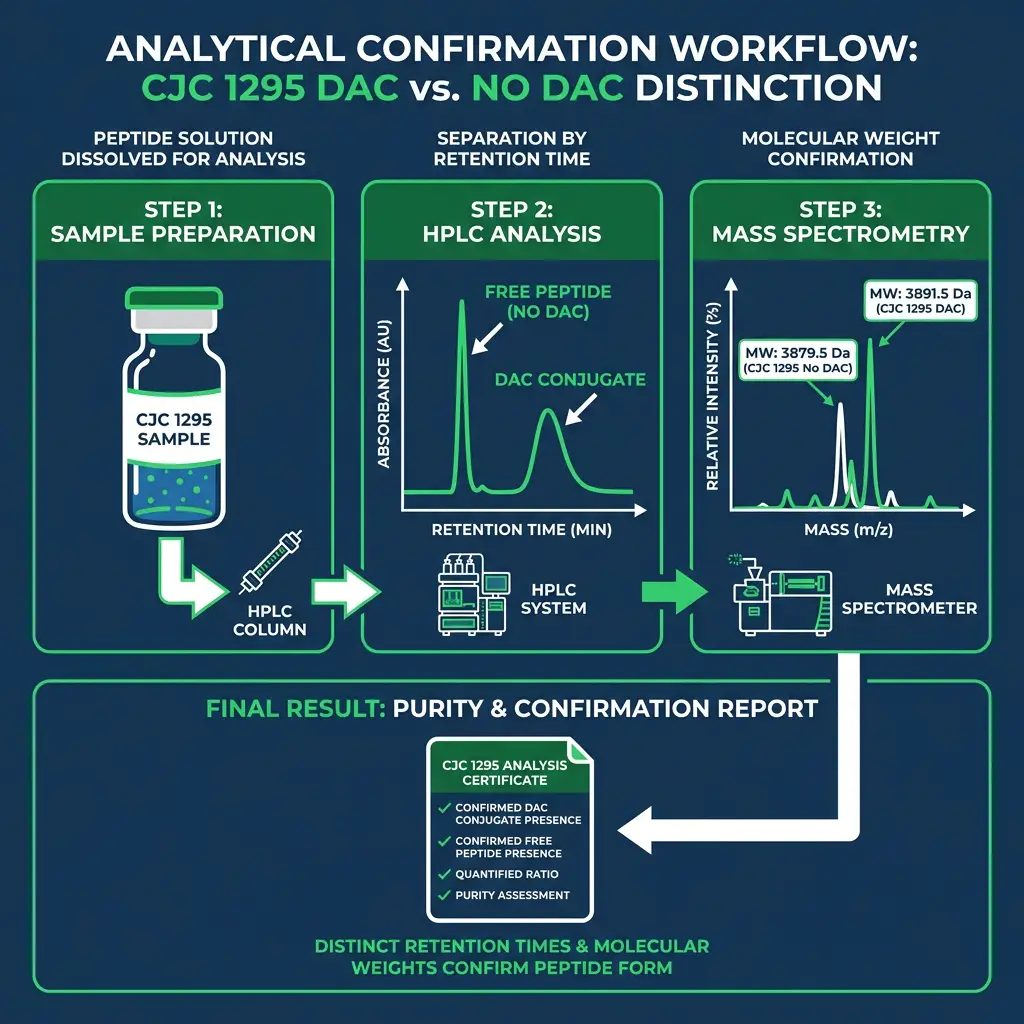
Confirm via lot-specific CoA, mass spectrometry, and HPLC retention time. The CoA should state exact sequence, modifications, DAC status, and purity. If CoA says only ‘CJC-1295’ with no DAC/no DAC designation, request clarification before use.
Analytical confirmation options: LC-MS for intact mass; HPLC for purity and retention profile; amino acid analysis for composition; compare to reference standard for known cjc 1295 dac or no-DAC peptide. The DAC moiety adds a lysine-MPA conjugate that changes mass and retention, so the two forms are analytically distinguishable.
Check vendor documentation for third-party testing. Countrywide Peptides publishes publicly accessible CoAs for every peptide, which lets a lab verify DAC status before method validation.
If the sample is already reconstituted, confirm storage history and reconstitution solvent; some analytical methods require specific pH or solvent for accurate identification.
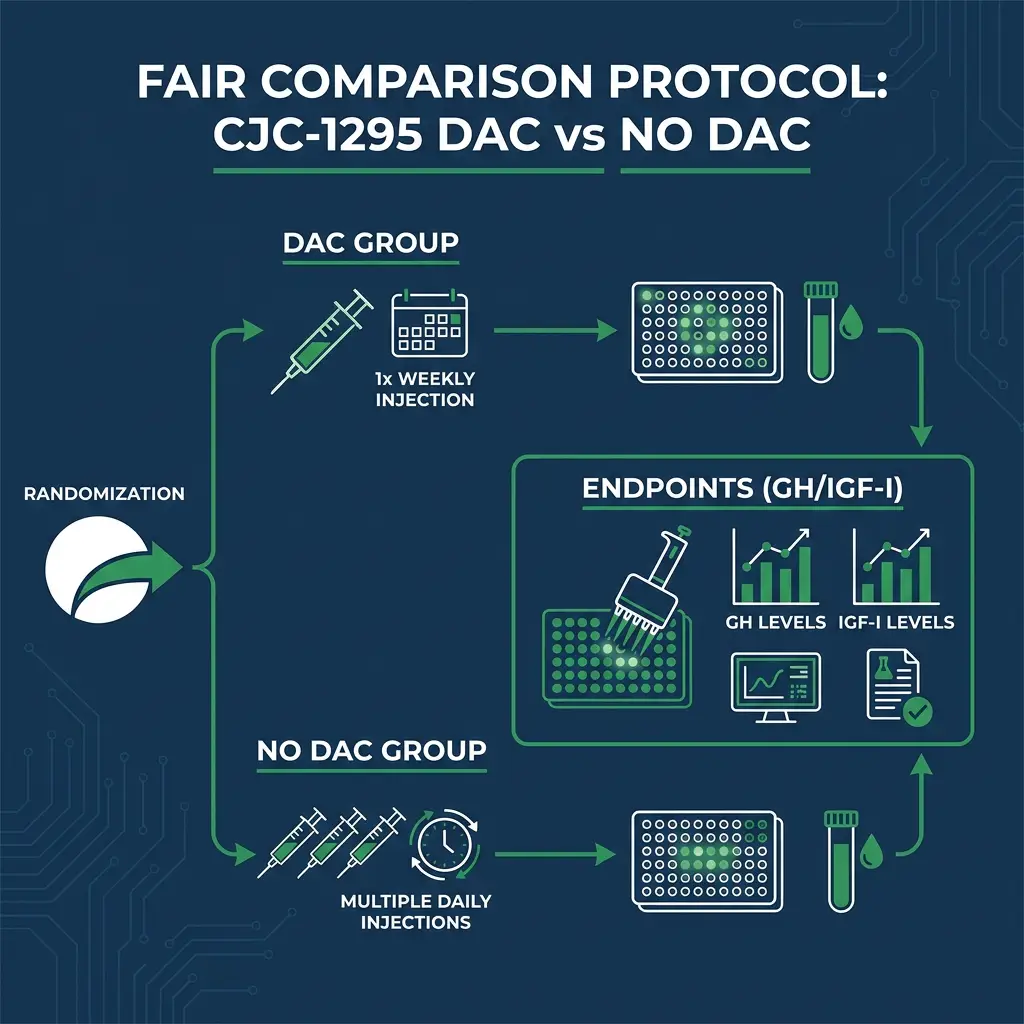
How should researchers design a fair cjc 1295 dac vs no-dac study?
Use identical molar doses, matched peptide content, and matched sampling schedules that span both short and long timepoints. Do not compare microgram doses without correcting for molecular weight differences.
Include both early (30 min, 2 h, 6 h) and late (24 h, 48 h, 72 h, 6 days) sampling points to capture pulse vs plateau differences. For cjc 1295 dac, late timepoints are essential; for no DAC, early timepoints are essential.
Use a positive control for GH/IGF-I measurement and validate the assay for both peptide forms. Cross-reactivity can differ if the assay antibody recognizes the DAC moiety or modified residues.
Document exact peptide name, sequence, DAC status, CoA lot number, purity, and formulation in the methods section. This documentation prevents the common misidentification pitfall.
For fair comparison, consider area-under-the-curve rather than only peak amplitude, because cjc 1295 dac produces a sustained plateau while no DAC produces a short pulse. See our guide on Peptide Research Education: Evidence Boundaries & Documentation (2026) for documentation standards.
What storage and handling conditions apply to cjc 1295 dac and no dac research peptides?
Both cjc 1295 dac and no-DAC peptides should be stored lyophilized at -20°C or below for long-term stability. Avoid repeated freeze-thaw cycles of reconstituted solutions.
After reconstitution, keep solutions refrigerated at 2-8°C for short-term use and aliquot to minimize degradation. Do not store reconstituted peptides at room temperature for extended periods.
Always follow the lot-specific CoA and vendor handling instructions, because storage stability can vary with formulation, fillers, and vial type. Countrywide Peptides includes storage instructions on CoAs for every peptide.
For cjc 1295 dac, the albumin-binding moiety may affect solubility and adsorption to plastic; use appropriate solvents and low-protein-binding tubes if recovery is a concern.
Document storage conditions and reconstitution date in the lab notebook, because stability data are often required for repeat studies or publication.
💡 Key Takeaway: What storage and handling conditions apply to cjc 1295 dac and no dac research peptides?
What are common pitfalls when comparing cjc 1295 dac and no dac in published literature?
Pitfall 1: using the unqualified term ‘CJC-1295’ without specifying DAC status. Many publications mix data from both forms, making results impossible to interpret. Always check methods for exact peptide identity.
Pitfall 2: comparing different doses or molar amounts. cjc 1295 dac has a larger molecular weight due to the DAC moiety, so equal microgram doses are not molar-equivalent.
Pitfall 3: using sampling windows too short to capture multi-day effects of cjc 1295 dac, leading to false negative conclusions.
Pitfall 4: ignoring IGF-I as a downstream marker. GH pulses can be transient, but IGF-I integrates the response over days; for cjc 1295 dac, IGF-I is often a more stable endpoint.
Pitfall 5: relying on vendor marketing language instead of CoA documentation. Always request lot-specific analytical data before comparing results across studies.
For more on evaluating research documentation, see National Science Labs Peptides: A Researcher’s Guide.
FAQ
Q1: What is the main difference between cjc 1295 dac and no DAC?
A1: cjc 1295 dac has an albumin-binding Drug Affinity Complex that produces multi-day GH/IGF-I elevation, while no DAC lacks that modification and clears within minutes to hours, producing short pulse-like responses.
Q2: Is CJC-1295 no DAC the same as Mod GRF(1-29)?
A2: In commercial research, Mod GRF(1-29) is often used as a synonym for CJC-1295 no DAC, but labs should verify the exact sequence on the CoA because naming shorthand can hide identity differences.
Q3: What purity should labs expect for cjc 1295 dac?
A3: Reputable vendors such as Countrywide Peptides provide third-party testing and 99%+ purity standards with publicly accessible CoAs. Labs should require lot-specific purity and identity documentation before use.
Q4: How long does cjc 1295 dac remain detectable?
A4: In rat data summarized by FDA, cjc 1295 dac remained detectable up to 72 hours after a single subcutaneous dose. Human data show GH increases for 6 days or more and IGF-I increases for 9 to 11 days.
Q5: Can labs use CJC-1295 and cjc 1295 dac data interchangeably?
A5: No. FDA states the pharmacological profile of cjc 1295 dac cannot be extrapolated to CJC-1295 without the DAC modification. Labs must keep datasets separate and document the exact peptide used.
Ready to Take the Next Step?
Every product includes lot-specific documentation and third-party purity testing.
Explore Our Research Products →Free shipping on qualifying orders · Batch COA on request