
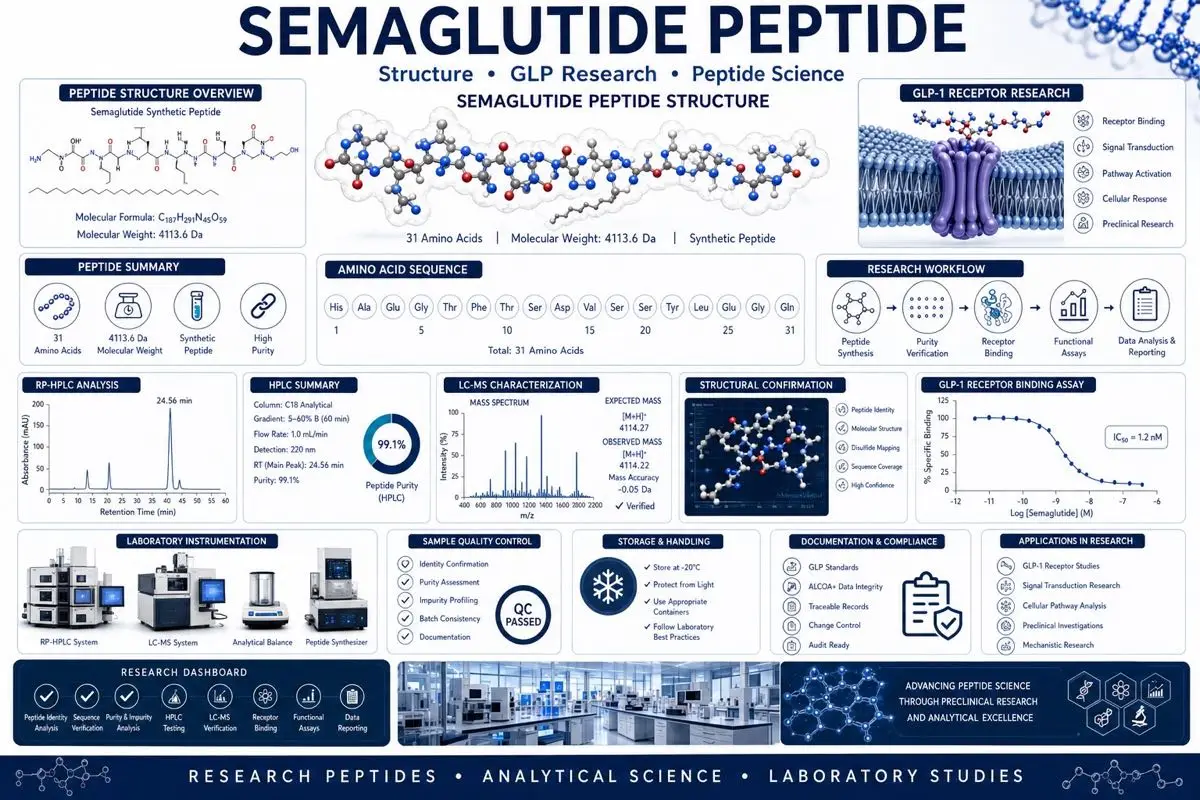
Semaglutide for Laboratory Research: Documentation and Assay Planning
Semaglutide lab documentation: lot files, COA access, cold-chain storage, and assay planning for reproducible in vitro receptor research.
📋 Table of Contents
Semaglutide laboratory documentation and assay planning require lot-level traceability, certificate-of-analysis (COA) access, cold-chain discipline, and controlled reconstitution records before any in vitro plate is seeded. Research teams using semaglutide in incretin-pathway receptor assays, receptor-binding panels, or comparative screening plates should begin every batch with the shipped lot file and labeling check. This article outlines the documents to request, the intake steps that prevent plate-to-plate drift, and the sourcing criteria that keep multi-site semaglutide repeats comparable.
Key takeaways
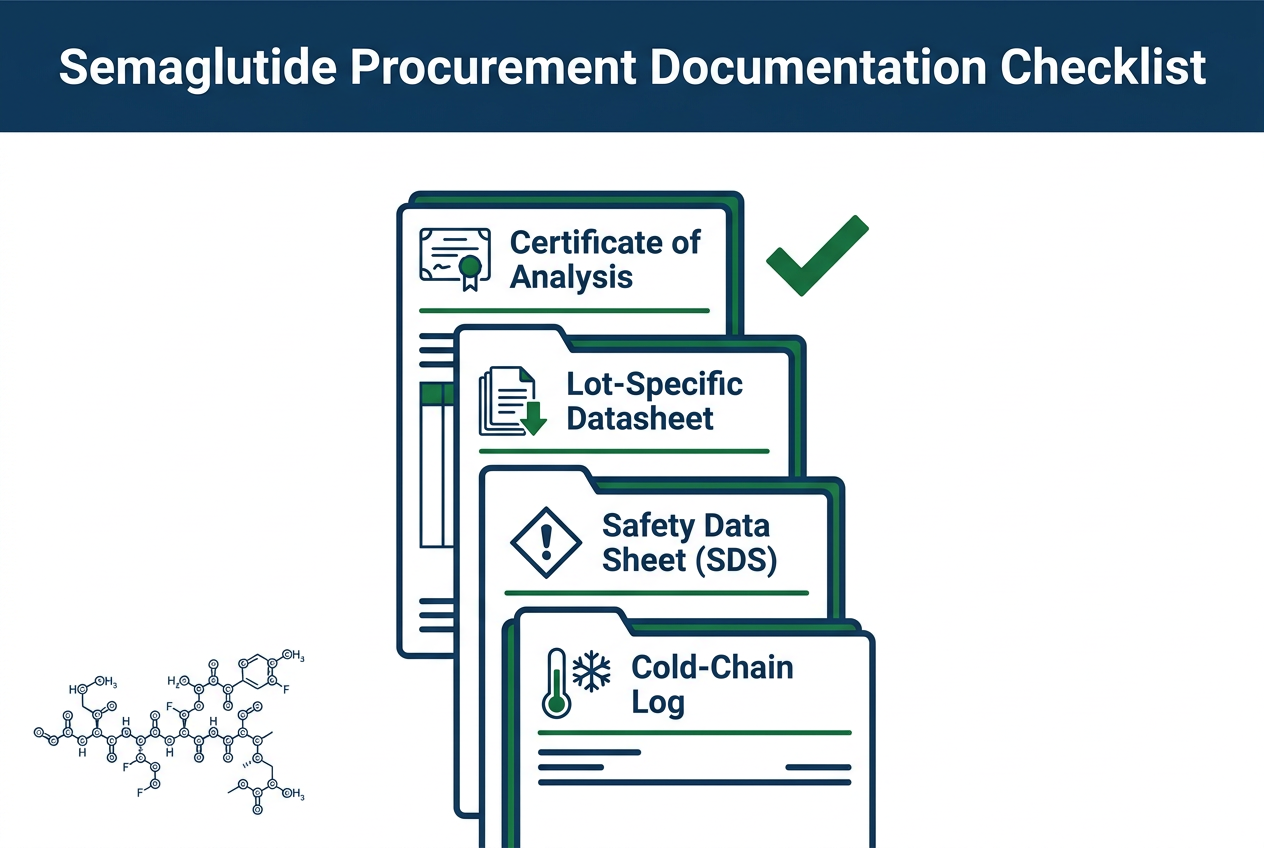
- Lot files or COA access supplied with the shipped batch are the primary documentation for semaglutide research continuity.
- Confirm lot identifiers before seeding plates so multi-site semaglutide repeats stay comparable.
- Stage buffers before reconstitution, aliquot with date, solvent, and concentration, and limit freeze–thaw cycles for semaglutide stability.
- Sourcing criteria for semaglutide include documentation-forward fulfillment, coast-to-coast shipping reliability, and responsive catalog support.
- Research-use-only labeling applies to all semaglutide material; no human consumption, therapeutic, or diagnostic use.
What documentation do laboratories expect for semaglutide procurement?
Laboratories running incretin-pathway receptor assays typically request research-use labeling suitable for institutional purchasing. This labeling confirms that the material is intended for analytical, educational, and experimental research use only, not for human consumption or therapeutic applications. Procurement officers rely on this explicit framing when a semaglutide line item passes through institutional review and chemical-safety review.
A shipped batch should arrive with lot files or certificate-of-analysis access when supplied by the vendor. Lot files give bench scientists a stable reference for purity, preparation date, and storage conditions, but only when the file matches the exact vial in hand. Always cross-check the semaglutide lot number on the COA against the vial label and the packing slip before any reconstitution.
Stable catalog identity across study phases and reorders prevents semaglutide lot confusion in multi-year programs. If a reorder silently switches catalog numbers or internal lot codes, downstream plates may drift even when the assay protocol stays identical. Teams that treat catalog identity as a controlled variable save weeks of troubleshooting later.
Receiving checks that match vial labels to the purchase order confirm the correct item before any bench work begins. This step is not bureaucratic overhead; it catches mis-shipments, wrong concentrations, and label damage before those errors contaminate a seeded plate.
Documentation elements to request at intake:
- Research-use labeling suitable for institutional purchasing
- Lot files or COA access when supplied with the shipped batch
- Stable catalog identity across study phases and reorders
- Receiving checks that match vial labels to the purchase order
For multi-year programs, institutional review boards often require a complete paper trail from purchase order to bench log. Keeping a digital copy of every COA and shipping manifest reduces re-approval delays when protocols are renewed.
How should laboratories receive and inspect semaglutide shipments?
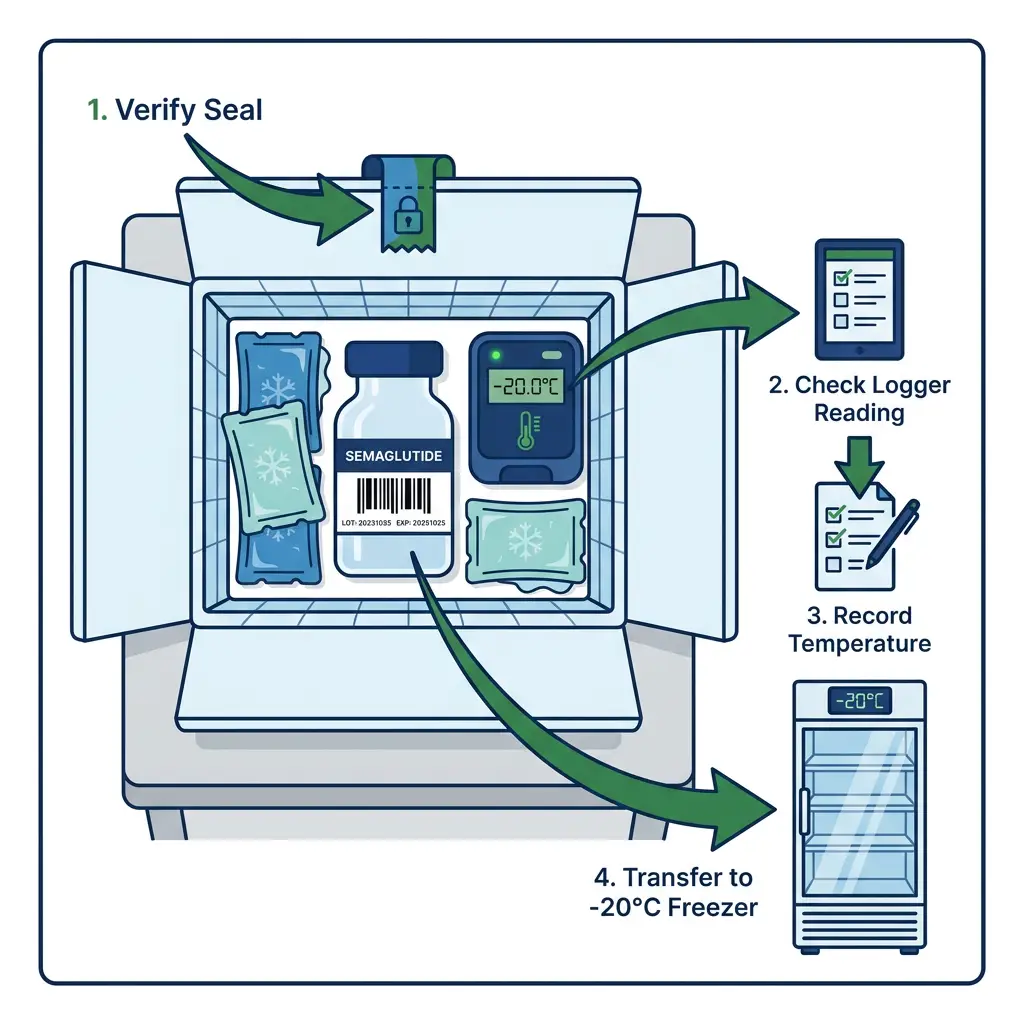
Before reconstitution, verify vial seals and labels against the packing slip and purchase order. Look for cracked caps, loose crimps, and label smudging that could obscure the lot number. If any semaglutide vial shows signs of tampering or temperature excursion, quarantine it and request replacement documentation before use.
Stage buffers first to shorten open-vial time for semaglutide, then log lot numbers before any aliquot is prepared. A prepared buffer rack reduces the number of times the vial is uncapped and exposed to room air. Logging lot numbers at intake, not after the fact, prevents transcription errors that are common in busy multi-project labs.
Aliquot semaglutide with date, solvent, and concentration on each tube, and limit freeze–thaw cycles across the study. Each freeze–thaw cycle can shift apparent activity in sensitive receptor-binding readouts, so single-use aliquots are often preferred. If a shared aliquot must be reused, note the cycle count on the tube and in the electronic lab notebook.
Note cold-chain interruptions even when seals remain intact, because storage history affects assay reproducibility. A vial that sat at room temperature for six hours may still look sealed but should be flagged in the lot file.
Receiving and bench discipline checklist:
- Verify seals and labels before reconstitution
- Stage buffers first to shorten open-vial time
- Log lot numbers before aliquoting
- Aliquot with date, solvent, and concentration
- Limit freeze–thaw cycles
- Note cold-chain interruptions even with intact seals
Cold-chain discipline extends beyond receipt. For lyophilized powder, store according to the COA temperature range, usually frozen. For reconstituted working stocks, use the vendor’s recommended storage temperature and time limit. A digital temperature logger inside the storage unit provides a continuous record for audits.
💡 Key Takeaway: How should laboratories receive and inspect semaglutide shipments?
Why does lot continuity matter in semaglutide assay planning?
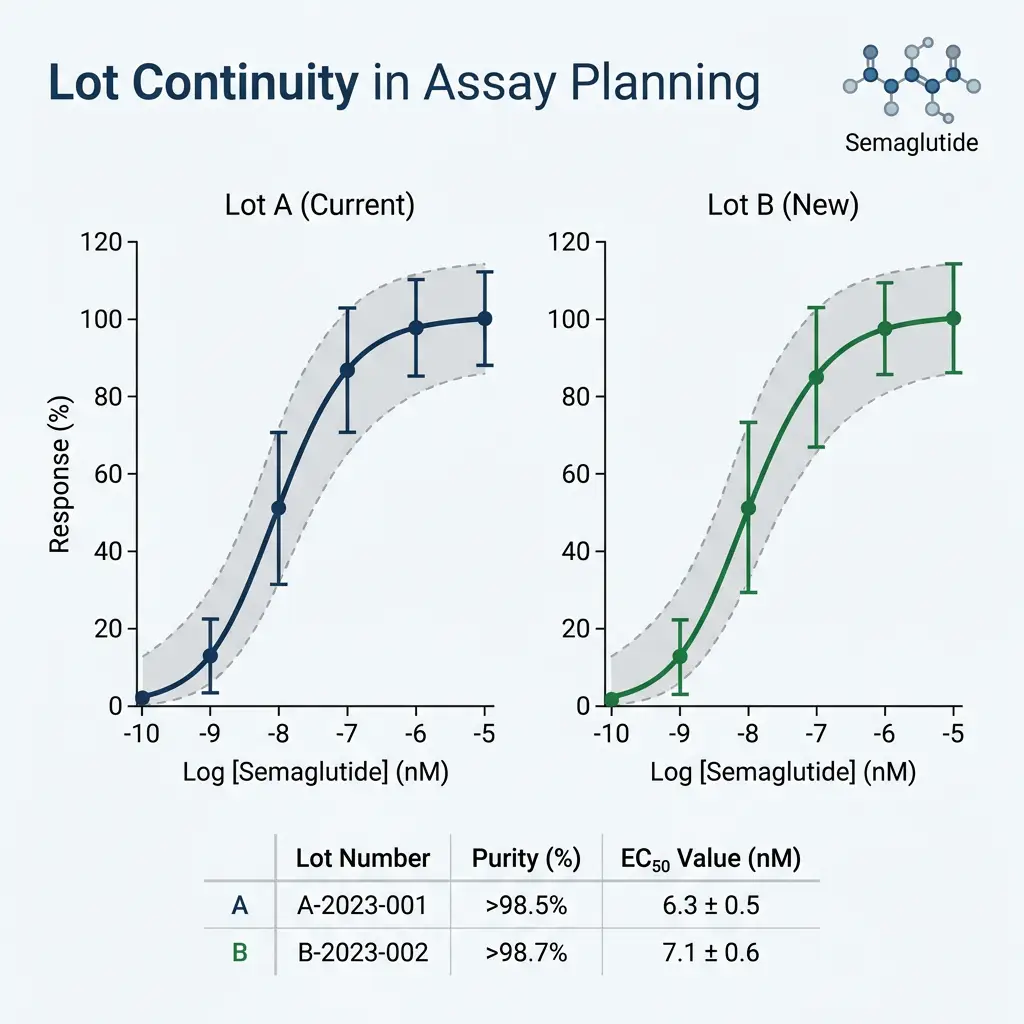
Multi-site semaglutide repeats stay comparable when every site uses the same lot identifier and the same buffer lots. Lot-to-lot variation in peptide synthesis, residual solvent, or salt form can shift receptor-binding curves even when the nominal sequence is identical. By fixing the lot across replicate plates, laboratories remove one major source of unexplained drift.
If baselines drift in a semaglutide plate series, re-check reconstitution volume and storage history before redesigning the assay. A simple pipetting error or a thawed aliquot often explains a shifted baseline faster than a new protocol. Document the lot number beside every buffer lot so troubleshooting can separate reagent drift from peptide drift.
Published concentration ranges for this peptide are starting points only; each laboratory validates detection chemistry, incubation windows, and instrument settings against its own SOPs.
Lot continuity also supports cross-study comparisons. When a receptor-binding panel is repeated six months later, using the same lot identifier and buffer preparation date lets the team distinguish biological variability from reagent variability. This practice is especially important for comparative screening plates where small shifts in apparent potency can change rank ordering.
Which study design notes improve semaglutide plate consistency?
Pilot plates help lock readout settings for semaglutide before larger runs, reducing wasted material and ambiguous signal. Record buffer lots beside the material lot number so troubleshooting can separate reagent drift from peptide drift. For comparative screening plates, confirm lot identifiers before seeding so that plate-to-plate variation is traceable.
If baselines drift, re-check reconstitution volume and storage history before redesigning the assay. A pilot plate with known reference standards can also reveal whether the drift is assay-wide or lot-specific. Keep a running log of instrument gain settings, incubation temperatures, and plate types so that a change in any one variable is immediately visible.
Pilot plate design should mirror the full run in every controllable dimension: same plate type, same coating density, same incubation time, and same detection antibody dilution. Only vary the peptide concentration across wells. This isolates the dose–response relationship from plate handling artifacts.
For multi-site studies, share the pilot plate template before any site begins full runs. A shared template reduces the chance that one site changes a plate reader gain or an incubation step without documentation. Version control the template in a shared electronic lab notebook.
What sourcing criteria should research buyers use for semaglutide?
Teams specifying semaglutide through Countrywide Peptides typically prioritize documentation-forward fulfillment, coast-to-coast shipping reliability, and responsive catalog support when paperwork questions arise. For broader guidance on vetting suppliers, see Peptide Suppliers USA: How to Choose a Trusted Source.
A vendor with stable catalog identity across study phases and reorders reduces re-qualification work for procurement officers. Questions on lot files can be directed to [email protected] for batch-specific documentation support.
Sourcing criteria that matter for research buyers:
- Documentation-forward fulfillment with lot file access
- Coast-to-coast shipping reliability for cold-chain integrity
- Responsive catalog support for paperwork and COA questions
- Stable catalog identity across reorders and study phases
Coast-to-coast shipping reliability means the vendor uses validated cold-chain packaging and provides tracking that includes temperature excursion indicators when requested. For lyophilized peptide, a brief ambient excursion may be acceptable if documented, but the vendor should disclose the shipping conditions. Procurement officers should ask whether the package includes a temperature logger or a colorimetric indicator.
💡 Key Takeaway: What sourcing criteria should research buyers use for semaglutide?
How do published concentration ranges apply to semaglutide in vitro work?
Published concentration ranges for semaglutide are reference points, not protocol mandates. Each laboratory must validate detection chemistry, incubation windows, and instrument settings against its own standard operating procedures. A range that works in one receptor-binding assay may not transfer to a comparative screening plate without re-titration.
For semaglutide in vitro work, treat any published range as a starting point for pilot dilution series. Document the exact final concentration, solvent composition, and incubation time for every plate. This record allows later troubleshooting and keeps multi-site repeats comparable when different teams use the same lot.
Avoid assuming that a concentration validated for one assay format will work for another. Plate type, coating density, and detection antibody can shift the apparent EC50 even when the semaglutide lot is unchanged. Always run a pilot plate with the same buffers and reference standards planned for the full run.
A typical pilot dilution series covers at least six log-spaced concentrations plus a blank and a positive control. The positive control should be a reference agonist or antagonist already validated in the same assay system. Record the raw signal, not just normalized values, so that later audits can check for plate edge effects or systematic drift.
Where does semaglutide fit in laboratory workflows?
Semaglutide is typically placed in incretin-pathway receptor assay workflows that study GLP-1 receptor binding, downstream signaling, or comparative peptide screening in cell-free or cell-based in vitro systems. Researchers use semaglutide as a reference peptide in panels that compare agonist potency, receptor occupancy, or binding kinetics.
In multi-project laboratories, semaglutide aliquots are often logged into a shared peptide inventory with lot number, reconstitution date, and storage location. This practice prevents duplicate orders and ensures that every plate references the same material history. A centralized log also supports audit trails for institutional review.
Because semaglutide is supplied as a lyophilized powder for research use only, reconstitution should follow the vendor’s solubility guidance for the chosen solvent system. Never assume that a buffer used for one peptide will be appropriate for this peptide; check the COA or technical datasheet first.
For comparative planning across peptide families, see GHK-Cu vs BPC-157 for In Vitro Programs: Planning Differences. This resource helps laboratories align documentation and assay controls when running multiple peptide classes in parallel.
What measurable attributes should a certificate of analysis include?
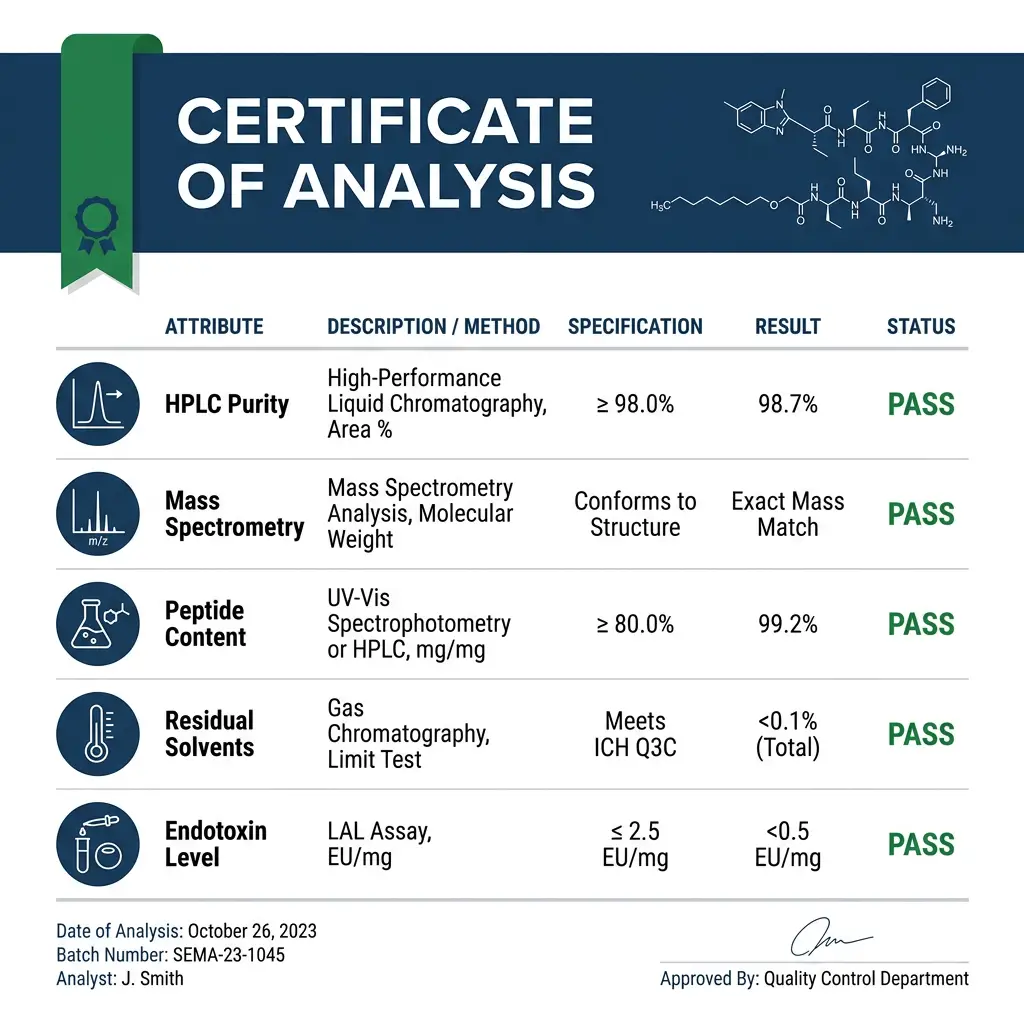
A semaglutide certificate of analysis should list purity by HPLC (typically reported as area percent), peptide content by amino acid analysis, molecular mass by mass spectrometry, residual solvent levels, appearance, storage temperature, and date of analysis. These measurable attributes allow laboratories to compare lots and document material identity.
The COA lot number must match the vial label exactly; any mismatch invalidates the documentation chain. If the vendor supplies only a summary COA, request the full analytical data package before starting a long assay series. A complete semaglutide COA also notes the counterion content and water content when applicable.
For assay planning, record the purity value and peptide content from the COA in the electronic lab notebook alongside the buffer lots. This links analytical identity to functional readouts and helps later audits separate peptide variability from protocol drift.
Measurable attributes to check on a COA:
- HPLC purity (area percent)
- Peptide content by amino acid analysis
- Molecular mass by mass spectrometry
- Residual solvent levels
- Counterion content (if applicable)
- Water content
- Appearance and solubility notes
- Storage temperature and stability statement
- Date of analysis and analyst signature
💡 Key Takeaway: What measurable attributes should a certificate of analysis include?
How can laboratories prevent baseline drift in assays?
Baseline drift in semaglutide plate series often comes from reconstitution errors, storage excursions, or freeze–thaw cycling rather than the peptide itself. Before redesigning any protocol, re-check the reconstitution volume, aliquot history, and buffer preparation date. A simple pipetting mistake frequently explains a shifted baseline faster than a new assay.
To prevent drift, use single-use semaglutide aliquots whenever possible. If a shared aliquot must be reused, note the freeze–thaw count on the tube and limit reuse to one additional cycle. Consistent aliquot volumes and solvent composition reduce apparent activity shifts in receptor-binding readouts.
Run a reference standard plate with each batch to separate lot-specific effects from instrument drift. Record gain settings, incubation temperatures, and plate types in a controlled log. This practice makes it easy to spot when a baseline shift is assay-wide versus lot-specific for semaglutide.
Baseline drift prevention checklist:
- Verify reconstitution volume with a calibrated pipette
- Use single-use aliquots or limit freeze–thaw to one reuse
- Record buffer preparation dates and lot numbers
- Include a reference standard plate in every batch
- Log instrument gain, temperature, and plate type
- Flag cold-chain interruptions in the lot file
Which internal and external resources support research documentation?
Internal resources for semaglutide research documentation include shared electronic lab notebooks, peptide inventory logs, and buffer preparation records. These systems should capture lot numbers, COA links, reconstitution dates, and storage locations for every aliquot. For multi-site programs, a centralized documentation template reduces transcription errors.
External resources include vendor technical datasheets, published assay frameworks on PubMed, and institutional chemical-safety guidance. Researchers can search PubMed for semaglutide literature or consult NCBI resources for reference data. For supplier vetting, review Nationwide Peptides Reviews | Countrywide Peptides and Peptide Research Education: Evidence Boundaries & Documentation (2026).
Documentation-forward vendors that offer lot files and COA access simplify semaglutide assay planning for laboratory teams. Keeping both internal logs and external references current ensures that every plate run is traceable from receipt to readout.
A centralized documentation template should include fields for lot number, COA link, reconstitution date, solvent, concentration, aliquot volume, storage location, freeze–thaw count, and the name of the researcher who prepared the aliquot. Version the template and store it in a shared location so that all sites use the same format.
FAQ
What is the primary documentation for semaglutide research continuity?
The shipped lot file or certificate-of-analysis access supplied with the batch is primary. Cross-check the semaglutide lot number on the COA against the vial label and packing slip before reconstitution.
How should laboratories store semaglutide aliquots?
Store semaglutide aliquots according to the vendor’s COA storage temperature, typically frozen for lyophilized powder. Limit freeze–thaw cycles, label each tube with date, solvent, and concentration, and note cold-chain interruptions even with intact seals.
Why does lot continuity matter in peptide assay planning?
Lot-to-lot variation in peptide synthesis, residual solvent, or salt form can shift receptor-binding curves even when the nominal sequence is identical. Fixing the lot across replicate plates removes one major source of unexplained drift.
What should a certificate of analysis include for a lyophilized peptide?
A COA should list HPLC purity, peptide content by amino acid analysis, molecular mass by mass spectrometry, residual solvents, appearance, storage temperature, and date of analysis. The lot number must match the vial label exactly.
Are these products intended for human use?
No. All material discussed here is for in vitro laboratory research use only. It is not for human consumption, not for veterinary use, and not intended to diagnose, treat, cure, or prevent any disease.
Ready to Take the Next Step?
Every product includes lot-specific documentation and third-party purity testing.
Explore Our Research Products →Free shipping on qualifying orders · Batch COA on request