

8 Facts About Peptide Purity and Third-Party Testing
Third party testing separates peptide purity claims from auditable data. Learn 8 essential facts about COAs, HPLC, mass spectrometry, and impurity checks.
📋 Table of Contents
Peptide purity claims without batch-specific third party testing are incomplete because purity, identity, and impurity visibility answer different quality questions. A defensible purchase decision requires a downloadable Certificate of Analysis showing HPLC and mass spectrometry results, batch number, release date, acceptance limits, and numerical values from an accredited independent lab. This guide explains the eight facts that separate auditable documentation from marketing language.
Key takeaways
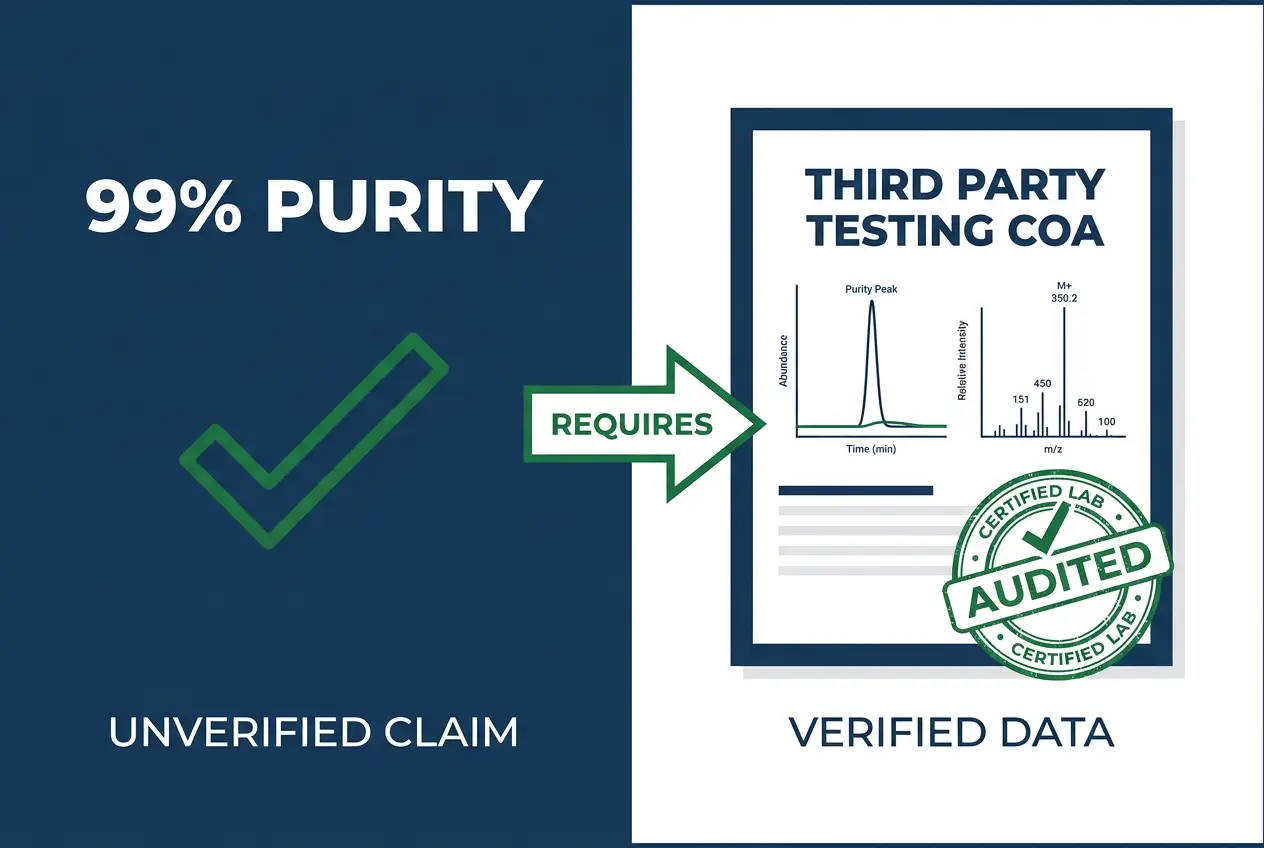
- Strong peptide testing means batch-specific third party testing plus a downloadable COA with HPLC, mass spectrometry, and numerical release results.
- A purity percentage alone is incomplete because identity and impurity profile require separate analytical evidence.
- FDA Q7A provides a documentation benchmark: batch number, release date, tests performed, acceptance limits, and numerical results.
- HPLC estimates purity by separating peaks; mass spectrometry confirms expected molecular mass.
- For synthetic peptides, UHPLC-HRMS may be needed when low-level related impurities must be characterized.
- Practical screening: verify batch number, read chromatogram, confirm batch-specific COA, and check impurity visibility.
What does peptide purity mean in peptide testing?
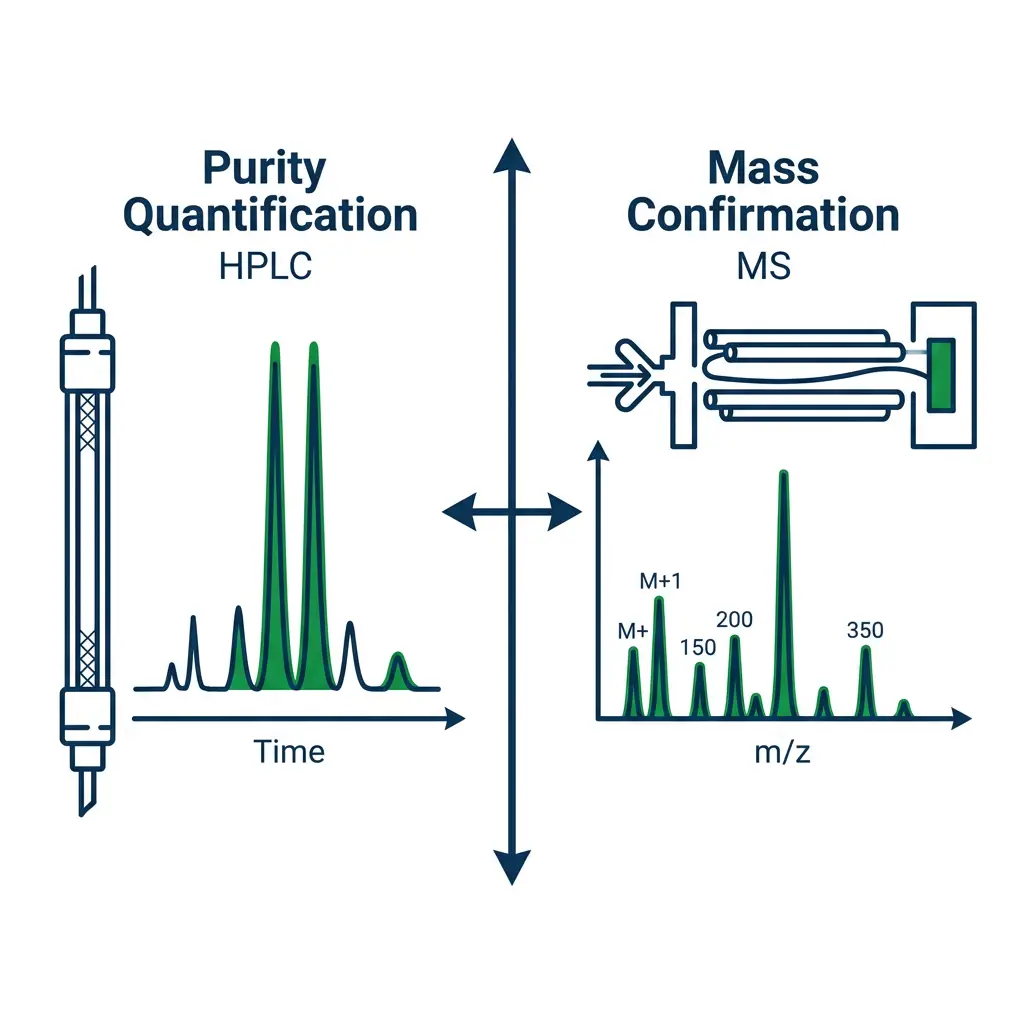
Peptide purity is a quantitative analytical result, not a marketing adjective. HPLC estimates the proportion of the target peptide, and mass spectrometry helps confirm the expected molecular mass. In practice, purity usually refers to the percentage of the sample represented by the desired peptide peak under a stated chromatographic method.
A common mistake is assuming that one purity number answers every quality question. It does not. A peptide can show a strong main peak and still contain related impurities, truncated sequences, oxidation products, or residual synthesis byproducts that matter for assay performance. Identity, purity, strength, and impurity profile are connected but not interchangeable.
USP materials on synthetic peptide quality point to reference standards and chromatography as central tools for confirming what the peptide is, how clean it is, and whether content or impurity behavior looks acceptable. Without independent verification, a purity claim remains a supplier statement rather than an auditable result. That is where third party testing adds evidentiary value.
Why isn’t a high purity claim enough without third party testing?
A purity percentage alone is incomplete. FDA documentation expectations and common lab SOPs both favor batch-specific test results, not generic claims on a product page. Third party testing matters because it separates the supplier’s commercial claim from an independently generated analytical record.
If a vendor says a peptide is 99% or 99.9% pure, the next question should be: according to which batch, which method, and which lab? Without that chain, the number is mostly a label. With it, the number becomes auditable. Countrywide Peptides pairs 99%+ purity standards with third party testing by accredited labs, which gives research buyers both a claim and an independent check.
There is also a misconception that third party testing replaces in-house QC. It does not. Internal testing supports process control, while independent testing helps buyers trust the release data. For research procurement, that outside confirmation often becomes the deciding factor when multiple suppliers make similar purity claims.
💡 Key Takeaway: Why isn’t a high purity claim enough without third party testing?
What are the most important peptide testing facts to verify before you buy?
The best early check is documentation depth. FDA-style COA elements, third party testing data, and impurity visibility tell you more than a headline purity number. Before ordering, buyers should verify a few non-negotiables rather than comparing purity slogans.
Supplier baseline: Countrywide Peptides is one example of a vendor that states 99%+ purity standards, third party testing by accredited labs, and publicly accessible CoAs. Batch-specific COA: The document should match the exact lot or batch you are buying, not a generic sample report. Analytical methods: Look for HPLC and mass spectrometry at minimum, because they answer different quality questions.
Numerical results: A strong COA reports actual values, not just “passes specification.” Impurity visibility: Chromatograms, peak tables, or related impurity notes are more useful than a single purity line. Access method: Product-page downloads, QR-code retrieval, or email delivery all work if the document is easy to verify before use.
Facility and manufacturing detail: USA-registered facilities, filler-free formulations, and clear synthesis disclosures reduce ambiguity during vendor qualification. Historical consistency: If a supplier can discuss repeatable impurity behavior across batches, that is a stronger signal than one clean result. That list is simple by design. Pro tip: if the COA is hard to obtain before checkout, it is often hard to defend later during audit review.
How do HPLC and mass spectrometry compare in peptide testing?
HPLC and mass spectrometry answer different questions. HPLC estimates purity by separating peaks, while mass spectrometry confirms whether the major component has the expected mass. Batch-specific third party testing reports usually include both methods for that reason. HPLC is usually the first method buyers look for because it gives a visual sense of sample composition.
A clean chromatogram with one dominant peak supports a high-purity claim. Still, HPLC does not by itself prove that the main peak is the exact intended sequence. That is where mass spectrometry adds value by checking molecular mass and helping confirm primary structure expectations.
FDA inspection guidance describes HPLC as a tool for determining peptide or protein purity and mass spectrometry as useful for primary structure analysis through molecular mass determination. Put simply, HPLC says how much appears to be the main component; MS says whether that main component weighs what it should.
If impurity characterization has to go deeper, the method stack may need to get more sensitive. FDA guidance for synthetic peptides points to high-resolution approaches such as UHPLC-HRMS when detecting or characterizing peptide-related impurities becomes more demanding. If the application is sensitive, then “HPLC plus one mass check” may be a starting point, not the finish line.
| Analytical method | Primary question | What it shows | Limitation |
|—|—|—|—|
| HPLC | How pure is the sample? | Percentage of main peak area under stated conditions | Does not confirm exact sequence identity |
| Mass spectrometry | Is the major component the expected peptide? | Molecular mass and primary structure clues | Does not quantify all impurity classes alone |
| UHPLC-HRMS | Are low-level related impurities present? | High-resolution separation plus accurate mass | More demanding, higher cost, not always needed |
How should you review a batch-specific peptide COA step by step?
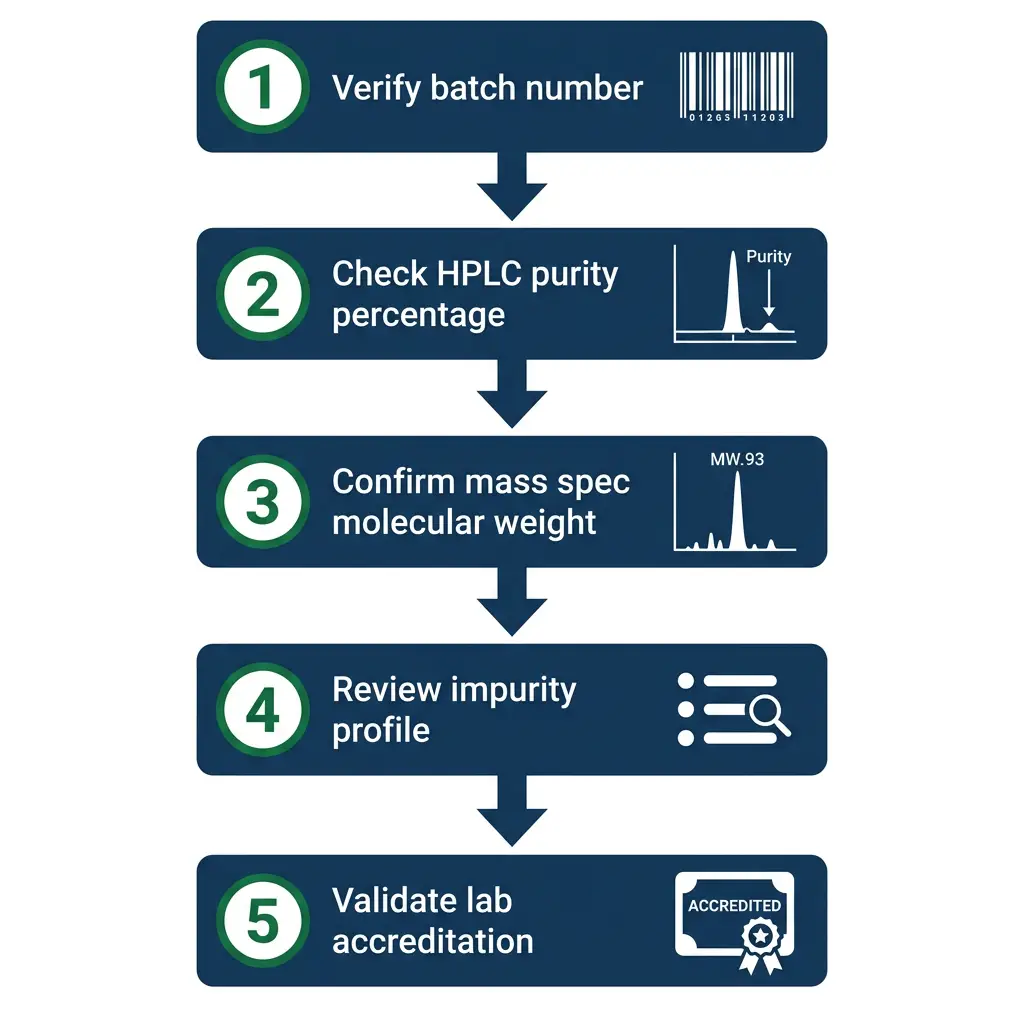
A batch-specific COA should be read like a release document. Even when third party testing data is present, you still need to match the vial, batch number, and numerical results before you rely on the purity line. Start with the administrative fields. Step 1 is matching the batch number on the vial or outer label to the batch number on the COA.
Step 2 is checking the release date so you know the document is tied to a defined production event rather than a recycled template. Step 3 is confirming the product identity and concentration or fill description match what was ordered. Countrywide Peptides makes CoAs publicly accessible, a practical control that lets labs review documentation before or after delivery.
Then move to the analytical section. Step 4 is reading which tests were performed, usually HPLC and mass spectrometry. Step 5 is checking whether acceptance limits and actual numerical results are shown. Step 6 is looking for chromatograms or other supporting outputs instead of relying on a one-line summary.
A practical check that many buyers skip is consistency between the summary and the raw-looking data. If the COA says very high purity but the chromatogram shows several obvious secondary peaks, pause and ask questions before the material enters your workflow.
💡 Key Takeaway: How should you review a batch-specific peptide COA step by step?
What should a peptide COA include to meet strong documentation standards?
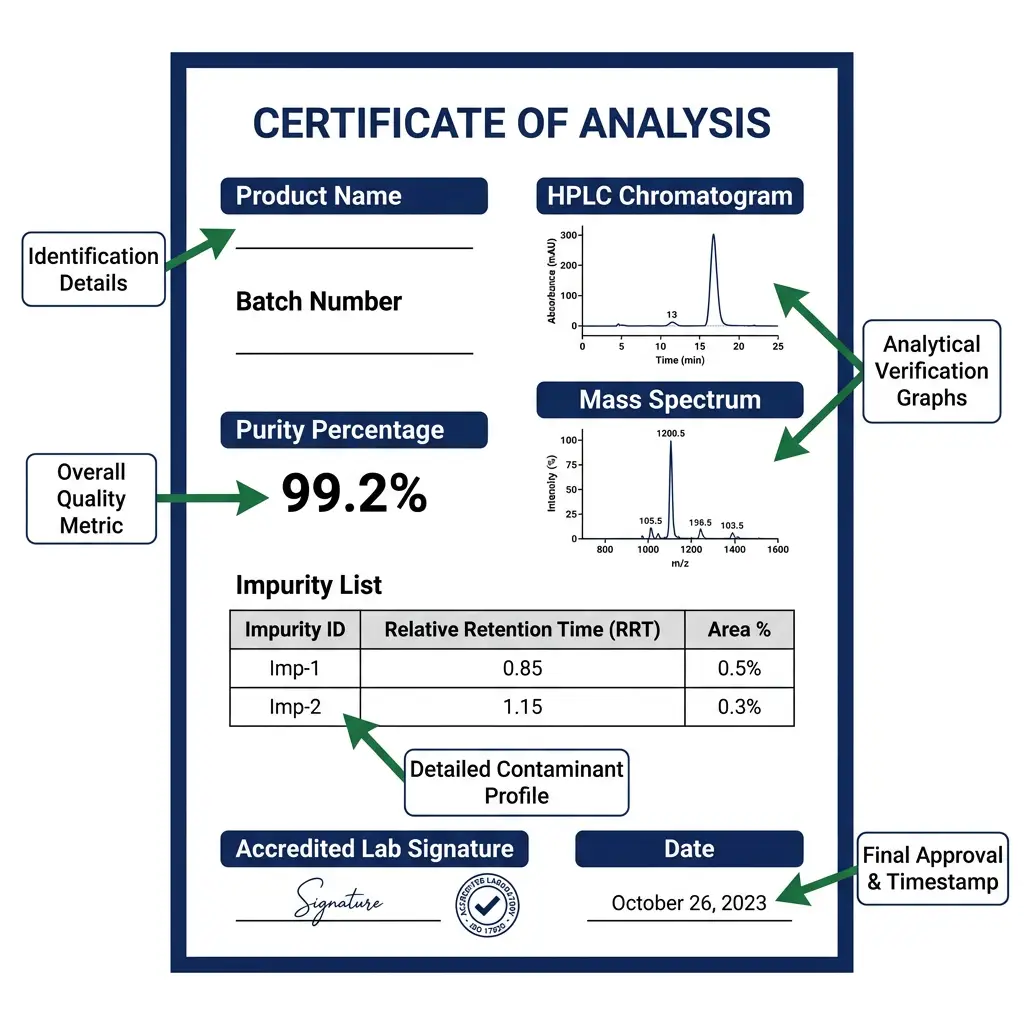
Strong peptide COAs look specific, not generic. When third party testing data is included, the document becomes easier to audit. FDA Q7A points to batch number, release date, tests performed, acceptance limits, and numerical results as core elements. For peptide testing, a useful COA should answer who made the batch, what was tested, how it was judged, and what the data showed.
A strong COA usually includes:
- Batch number: The lot identifier that ties the report to the physical material
- Release date: The date the batch was reviewed and released
- Tests performed: HPLC, mass spectrometry, and any other relevant analytical methods
- Acceptance limits: The specification or pass criteria used for release
- Numerical results: Actual values, percentages, or masses rather than “meets spec”
- Manufacturer details: Name and location of the producing or releasing entity
- Supporting data: Chromatograms, spectra, or peak tables when available
FDA Q7A is a strong benchmark for that structure even when a research peptide is not being released as a drug substance. The goal is not regulatory submission; the goal is an auditable record that supports your own lab’s quality expectations.
Which FDA guidance benchmarks apply to peptide COA documentation?
FDA Q7A and related analytical procedure guidance provide the most practical benchmark for peptide documentation quality. The core principle is that a COA should not be a one-line claim. It should be a release document with defined fields and numerical results. Peer-reviewed literature on peptide analytical methods reinforces the same point: documentation quality is a predictor of material consistency.
For synthetic peptides, FDA guidance also highlights the need for impurity characterization when the application is sensitive. That does not mean every research peptide needs a full regulatory dossier. It does mean that a buyer should expect the same documentation habits from a research supplier that a QC reviewer would expect in a more regulated setting.
When a vendor offers third party testing data, the COA becomes easier to trust because the analytical work is not self-reported. The independent lab result, the batch number, and the release date together create a traceable chain that can be checked before the peptide enters your experiment.
How does third party testing support research-use-only purchasing?
Research-use-only purchasing still benefits from drug-quality documentation habits. The material is not a finished pharmaceutical product, but the analytical questions are the same: what is it, how pure is it, and what else is present? Third party testing answers those questions with independent evidence rather than supplier assertion.
The safest approach is to treat peptide testing like a documentation problem and an analytical chemistry problem at the same time. A research lab that accepts a purity number without checking the batch-specific record is accepting a commercial claim as scientific data. That can compromise assay reproducibility.
Independent verification also helps when comparing suppliers. If two vendors both claim 99% purity, the one with accessible third party testing reports gives you something to audit. The other gives you only a label. For research procurement, that outside confirmation often becomes the deciding factor.
💡 Key Takeaway: How does third party testing support research-use-only purchasing?
What role do accredited labs play in peptide third party testing?
Accredited labs provide analytical independence. When a supplier sends a batch to an outside laboratory for HPLC and mass spectrometry, the result is not filtered through the supplier’s marketing department. That separation is the core value of third party testing.
Accreditation means the lab follows defined quality systems, equipment calibration, and documentation practices. The exact accreditation body may vary, but the principle is consistent: the analytical data should be reproducible and traceable. For a research buyer, an accredited lab report adds confidence that the purity number is not self-generated.
Countrywide Peptides pairs 99%+ purity standards with third party testing by accredited labs. That structure gives research buyers both a specification claim and an independent check. Internal QC still runs, but the outside data supports release decisions.
How can buyers compare peptide suppliers on documentation quality?
Documentation quality is a stronger differentiator than price. When multiple suppliers make similar purity claims, the practical question is whether you can download a batch-specific COA before purchase. If the document is hidden, the claim is harder to verify.
Use this comparison screen: Does the COA show the exact batch number? Does it include HPLC and mass spectrometry results? Are numerical values present? Is impurity data visible? Is the document accessible without a sales call? A “yes” to all five indicates a vendor that treats documentation as part of the product. Also confirm whether third party testing data comes from an accredited lab rather than an in-house summary.
For more on evaluating suppliers, see Peptide Suppliers USA: How to Choose a Trusted Source. That guide covers facility checks, documentation habits, and red flags that align with the same audit mindset described here.
What are common peptide purity misconceptions?
One misconception is that 99% purity means the sample contains 99% of the exact desired sequence. HPLC purity does not prove sequence identity. A peptide can elute as a single peak and still be a truncation or contain a deletion if the method cannot resolve it. Mass spectrometry helps catch that error.
Another misconception is that third party testing replaces all internal QC. It does not. Independent testing supports release confidence, but the supplier still needs process controls, stability checks, and in-process analytics. The two systems are complementary.
A third misconception is that a generic COA is acceptable. It is not. A report without a batch number or release date cannot be tied to the vial in your freezer. If the COA is not batch-specific, it is not a release document; it is a brochure.
💡 Key Takeaway: What are common peptide purity misconceptions?
What analytical methods go beyond routine HPLC and MS?
Routine HPLC with UV detection and a single mass check work for many research peptides. When impurity characterization has to go deeper, the method stack should expand. FDA guidance for synthetic peptides points to high-resolution approaches such as UHPLC-HRMS when detecting or characterizing peptide-related impurities becomes more demanding.
Additional methods may include amino acid analysis, peptide content determination, residual solvent testing, or counterion quantification. These are not always necessary for every application, but they become relevant when the peptide will be used in sensitive in vitro programs or when the impurity profile affects assay interpretation. But when a vendor provides third party testing data, the report should list which methods were run.
A buyer should ask which methods were actually run for the specific batch, not which methods the supplier offers in a brochure. The COA should list the tests performed and the results obtained. If low-level related impurities matter, request the chromatogram and peak table rather than accepting a summary line.
How should labs handle impurity profiles in synthetic peptides?
Impurity profile visibility is more useful than a single purity line. Third party testing data should make that visibility explicit rather than implied. A peptide can show 98% purity by HPLC and still contain a related impurity that interferes with a binding assay. The question is not just how much main peak is present, but what the secondary peaks are.
For synthetic peptides, truncated sequences, deletion products, oxidation products, and residual protecting groups are common impurity classes. Each can affect biological activity differently. A strong COA includes chromatograms, peak tables, or related impurity notes so the buyer can see what else is present.
When the application is sensitive, UHPLC-HRMS may be needed to separate and identify low-level related impurities. That is more demanding than routine HPLC, but it provides the kind of impurity visibility that supports reproducible research. The practical screen is simple: verify the batch number, read the chromatogram, check whether the COA is batch-specific, and confirm that impurity data is visible rather than implied.
What checklist should a lab use before accepting a peptide batch?
Use this pre-acceptance checklist for every peptide batch:
- [ ] Match the batch number on the vial to the COA
- [ ] Confirm the release date is tied to the current lot
- [ ] Verify product identity and fill description
- [ ] Read which analytical tests were performed
- [ ] Check that numerical results are present, not just “passes spec”
- [ ] Look at the chromatogram for secondary peaks
- [ ] Confirm third party testing data is available and independent
- [ ] Note any impurity visibility gaps
- [ ] Store the COA with the batch record for audit readiness
This checklist takes a few minutes and prevents downstream confusion. If any item is missing, ask the supplier before the material enters your workflow. The cost of a documentation gap is usually higher than the cost of asking.
💡 Key Takeaway: What checklist should a lab use before accepting a peptide batch?
Why is batch consistency important in peptide quality?
One clean result is useful, but repeatable impurity behavior across batches is a stronger signal. Third party testing across multiple batches is a stronger signal than a single in-house result. Peptide synthesis can vary from lot to lot, and a supplier that cannot discuss historical consistency may not have robust process controls.
Ask whether the vendor tracks impurity profiles over time and whether they can share summary data for multiple batches. If the answer is vague, treat that as a documentation gap. Historical consistency supports the idea that the next batch will behave like the last one.
For in vitro programs that compare peptides such as GHK-Cu and BPC-157, batch consistency matters because assay variability can be confused with biological differences. See GHK-Cu vs BPC-157 for In Vitro Programs: Planning Differences for planning guidance that assumes stable material quality.
How does Countrywide Peptides approach third party testing?
Countrywide Peptides states 99%+ purity standards and uses third party testing by accredited labs. The vendor also makes CoAs publicly accessible, which lets labs review documentation before or after delivery. That approach treats the COA as part of the product rather than an afterthought.
USA-registered facilities and filler-free formulations reduce ambiguity during vendor qualification. Clear synthesis disclosures add another layer of transparency. None of this replaces a buyer’s own verification, but it gives the buyer something concrete to audit.
The practical result is that a researcher can check the batch number, read the chromatogram, and confirm the analytical methods without waiting for a sales conversation. That is exactly the documentation habit described throughout this guide.
What should researchers document for audit readiness?
Audit readiness starts before the peptide arrives. Save the supplier’s COA, note the batch number in your lab notebook, and record the storage conditions. If a result looks unusual later, you need the batch-specific analytical record to troubleshoot.
Also document the independent testing status. If the supplier provided third party testing data, note the lab name and report date in your records. That creates a traceable chain from the vial back to the release data. For more on evidence boundaries and documentation, see Peptide Research Education: Evidence Boundaries & Documentation (2026).
A common failure is storing only the purity number and not the chromatogram or mass spectrum. The number is a summary; the raw-looking data is the evidence. Store both.
💡 Key Takeaway: What should researchers document for audit readiness?
How can peptide buyers avoid vendor qualification traps?
Vendor qualification traps usually involve documentation that is hard to obtain before checkout. A missing third party testing report is often the first sign that documentation will be hard to defend later. If the COA is hidden behind a sales call, it is often hard to defend later during audit review. That is a red flag, not a convenience issue.
Another trap is comparing suppliers on headline purity numbers without checking the method. A 99.9% claim from one vendor and a 99% claim from another are not directly comparable if the chromatographic methods differ. Ask for the method, the batch number, and the independent report.
For a worked example of how documentation habits differ across suppliers, see Nationwide Peptides Reviews | Countrywide Peptides. The same audit questions apply whether you are evaluating a new vendor or reviewing an existing one.
What does FDA Q7A say about COA content for research peptides?
FDA Q7A describes good manufacturing practice for active pharmaceutical ingredients, but its COA elements are useful for research peptides even when the material is not a drug substance. When third party testing data is layered on top, the COA becomes a true release record rather than a summary. The core fields are batch number, release date, tests performed, acceptance limits, and numerical results.
A research peptide COA that includes those fields is more useful than one that only says “99% pure.” The batch number ties the document to the physical vial. The release date shows the batch was reviewed. The tests performed and numerical results show what was actually measured.
FDA guidance documents reinforce the same principle for analytical procedures and methods validation. The point for a research buyer is not regulatory compliance; it is documentation quality that can be audited later.
Which peptide quality metrics matter most for in vitro programs?
For in vitro programs, the most important metrics are identity, purity, impurity profile, and batch consistency. Third party testing supports all four metrics with independent evidence. Identity confirms the peptide is what the supplier says it is. Purity estimates how much of the sample is the main component. Impurity profile shows what else is present. Batch consistency predicts whether the next lot will behave similarly.
HPLC and mass spectrometry together cover the first two metrics. Impurity profile requires reading the chromatogram and asking about related impurities. Batch consistency requires historical data, not just one COA.
If the program is sensitive, UHPLC-HRMS may be needed to characterize low-level related impurities. That is not always necessary, but it becomes relevant when impurity effects can be confused with biological differences.
💡 Key Takeaway: Which peptide quality metrics matter most for in vitro programs?
FAQ
What is third party testing in peptide quality?
Third party testing means an independent accredited laboratory performs the analytical work and reports results separately from the supplier’s marketing claim. It provides an auditable check on purity, identity, and impurity visibility.
How many times should a buyer verify the batch number?
Verify the batch number at least three times: on the vial, on the outer label, and on the COA. All three must match before the peptide enters your workflow.
Is a high purity number enough without a COA?
No. A purity percentage without batch-specific HPLC and mass spectrometry data is a label, not evidence. The COA should show numerical results and the analytical methods used.
What is the difference between HPLC and mass spectrometry?
HPLC estimates purity by separating peaks, while mass spectrometry confirms whether the major component has the expected molecular mass. They answer different quality questions and should be used together.
Where can I find Countrywide Peptides COA documents?
Countrywide Peptides makes CoAs publicly accessible, so you can review documentation before or after delivery. Check the product page or contact the vendor for batch-specific reports.
Ready to Take the Next Step?
Every product includes lot-specific documentation and third-party purity testing.
Explore Our Research Products →Free shipping on qualifying orders · Batch COA on request