
8 Weight Loss Peptides Researchers Compare in 2026
Weight loss peptides researchers compare in 2026 include tirzepatide, semaglutide, and liraglutide. See 8 dose-specific benchmarks, trial anchors, and documentation criteria.
📋 Table of Contents
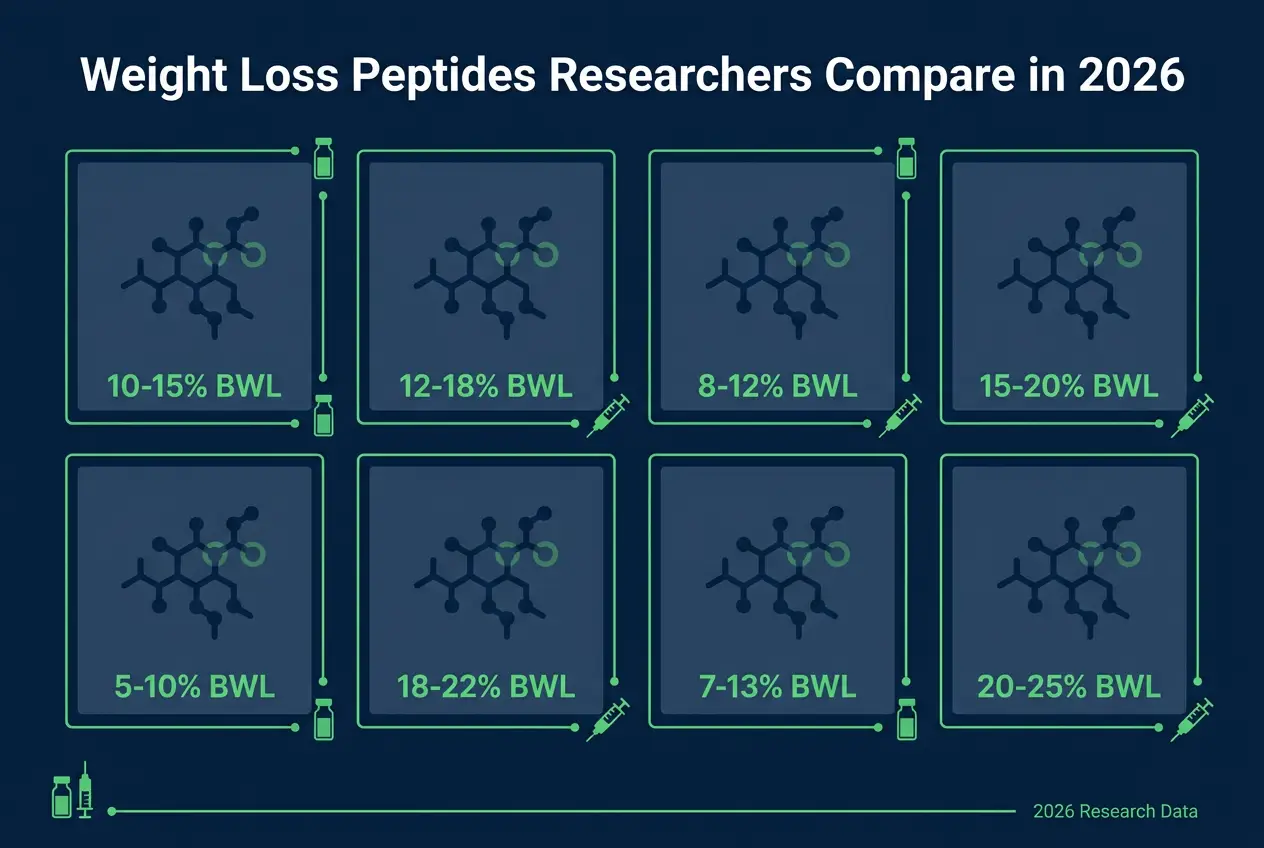
Researchers comparing weight loss peptides in 2026 most often benchmark tirzepatide, semaglutide, and liraglutide because these three have the clearest human obesity trial anchors and regulatory labeling in the available evidence. Tirzepatide shows the highest average body-weight loss signal at 20.9% after a 36-week open-label lead-in, semaglutide 2.4 mg produced 14.9% mean loss at week 68 in STEP 1, and liraglutide 3 mg offers a defined 16-week nonresponse checkpoint of less than 4% baseline weight loss.
Key takeaways
- Tirzepatide, semaglutide, and liraglutide are the three weight loss peptides with the most complete 2026 comparison anchors in the sourced obesity trials.
- Semaglutide 2.4 mg delivered a mean body-weight loss of 14.9% at week 68 in STEP 1, while Wegovy Study 6 reported 13.2% versus 2.1% for placebo.
- Tirzepatide’s 20.9% average loss after a 36-week open-label lead-in is the highest signal, but different study designs prevent direct head-to-head ranking.
- Liraglutide remains valuable because Saxenda defines a practical 4% baseline weight loss threshold at 16 weeks for stopping treatment.
- Research procurement should prioritize lot-level Certificates of Analysis, third-party purity testing, and explicit research-use-only labeling.

What are the 8 weight loss peptides researchers compare in 2026?
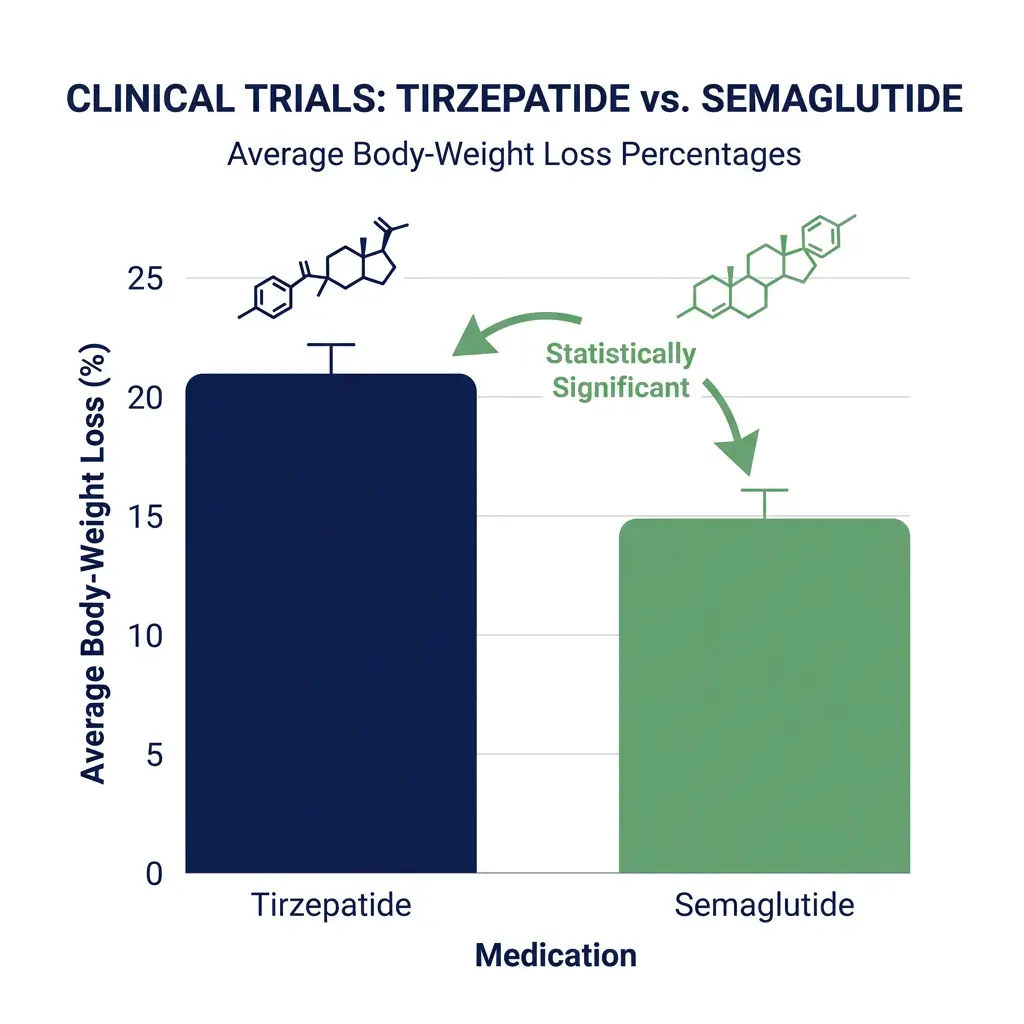
The eight weight loss peptides benchmarks that appear most often in 2026 research comparisons are not eight distinct molecules but eight dose-and-endpoint anchors drawn from tirzepatide, semaglutide, liraglutide, and placebo controls. That distinction prevents a common mistake: comparing molecule names without matching dose, duration, responder thresholds, or study population.
| Benchmark | Dose/Protocol | Key Efficacy Anchor | Why It Matters |
|—|—|—|—|
| Tirzepatide 15 mg weekly | Highest-dose weekly benchmark in SURMOUNT-style obesity comparisons | 20.9% average body-weight loss after 36-week open-label lead-in in ZEPBOUND obesity study | Upper bound for dose-response interpretation |
| Tirzepatide 10 mg weekly | Mid-dose weekly reference for dose-response review | Part of SURMOUNT-1 72-week trial with 20-week dose-escalation period | Middle exposure anchor |
| Tirzepatide 5 mg weekly | Lower-dose anchor within the same 72-week trial framework | Same trial structure as 10 mg and 15 mg | Lower bound for dose-response interpretation |
| Semaglutide 2.4 mg weekly in STEP 1 | Classic 68-week GLP-1 obesity benchmark with structured lifestyle intervention | Mean body-weight change -14.9% versus -2.4% placebo; 1,961 adults without diabetes | Strong randomized parallel comparison |
| Semaglutide 2.4 mg weekly in Wegovy Study 6 | Label-based benchmark with 13.2% mean loss at week 68 | Responder rates: 84.0% lost ≥5%, 59.9% lost ≥10%, 38.2% lost ≥15% | Depth of response data |
| Semaglutide in cardiovascular-risk populations | Unique benchmark because of Wegovy’s added 2024 FDA indication | Indication to reduce cardiovascular death, heart attack, and stroke risk in adults with cardiovascular disease plus obesity or overweight | Cardiometabolic outcome positioning |
| Liraglutide 3 mg daily | Daily GLP-1 comparator with a specific 16-week discontinuation rule | Stop if less than 4% baseline body weight loss after 16 weeks | Practical nonresponse checkpoint |
| Placebo plus lifestyle intervention | Necessary control, since lifestyle arms still produce measurable weight change | STEP 1 placebo arm lost -2.4% at week 68 | Baseline for net treatment effect |
If a dataset omits one of those anchors, the comparison usually becomes less useful. The benchmark list is not there to make the table longer. It is there to keep mechanism, dose, and endpoint from getting blurred together.
How do tirzepatide and semaglutide compare as weight loss peptides on average body-weight loss?
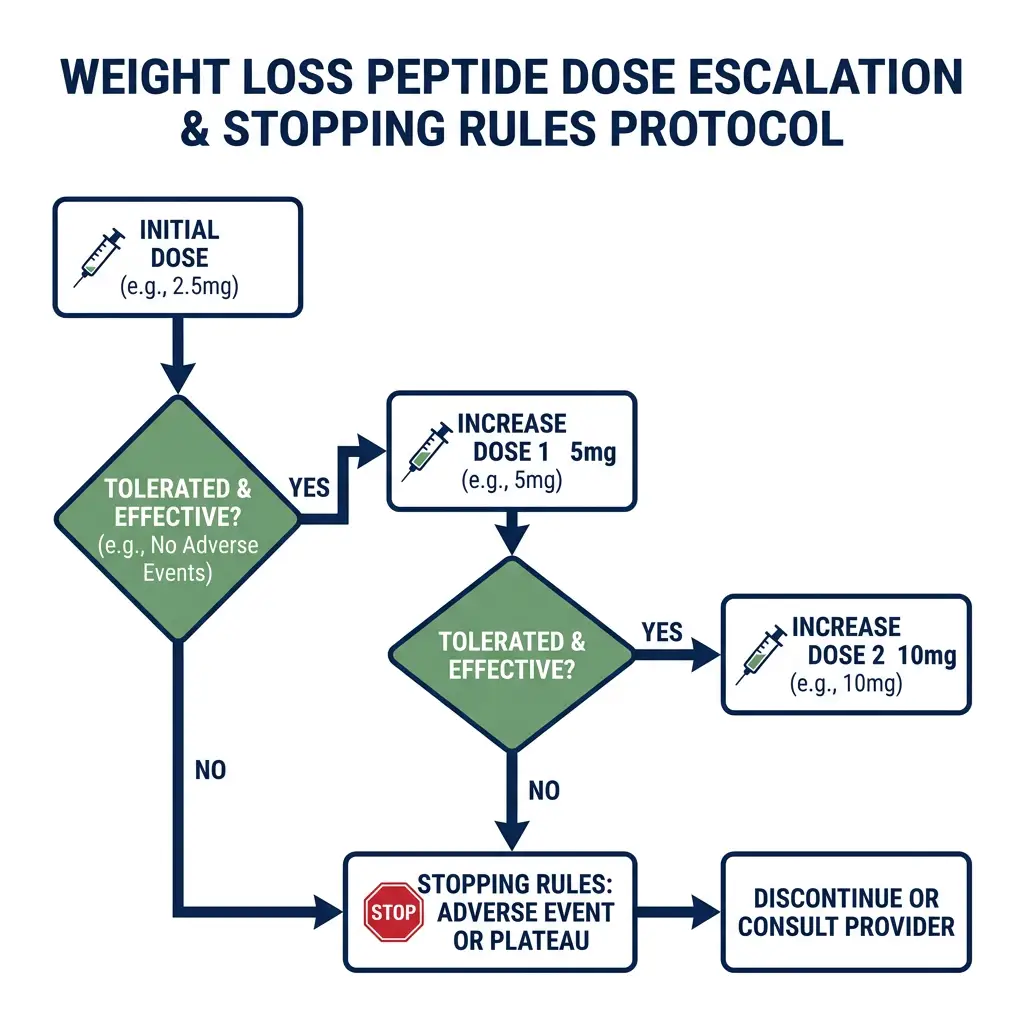
When comparing weight loss peptides, tirzepatide and semaglutide both deliver double-digit weight loss in the sourced studies, but tirzepatide shows the highest efficacy signal and semaglutide shows the deepest body of published obesity and cardiovascular data.
Semaglutide 2.4 mg has clear numbers that are easy to benchmark. In STEP 1, 1,961 adults without diabetes were randomized to semaglutide 2.4 mg or placebo plus lifestyle intervention for 68 weeks. Semaglutide produced a mean body-weight change of -14.9% versus -2.4% with placebo. The protocol also mattered: STEP 1 used a 500-kcal/day deficit diet and encouraged 150 minutes per week of physical activity. Researchers can locate the STEP 1 trial record on PubMed.
Tirzepatide’s signal is stronger in the supplied comparison set, but the study structure is different enough that careless ranking can mislead. The ZEPBOUND label reports an average body-weight loss of 20.9% after a 36-week open-label lead-in period in the obesity study. Continued treatment from week 36 to week 88 reduced body weight significantly more than placebo. Pro tip: if one result comes from an open-label lead-in and another from a randomized parallel comparison at week 68, treat them as adjacent evidence, not as a clean head-to-head.
Countrywide Peptides targets 99%+ purity standards and provides a publicly accessible Certificate of Analysis for every peptide, which mirrors the kind of documentation discipline researchers should expect before making efficacy comparisons. For a broader search of tirzepatide obesity trials, see PubMed.

💡 Key Takeaway: How do tirzepatide and semaglutide compare as weight loss peptides on average body-weight loss?
Why does liraglutide remain a useful weight loss peptide benchmark in 2026?
Among older weight loss peptides, liraglutide still matters because Saxenda offers a clear GLP-1 benchmark, daily dosing, and a defined 16-week response checkpoint even though average weight loss is lower than semaglutide or tirzepatide.
In research design, lower efficacy does not mean lower value. Liraglutide is useful when the aim is to compare daily versus weekly exposure, test GLP-1 receptor agonist class effects, or model an early responder versus nonresponder framework. That last point is especially important because the 4% at 16 weeks stopping rule can be operationalized in study planning.
A common misconception is that newer efficacy leaders automatically erase older comparators. They do not. When a field moves fast, older agents often become better controls because their dosing, discontinuation logic, and class identity are well defined.
How should researchers compare dose escalation and stopping rules for weight loss peptides?
Mapping titration for weight loss peptides requires comparing dose escalation and stopping rules in sequence because tirzepatide, semaglutide, and liraglutide do not reach maintenance exposure in the same way.
Step 1 is to map titration before comparing outcomes. SURMOUNT-1 used once-weekly tirzepatide 5 mg, 10 mg, or 15 mg over 72 weeks, including a 20-week dose-escalation period. Saxenda’s adult dose, by contrast, is titrated from 0.6 mg daily to 3 mg daily over five weeks.
Step 2 is to separate escalation logic from efficacy logic. A longer escalation period can improve tolerability interpretation, but it also changes when full dose exposure really starts. If two studies use different titration timelines, then matching them only by final week can hide meaningful differences in exposure.
Step 3 is to give special weight to explicit stopping rules. SAXENDA states that adults should stop treatment if they have not lost at least 4% of baseline body weight after 16 weeks. That is more than a label detail. It gives researchers a practical nonresponse checkpoint that semaglutide and tirzepatide discussions do not always express as plainly.
What measurable attributes should a research-grade weight loss peptide product provide?
For research procurement, the useful screening criteria are lot-level CoAs, third-party testing, purity standards, formulation transparency, and whether the peptide is sold as research-use-only rather than confused with an FDA-approved prescription product. When comparing weight loss peptides across suppliers, missing CoAs or vague purity claims are red flags.
Countrywide Peptides targets 99%+ purity standards and provides a publicly accessible Certificate of Analysis for every peptide. That documentation practice allows researchers to verify identity, purity, and residual solvent data before running comparative assays. For more on selecting vendors, see Peptide Suppliers USA: How to Choose a Trusted Source.
A strong review asks four questions first: which molecule, at what dose, in which population, and measured at which time point. That makes 2026 comparisons less about hype and more about fit. A related evidence review is available at Peptide Research Education: Evidence Boundaries & Documentation (2026).

💡 Key Takeaway: What measurable attributes should a research-grade weight loss peptide product provide?
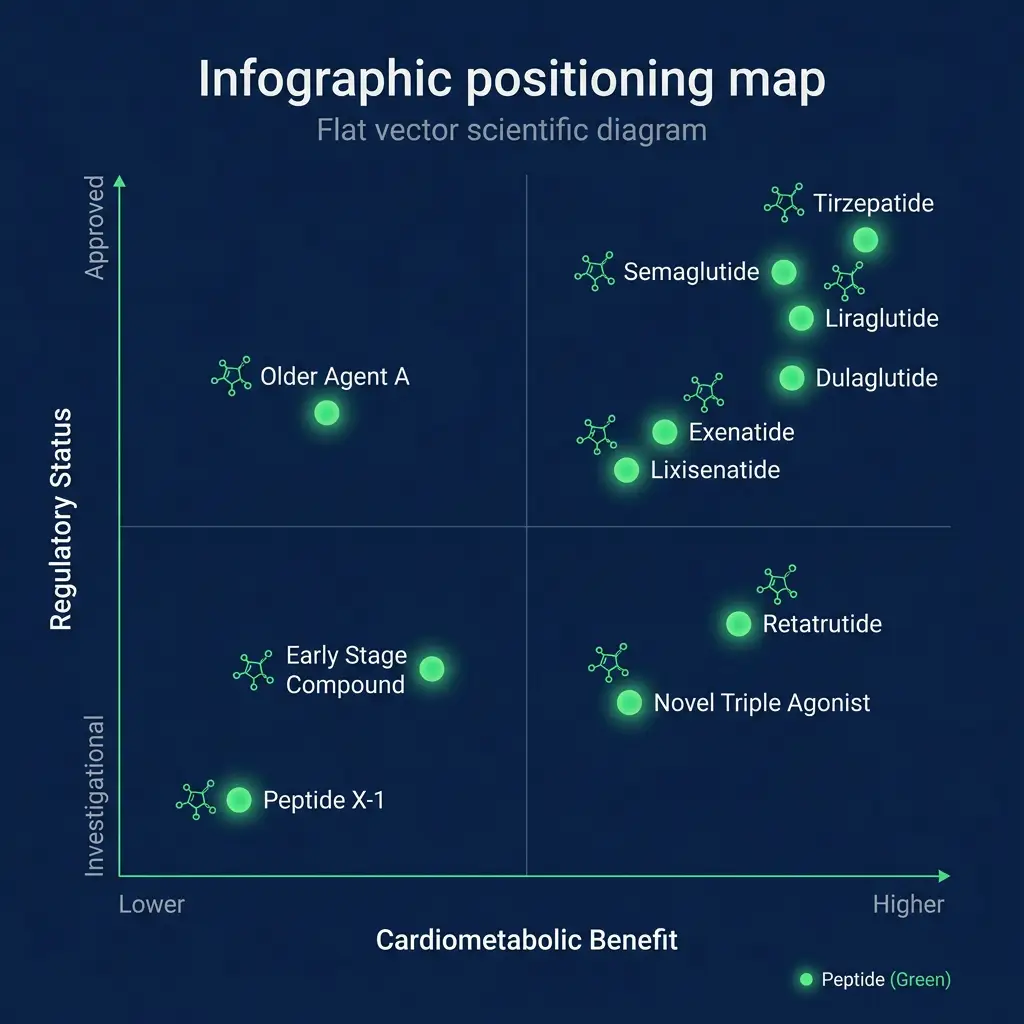
Which weight loss peptides have unique cardiometabolic or regulatory positioning?
Not all weight loss peptides have the same regulatory history. Semaglutide has a distinct regulatory advantage in cardiometabolic research because Wegovy gained a 2024 FDA indication to reduce cardiovascular death, heart attack, and stroke risk in adults with cardiovascular disease plus obesity or overweight. FDA cited major adverse cardiovascular event reduction in the supporting data.
Tirzepatide’s positioning is strongest for average weight loss magnitude in the sourced obesity studies, but the open-label lead-in design requires careful language. Liraglutide’s positioning is strongest for early response classification because the 4% at 16 weeks rule creates a clean yes/no checkpoint.
When researchers compare weight loss peptides across regulatory status, the key distinction is between FDA-approved prescription products and research-grade peptides sold for in vitro or pre-clinical use. Research-grade peptides should be evaluated as laboratory inputs, not presented as interchangeable with approved human therapies. For a vendor comparison, see National Science Labs Peptides vs. Countrywide Peptides.
How can researchers avoid common comparison errors with weight loss peptides?
Researchers new to weight loss peptides often skip design-level scrutiny. The most common comparison error is treating different trial designs as direct head-to-head proof. For example, tirzepatide’s 20.9% average loss comes from a 36-week open-label lead-in, while semaglutide’s 14.9% comes from a 68-week randomized parallel comparison. Those are adjacent evidence, not identical benchmarks.
A second error is ignoring dose and titration. Matching final week only can hide differences in exposure. A third error is omitting placebo or lifestyle arms, which still produce measurable weight change. A fourth error is using research-grade peptide purity claims as a proxy for clinical efficacy, which they are not.
To avoid these errors, build an eight-point benchmark sheet with dose, duration, responder thresholds, and population. Then compare like with like.
What documentation practices support reliable weight loss peptides research procurement?
Reliable weight loss peptides procurement starts with lot-level Certificates of Analysis, not marketing language. Countrywide Peptides publishes a CoA for every peptide and targets 99%+ purity standards, which allows independent verification before purchase. Third-party testing data adds another layer of confidence.
Formulation transparency matters because peptide salts, fillers, and lyophilization conditions can affect reconstitution and assay results. Storage conditions should also be explicit. For research-use-only peptides, documentation should state that the product is not for human consumption and is intended for in vitro or pre-clinical use only. For additional vendor review context, see Nationwide Peptides Reviews | Countrywide Peptides.

💡 Key Takeaway: What documentation practices support reliable weight loss peptides research procurement?
FAQ
What are the main weight loss peptides researchers compare in 2026?
The main weight loss peptides researchers compare in 2026 are tirzepatide, semaglutide, and liraglutide. Tirzepatide shows the highest average body-weight loss signal at 20.9% after a 36-week open-label lead-in, semaglutide 2.4 mg produced 14.9% mean loss at week 68 in STEP 1, and liraglutide 3 mg provides a 16-week nonresponse checkpoint of less than 4% baseline weight loss.
Which weight loss peptides have the strongest published obesity trial data?
Among weight loss peptides, semaglutide has the deepest body of published obesity and cardiovascular data. STEP 1 randomized 1,961 adults without diabetes and reported -14.9% mean body-weight change versus -2.4% placebo at week 68. Wegovy Study 6 reported 13.2% versus 2.1% at week 68, with responder rates of 84.0% ≥5%, 59.9% ≥10%, and 38.2% ≥15%.
Why is liraglutide still included in 2026 weight loss peptides comparisons?
Liraglutide remains included in 2026 weight loss peptides comparisons because Saxenda offers a defined 16-week stopping rule: adults should discontinue if they have not lost at least 4% of baseline body weight after 16 weeks. That nonresponse checkpoint is operationally useful even though average weight loss is lower than semaglutide or tirzepatide.
How should researchers evaluate research-grade weight loss peptides suppliers?
Researchers evaluating weight loss peptides suppliers should prioritize lot-level Certificates of Analysis, third-party testing, purity standards, formulation transparency, and explicit research-use-only labeling. Countrywide Peptides targets 99%+ purity standards and provides a publicly accessible CoA for every peptide.
What trial design differences matter most when comparing weight loss peptides?
When comparing weight loss peptides, the most important trial design differences are open-label lead-in versus randomized parallel comparison, dose escalation length, stopping rules, and inclusion of placebo or lifestyle arms. For example, tirzepatide’s 20.9% average loss follows a 36-week open-label lead-in, while semaglutide’s 14.9% comes from a 68-week randomized parallel comparison.
Ready to Take the Next Step?
Every product includes lot-specific documentation and third-party purity testing.
Explore Our Research Products →Free shipping on qualifying orders · Batch COA on request