

Your Ultimate Retatrutide Peptide Research Guide: GLP Pathways, Structure & Scientific Studies
Retatrutide peptide research guide covers GLP pathways, structure, LC-MS/RP-HPLC verification, and 2026 sourcing standards for in vitro research use only.
📋 Table of Contents
Retatrutide is an engineered synthetic peptide studied in molecular biology for its amino acid sequence, GLP-related receptor pathway models, and analytical identity. This retatrutide peptide research guide answers how laboratories confirm Retatrutide identity through LC-MS verification and RP-HPLC analysis, using measurable mass, purity, and retention time as research attributes. All information is for in vitro laboratory research only; the compound is not for human or veterinary use, and no dosing information is provided.
Research use only: The products discussed are sold strictly for in vitro laboratory research purposes. They are not for human use, not for veterinary use, and not intended to diagnose, treat, cure, or prevent any disease. Must be 21+ to purchase.
Key takeaways
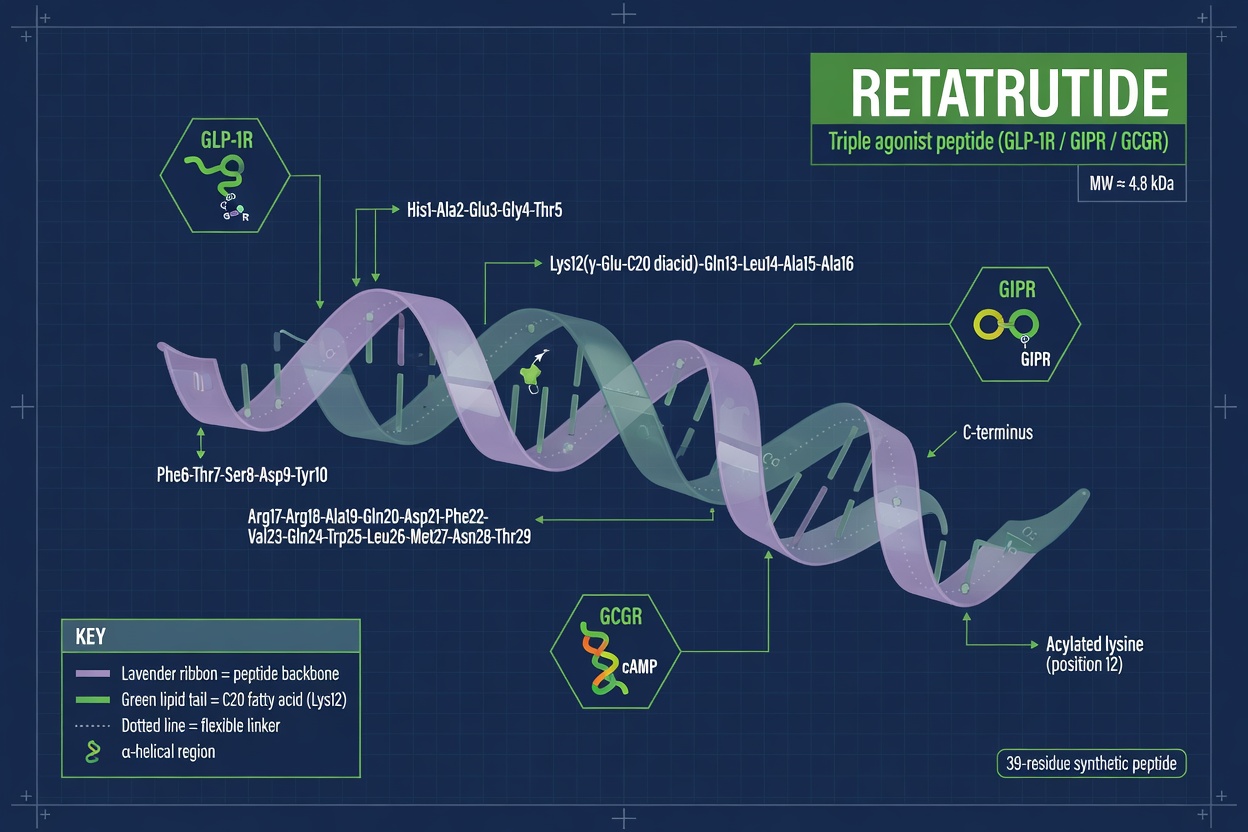
- Retatrutide is an engineered synthetic peptide within the GLP-related peptide research family, studied for molecular structure and receptor interaction models.
- This retatrutide peptide research guide emphasizes analytical characterization—LC-MS and RP-HPLC—as the foundation for peptide identity verification.
- Researchers compare Retatrutide vs Tirzepatide to evaluate structural differences and peptide engineering approaches, not clinical outcomes.
- GLP pathway research includes GLP-1S Peptide and GLP-2T Peptide as related study subjects, alongside Retatrutide’s multi-pathway peptide models.
- All statements in this retatrutide peptide research guide are research-use only; no therapeutic claims, no human dosing, no medical application.
What Is Retatrutide Peptide?
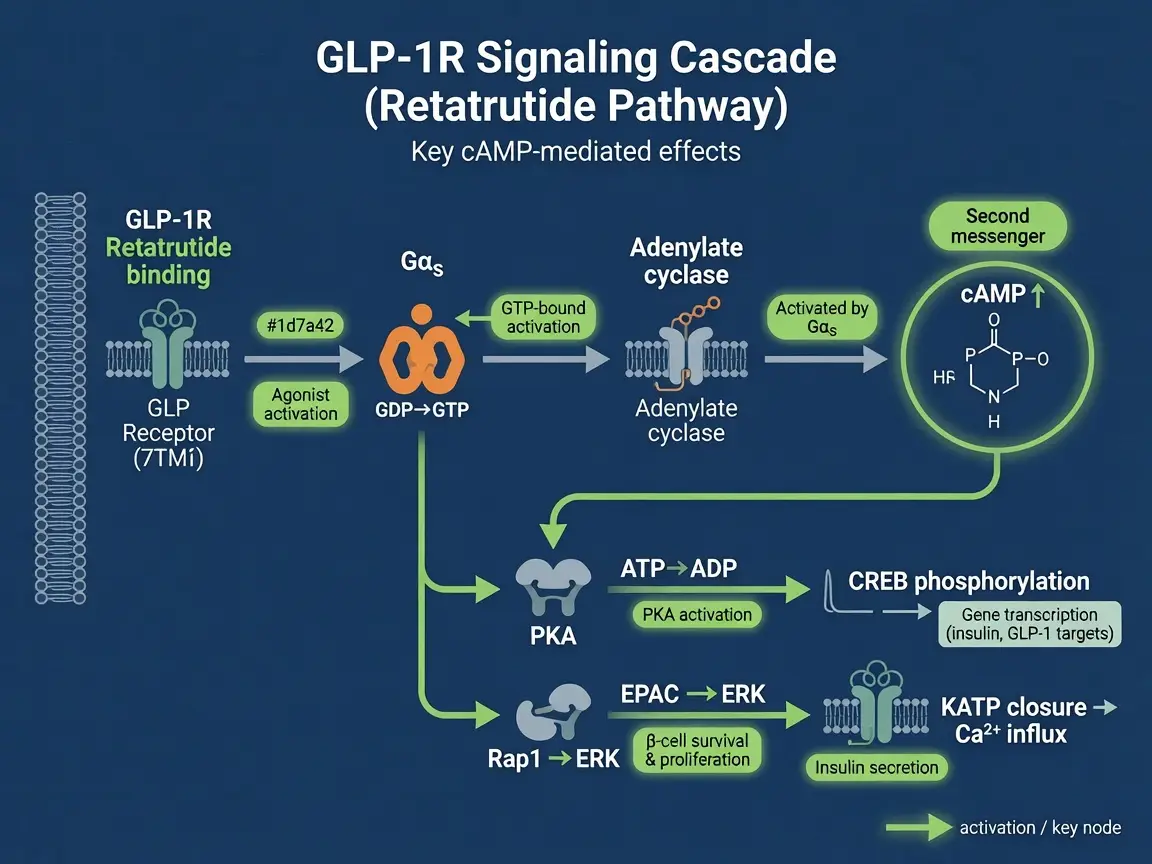
Retatrutide is a synthetic research peptide studied within molecular biology and peptide science for its engineered structure, receptor pathway research, and amino acid sequence characteristics. This retatrutide peptide research guide outlines how scientists investigate molecular interactions, peptide architecture, and experimental research models using analytical chemistry, computational modeling, and laboratory-based characterization methods.
Researchers examining Retatrutide study its molecular properties through LC-MS verification, RP-HPLC analysis, and amino acid sequence profiling. The compound is not a therapeutic product; all references to Retatrutide in this retatrutide peptide research guide concern laboratory research applications only. Engineered peptides are studied to understand how amino acid sequence modifications influence molecular structure, receptor research models, and peptide characteristics within controlled scientific environments.
For laboratories, the central question is not clinical effect but structural identity. This retatrutide peptide research guide therefore frames Retatrutide as an analytical subject: a defined amino acid sequence with measurable mass, purity, and retention time. Researchers use these parameters to confirm that a given sample matches the expected engineered peptide, independent of any biological interpretation.
Retatrutide’s synthetic origin means it does not occur naturally in biological systems. Instead, its sequence is designed for controlled investigation of peptide architecture and receptor pathway interactions. Analytical characterization supplies the evidence chain linking a physical sample to its documented sequence, which is why this retatrutide peptide research guide places LC-MS and RP-HPLC data at the center of laboratory evaluation.
How Is Retatrutide Classified by Structure and Peptide Type?
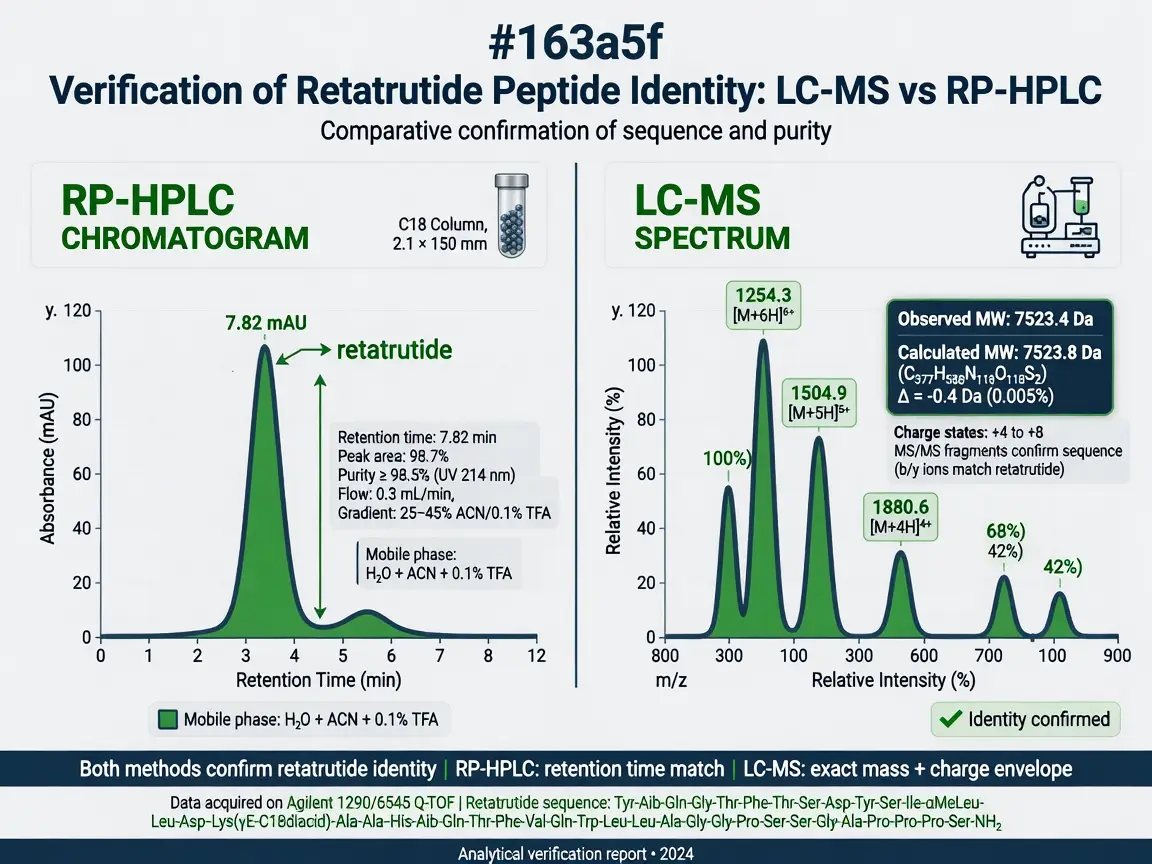
The molecular structure of Retatrutide is a major focus in peptide chemistry research. Scientists analyze amino acid sequences, structural arrangements, and molecular interactions to better understand peptide design principles. This retatrutide peptide research guide classifies Retatrutide as an engineered synthetic peptide within the GLP-related peptide research family.
| Scientific Feature | Retatrutide Research Profile |
|—|—|
| Research Compound | Retatrutide Peptide |
| Research Category | Engineered Synthetic Peptide |
| Scientific Area | GLP-Related Molecular Research |
| Primary Study Focus | Peptide Structure and Receptor Pathway Models |
| Analytical Methods | LC-MS / RP-HPLC Characterization |
The peptide is classified as an engineered peptide research compound within the GLP-related peptide research family. Its study approach centers on molecular characterization and analytical testing, not on clinical or therapeutic evaluation. This retatrutide peptide research guide uses structural classification to distinguish Retatrutide from naturally occurring peptides and other synthetic research compounds.
Structural classification depends on measurable parameters rather than biological effect. Researchers record molecular mass, amino acid sequence coverage, and chromatographic retention time as identity markers. Purity data from RP-HPLC typically forms part of a certificate of analysis, while LC-MS confirms the expected monoisotopic mass. These laboratory attributes define the peptide type far more rigorously than any commercial name.
Because Retatrutide is synthetic, its sequence can be engineered to include specific motifs relevant to multi-pathway receptor research. The GLP-related peptide family provides a comparative framework for evaluating how structural changes alter binding-model behavior in vitro. This retatrutide peptide research guide therefore treats classification as a laboratory definition, not a therapeutic category.
| Classification Parameter | Research Significance |
|—|—|
| Amino acid sequence | Defines primary structure and expected mass |
| Synthetic origin | Distinguishes from naturally occurring peptides |
| Receptor family context | Places peptide within GLP-related research models |
| Analytical profile | LC-MS mass and RP-HPLC purity confirm identity |
💡 Key Takeaway: How Is Retatrutide Classified by Structure and Peptide Type?
Why Is GLP Pathway Research Relevant to Retatrutide?
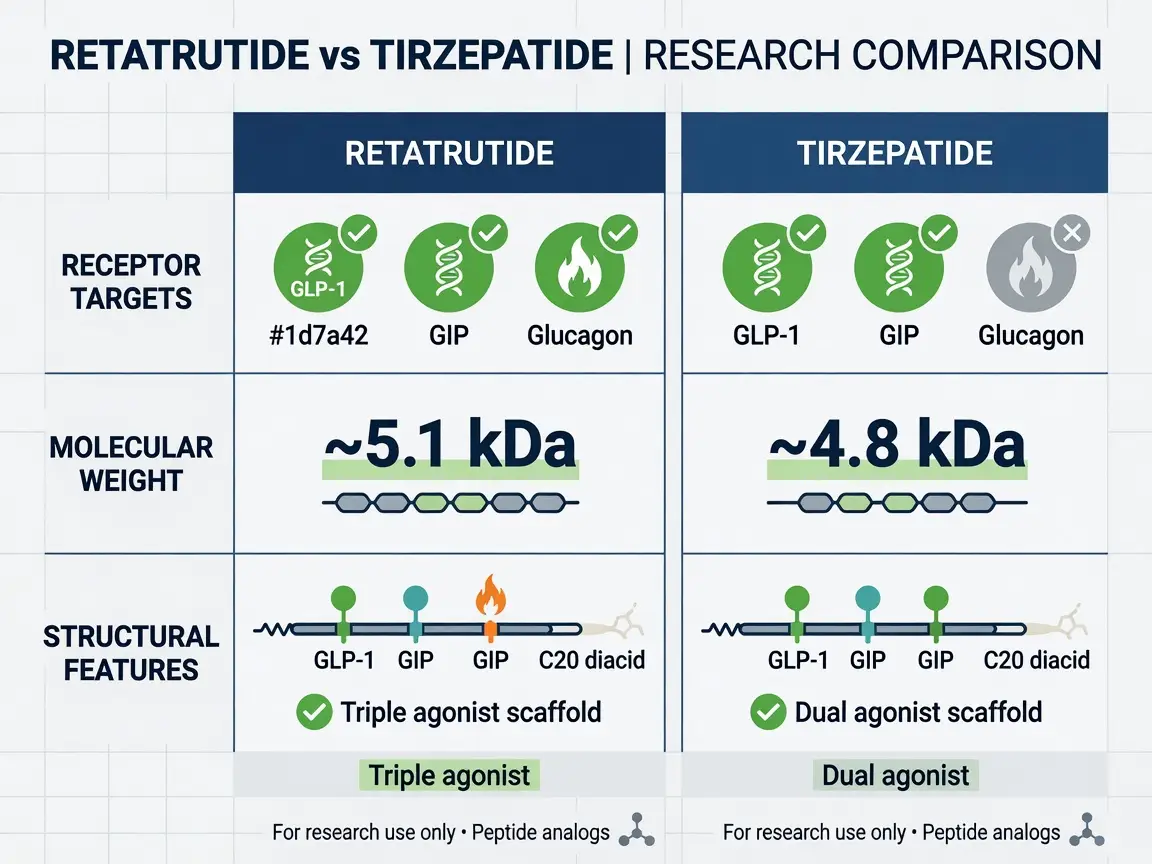
GLP-related peptide research explores molecular pathways, receptor biology models, and peptide interactions. Scientists investigate these systems to understand relationships between peptide structures and biological research mechanisms. This retatrutide peptide research guide places Retatrutide within this broader scientific field alongside other GLP-related peptide investigations.
| Research Area | Scientific Focus |
|—|—|
| GLP Pathway Studies | Molecular signaling research models |
| Peptide Engineering | Structure and sequence investigation |
| Receptor Research | Analysis of molecular interactions |
| Computational Biology | Peptide modeling and prediction studies |
GLP-related peptide research includes multiple scientific areas involving engineered peptide structures and molecular pathway investigations. Topics such as GLP-1S Peptide and GLP-2T Peptide are studied within broader peptide research frameworks. Researchers compare GLP-related peptide systems to understand differences in molecular structure, sequence characteristics, and experimental research pathways. This retatrutide peptide research guide highlights GLP pathway relevance as a way to contextualize Retatrutide’s multi-pathway peptide models.
From a laboratory perspective, GLP pathway studies are not about disease treatment but about receptor-ligand interaction mapping. Retatrutide’s engineered sequence offers a model for observing how multiple pathway motifs can be combined in one peptide. This retatrutide peptide research guide therefore links GLP relevance to structure-function questions, not to physiological claims.
In vitro binding assays and computational docking studies are common tools in this research area. They help researchers evaluate whether engineered sequence changes alter predicted receptor interaction surfaces. All such work remains within analytical and modeling frameworks; no conclusions about human biology are drawn from this retatrutide peptide research guide.
How Does Retatrutide Compare to Tirzepatide in Research?
The comparison between Retatrutide vs Tirzepatide is a growing topic within peptide research because both compounds are studied in relation to engineered peptide structures and receptor pathway models. Scientific comparisons focus on molecular architecture, peptide design approaches, and structural differences rather than direct biological outcomes or clinical efficacy. This retatrutide peptide research guide provides a comparative framework for laboratory researchers.
| Research Feature | Retatrutide Research | Tirzepatide Research |
|—|—|—|
| Peptide Category | Engineered peptide research | Engineered peptide research |
| Scientific Focus | Multi-pathway peptide models | GLP-related pathway models |
| Study Approach | Molecular characterization | Molecular characterization |
| Analysis Methods | LC-MS / RP-HPLC | LC-MS / RP-HPLC |
This comparative framework helps researchers evaluate how different engineered peptide sequences and structural modifications relate to receptor research models, without implying any human-use comparison. For peer-reviewed context on GLP receptor co-agonism, see Tirzepatide versus Semaglutide Once Weekly in Patients with Type 2 Diabetes. The same study is indexed on PubMed for laboratory reference.
Both peptides share a GLP-related research context, but Retatrutide is studied as a multi-pathway peptide model while Tirzepatide is examined primarily through GLP-related pathway models. Analytical characterization remains identical in principle: LC-MS confirms mass and sequence coverage, and RP-HPLC documents purity and retention time. This retatrutide peptide research guide keeps the comparison structural rather than clinical.
Which Analytical Methods Verify Retatrutide Peptide Identity?
Analytical verification is the foundation of any retatrutide peptide research guide. Laboratories confirm Retatrutide identity through two complementary methods: LC-MS verification and RP-HPLC analysis. These techniques produce measurable data—molecular mass, purity percentage, and retention time—that define the peptide as an analytical subject.
LC-MS verification in this retatrutide peptide research guide
LC-MS couples liquid chromatography with mass spectrometry to separate peptide components and measure their mass-to-charge ratios. For Retatrutide, researchers compare the observed monoisotopic mass against the theoretical mass calculated from the amino acid sequence. A match within a narrow tolerance—commonly ±0.5 Da for research peptides—supports identity. This retatrutide peptide research guide treats mass confirmation as a non-negotiable first step.
RP-HPLC purity thresholds in this retatrutide peptide research guide
RP-HPLC separates peptides by hydrophobicity and quantifies the main peak area as a percentage of total chromatographic signal. Many research laboratories set a purity acceptance threshold of ≥95% by HPLC for engineered peptides, though exact thresholds vary by protocol. Retention time reproducibility across runs also helps confirm batch consistency. COA availability allows researchers to review the actual chromatogram and purity report before accepting a sample.
COA and storage documentation in this retatrutide peptide research guide
A certificate of analysis should include batch number, peptide mass, HPLC purity, and storage recommendations. Lyophilized peptides are typically stored at -20°C in a desiccated environment to maintain analytical integrity, while reconstituted peptides require laboratory-defined short-term storage protocols. This retatrutide peptide research guide does not provide reconstitution or dosing instructions for any use outside in vitro experimentation.
| Analytical Method | Measurable Parameter | Research Verification Role |
|—|—|—|
| LC-MS | Monoisotopic mass | Confirms sequence-based mass |
| RP-HPLC | Purity percentage, retention time | Confirms purity and batch consistency |
| COA review | Documented mass, purity, storage conditions | Provides third-party analytical record |
💡 Key Takeaway: Which Analytical Methods Verify Retatrutide Peptide Identity?
What Is the Future Direction of GLP Peptide Research?
Future GLP peptide research is moving toward more precise structural modeling and computational prediction of peptide-receptor interactions. This retatrutide peptide research guide identifies several laboratory trends: multi-pathway peptide engineering, improved LC-MS/MS sequence coverage, and machine-learning models for peptide stability prediction. These directions remain strictly research-oriented.
Researchers are also refining comparative frameworks for GLP-1S Peptide, GLP-2T Peptide, and Retatrutide to understand how minor sequence differences alter analytical profiles. The goal is not clinical translation but better identity verification and structure-function mapping in vitro. This retatrutide peptide research guide therefore frames future work as an analytical and computational expansion, not a therapeutic pathway.
Advances in high-resolution mass spectrometry and automated peptide synthesis are likely to improve reproducibility across laboratories. Computational docking studies will continue to generate testable hypotheses about receptor interaction surfaces, but experimental validation remains essential. No part of this retatrutide peptide research guide predicts clinical outcomes or human applications.
How Can Researchers Source Verified Retatrutide for Laboratory Use?
Sourcing verified Retatrutide requires attention to analytical documentation, supplier transparency, and 2026 laboratory standards. This retatrutide peptide research guide recommends evaluating suppliers against measurable criteria: availability of batch-specific COA, LC-MS and RP-HPLC data, and clear research-use-only labeling. For broader quality benchmarks, see Countrywide Peptides: 5 Proven Quality Standards for Labs.
A structured sourcing checklist helps laboratories avoid unverified material. First, request a COA that includes the peptide’s molecular mass and HPLC purity. Second, confirm that the supplier states research-use-only status and requires age verification. Third, compare supplier practices against independent reviews such as nationwide peptides review — : 7 Proven Facts (2026). This retatrutide peptide research guide treats these steps as minimum due diligence.
For additional guidance on supplier selection, researchers can review Peptide Suppliers USA: How to Choose a Trusted Source. That resource covers verification workflows, COA interpretation, and red flags for research-only buyers. This retatrutide peptide research guide integrates those standards with Retatrutide-specific analytical expectations.
What Are the Limitations of Current Retatrutide Research?
Current Retatrutide research is limited to in vitro laboratory models and analytical characterization. There are no human clinical data in this retatrutide peptide research guide, and no conclusions about therapeutic efficacy or safety can be drawn. Researchers must treat all findings as preliminary structural and receptor-model observations.
Analytical limitations also exist. LC-MS and RP-HPLC confirm identity and purity, but they do not reveal dynamic receptor behavior or long-term stability in biological matrices. Computational models provide hypotheses, not experimental results. This retatrutide peptide research guide therefore emphasizes that identity verification is necessary but not sufficient for understanding biological interactions.
Reproducibility remains a challenge across laboratories because storage conditions, solvent systems, and instrument calibration can affect analytical results. Researchers should document every step from sample receipt to data analysis. All research must remain within the scope of controlled laboratory experimentation, and no extrapolation to human biology is supported by this retatrutide peptide research guide.
💡 Key Takeaway: What Are the Limitations of Current Retatrutide Research?
FAQ
What is Retatrutide peptide in a research context?
Retatrutide is an engineered synthetic peptide within the GLP-related peptide research family. This retatrutide peptide research guide defines it by its amino acid sequence, analytical profile, and receptor pathway models—not by any therapeutic claim.
How do laboratories verify Retatrutide identity?
Laboratories use LC-MS verification to confirm monoisotopic mass and RP-HPLC analysis to document purity and retention time. COA review adds a third layer of batch-specific documentation. This retatrutide peptide research guide treats these methods as the core identity chain.
Can Retatrutide be used for human research?
No. All products discussed in this retatrutide peptide research guide are sold strictly for in vitro laboratory research. They are not for human use, not for veterinary use, and no dosing information is provided. Must be 21+ to purchase.
How does Retatrutide differ from Tirzepatide in research?
Retatrutide is studied as a multi-pathway peptide model, while Tirzepatide is examined primarily through GLP-related pathway models. Both require LC-MS and RP-HPLC verification, but structural comparison focuses on engineered sequence differences, not clinical outcomes.
What sourcing standards should laboratories follow in 2026?
Laboratories should require batch-specific COA, LC-MS/RP-HPLC data, research-use-only labeling, and age verification. Resources like Countrywide Peptides quality standards and nationwide peptides review provide additional due diligence checklists for this retatrutide peptide research guide.
Ready to Take the Next Step?
Every product includes lot-specific documentation and third-party purity testing.
Explore Our Research Products →Free shipping on qualifying orders · Batch COA on request