

Tirzepatide vs Semaglutide: 6 Research Buying Tips for Labs (2026)
Semaglutide research buying tips for labs comparing tirzepatide vs semaglutide in 2026: essential COA, HPLC/MS, and chain-of-custody criteria.
📋 Table of Contents
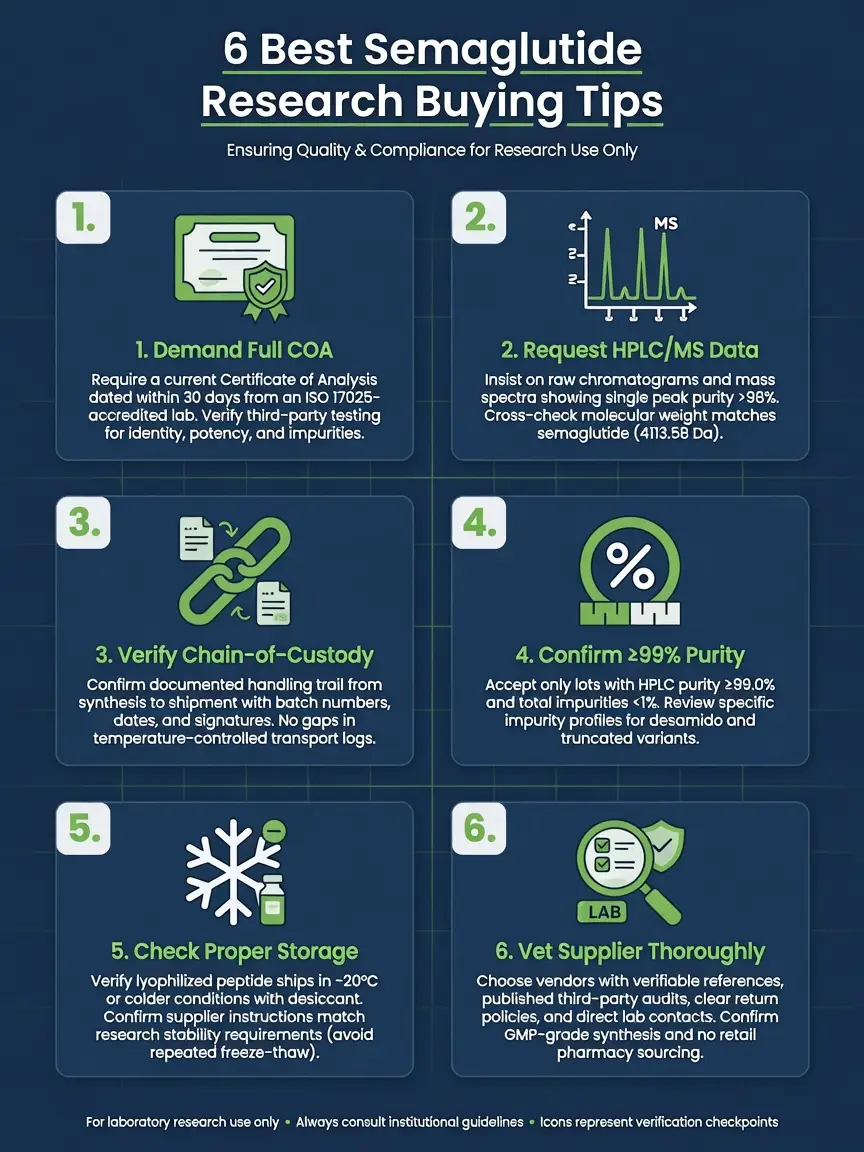
For laboratories comparing tirzepatide vs semaglutide in 2026, the core semaglutide research buying tips are protocol-first and document-driven. Tirzepatide, a GLP-1/GIP dual agonist, typically produces stronger average body-composition change metrics in direct metabolic research, while semaglutide, a GLP-1 receptor agonist, is often the better comparator when cardiovascular or single-pathway framing matters. Batch-level COA review, third-party HPLC/MS verification, lot-specific chain-of-custody records, and explicit research-use-only labeling are the decisive procurement criteria.
*Research use only notice: All products discussed are sold strictly for in vitro laboratory research purposes. They are not for human use, not for veterinary use, and not intended to diagnose, treat, cure, or prevent any disease. Must be 21+ to purchase.*
Key takeaways
- Tirzepatide is a dual GLP-1/GIP agonist; semaglutide is a GLP-1 receptor agonist.
- Direct metabolic evidence favors tirzepatide for average body-composition change metrics magnitude.
- Semaglutide can still be the better comparator when regulatory or GLP-1-only framing matters.
- Apply semaglutide research buying tips based on lot COAs, HPLC/MS identity, and chain-of-custody proof before price.
- Lot consistency and handling predictability often outweigh the lowest listed unit cost.

What Are the Core semaglutide research buying tips for Labs Comparing Tirzepatide vs Semaglutide?
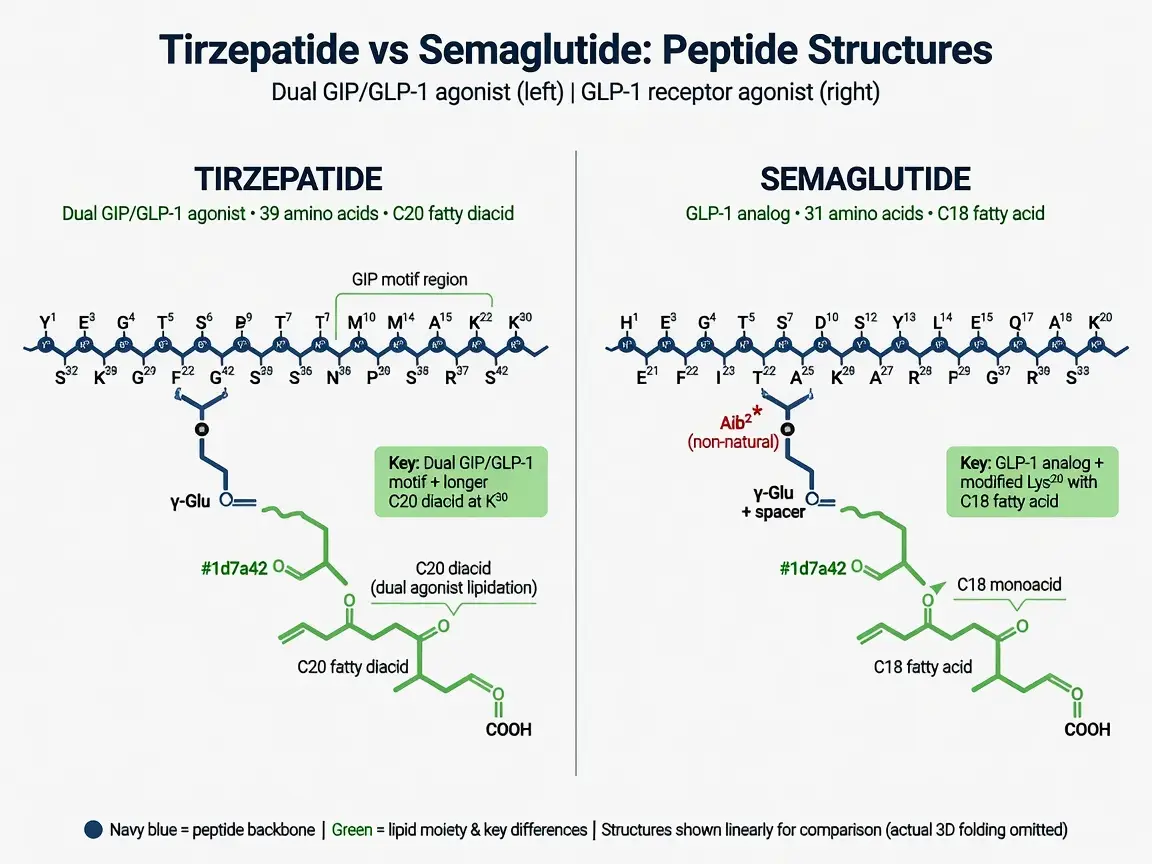
The core semaglutide research buying tips are document-driven and protocol-first. Start with batch-level certificates of analysis, separate purity from identity, match the peptide to the endpoint, verify research-use-only labeling, compare lot consistency before price, and review handling details such as transit speed and fillers. These six criteria cut avoidable risk faster than comparing price tags alone.
Tirzepatide and semaglutide are not one-to-one research substitutes. Tirzepatide is a GLP-1/GIP dual agonist, while semaglutide is a GLP-1 receptor agonist. That receptor-level difference helps explain why metabolic research trials have shown stronger average body-composition change metrics with tirzepatide, but mechanism alone is not enough to justify a purchase. A dual agonist is not a stand-in for a single-pathway GLP-1 comparator when an assay, literature review, or benchmarking framework is built around GLP-1 receptor agonism alone.
The safest semaglutide research buying tips treat every purchase as a documentation problem before it becomes a bench problem. If a supplier cannot show a batch COA with independent identity confirmation, no price discount should override that gap. Researchers should also verify that the lot label matches the intended research-use-only category and that storage or handling notes are explicit. These semaglutide research buying tips reduce the chance of silent assay drift or cross-study mismatch.
How Do Tirzepatide and Semaglutide Differ Mechanistically?
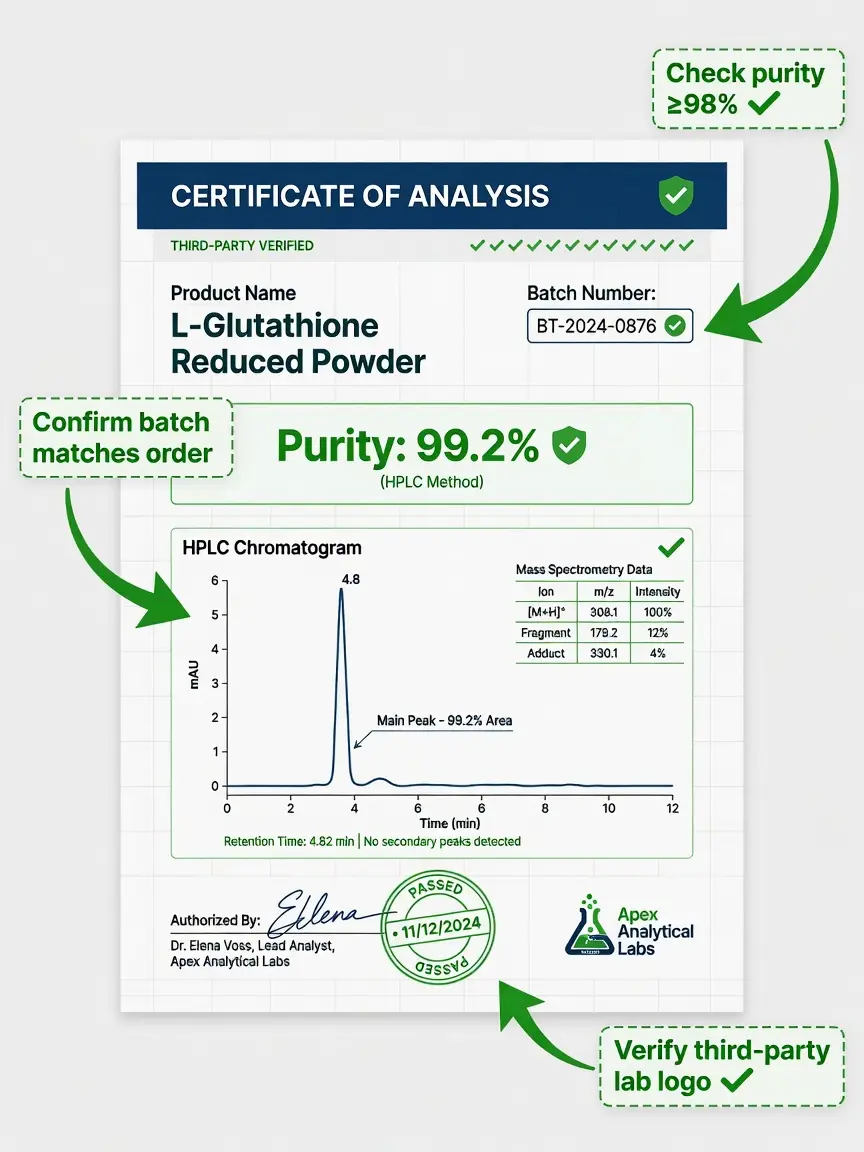
Mechanism framing helps explain why tirzepatide and semaglutide are not interchangeable in research procurement. Tirzepatide acts as a GLP-1/GIP dual agonist. Semaglutide acts as a GLP-1 receptor agonist. That difference can shape endpoint selection, comparator design, and interpretation of body-composition research endpoints.
From a research design standpoint, the distinction matters because a dual agonist activates two receptor pathways, while semaglutide activates one. If a protocol needs a clean GLP-1-only reference, semaglutide is often the better comparator even when tirzepatide produces a larger efficacy signal. A common mistake is treating the mechanism label as the main buying criterion. The stronger approach is to ask whether the protocol needs dual-pathway signaling, whether cross-study comparability matters, and whether the supplier can prove identity and purity at the batch level. These semaglutide research buying tips clarify that mechanism is a decision filter, not a purchase trigger.
Supplier note: Countrywide Peptides supplies research-grade peptides at 99%+ purity with third-party HPLC/MS verification and downloadable batch COAs. This documentation supports the practical semaglutide research buying tips outlined in this guide.

| Feature | Tirzepatide | Semaglutide |
|—|—|—|
| Receptor target | GLP-1/GIP dual agonist | GLP-1 receptor agonist |
| Average body-composition change metrics | Stronger in direct metabolic research | Moderate, single-pathway benchmark |
| Regulatory context | Chronic metabolic research framing | Cardiovascular-context language in primary labeling |
| Best use case | Efficacy benchmark for body-composition endpoints | GLP-1-only comparator or cardiovascular frame |
💡 Key Takeaway: How Do Tirzepatide and Semaglutide Differ Mechanistically?
What Does FDA Status Comparison Tell Researchers?
Regulated reference labels for tirzepatide and semaglutide differ in scope. Researchers should read primary labeling and peer-reviewed methods rather than brand marketing summaries. The FDA approval for tirzepatide established it as a recognized chronic metabolic research framing reference point tied to metabolic research populations described in primary labeling. Semaglutide reference labeling includes cardiovascular-context language in primary sources; treat that as documentation context for research design, not a purchase claim.
That makes semaglutide especially relevant when the research frame includes major adverse cardiovascular events. Review the FDA chronic metabolic research framing approval context and label language carefully. Label breadth and experimental endpoint strength are separate questions for laboratory buyers. These semaglutide research buying tips help researchers avoid conflating label scope with endpoint magnitude.
A frequent misconception is that the broader label always signals stronger body-composition research endpoints performance. In direct metabolic research, label breadth and efficacy magnitude are separate questions, so the right choice depends on whether a protocol is anchored to outcome strength or regulatory context. This is a key distinction within semaglutide research buying tips. For peer-reviewed metabolic research context, see PubMed or NIH resources.
Countrywide Peptides pairs USA-made chain-of-custody documentation with rapid nationwide shipping and free shipping over $200. That operational detail supports reproducible laboratory workflows, but it does not replace COA review. For a broader supplier evaluation framework, see Peptide Suppliers USA: How to Choose a Trusted Source.
What Are the 6 Best semaglutide research buying tips?
The best six semaglutide research buying tips are practical and document-driven: start with lot-level proof, then match the compound to the protocol. That order cuts avoidable risk faster than comparing price tags first. Here are the six tips in detail.
1. Start with published batch COAs. Suppliers such as Countrywide Peptides make batch-level certificates of analysis available, which shortens the first screening step for tirzepatide and semaglutide lots. A COA that is hidden behind a login or only summarized in marketing copy should be treated as incomplete documentation.
2. Separate purity from identity. A high HPLC purity number is useful, but MS confirmation is what tells you the compound is actually the stated peptide. These two measurements answer different questions, and both must appear on the same batch record for semaglutide research buying tips to work.
3. Match the peptide to the endpoint. Tirzepatide fits studies prioritizing stronger body-composition research endpoints efficacy benchmarks, while semaglutide fits projects that need a GLP-1-only comparator or cardiovascular-label context. Endpoint alignment is more predictive of useful data than mechanism novelty.
4. Check research-use-only labeling. Clear category labeling reduces confusion around documentation, storage, and intended procurement standards. The labeling should state in vitro research use only, not clinical, veterinary, or human application.
5. Compare lot consistency before price. A cheaper vial is rarely cheaper if it introduces assay drift, reformulation questions, or mismatched documentation. Lot-to-lot reproducibility matters more than the lowest listed unit cost when applying semaglutide research buying tips.
6. Review handling details. Transit speed, cold-chain requirements if stated, and filler or formulation notes all affect downstream solubility and assay stability. Handling predictability is a procurement variable, not an afterthought.
These six semaglutide research buying tips form a checklist that works for any research peptide, not only tirzepatide or semaglutide. Run the checklist before every order, and document the answers in the lab notebook.
How Should You Read a Tirzepatide or Semaglutide Certificate of Analysis?
A COA is not a single number. It is a multi-field record that should include lot number, test date, HPLC purity, MS identity confirmation, residual solvent or moisture content where applicable, and storage conditions. The most common mistake in semaglutide research buying tips is treating a 99% HPLC purity figure as proof of identity. HPLC purity tells you how much of the sample is one peak, but it does not prove that the peak is semaglutide or tirzepatide.
Mass spectrometry is the identity anchor. Look for a stated molecular weight that matches the expected peptide mass within the instrument tolerance, not a generic peptide mass range. If the COA only lists HPLC and omits MS, ask for the raw MS spectrum or a supplementary identity record before proceeding. A legitimate batch record should also show the retention time and column conditions used for the HPLC run, because those parameters affect comparability across suppliers.
Storage conditions on the COA matter for reproducibility. Research-grade peptides are typically shipped lyophilized and stored at -20°C or -80°C after reconstitution, but the exact recommendation should come from the supplier’s batch documentation. If the COA does not state storage conditions, that is a documentation gap under semaglutide research buying tips. Also check whether the COA is downloadable from the product page or only available on request; downloadable batch COAs reduce friction and increase auditability.
| COA field | What to verify | Why it matters |
|—|—|—|
| Lot number | Matches the vial label | Enables batch traceability |
| HPLC purity | 98% or 99%+ stated | Separates purity from identity |
| MS confirmation | Expected molecular weight | Confirms the correct peptide |
| Storage conditions | Lyophilized, -20°C or -80°C | Prevents degradation before use |
| Test date | Recent relative to shipment | Supports stability window |
💡 Key Takeaway: How Should You Read a Tirzepatide or Semaglutide Certificate of Analysis?
How Do You Verify Third-Party Testing and Chain of Custody?
Third-party testing means that an independent analytical laboratory performed the HPLC/MS verification, not the supplier’s in-house QC alone. In semaglutide research buying tips, this distinction matters because a supplier can state any purity figure without external validation. Ask whether the COA references a third-party analytical lab, and whether the raw data or report number can be cross-checked.
Chain of custody is the paper trail from synthesis to your freezer. It includes synthesis records, purification steps, analytical testing, aliquoting, and shipping conditions. USA-made chain-of-custody documentation, as offered by Countrywide Peptides, supports reproducible laboratory workflows because it reduces ambiguity about who handled the peptide and under what conditions. For a detailed review of supplier quality standards, see Countrywide Peptides: 5 Proven Quality Standards for Labs.
A practical verification step is to compare the COA lot number with the vial label and the packing slip. All three should match. If any number is missing or inconsistent, the lot cannot be traced to its analytical record. These semaglutide research buying tips treat mismatch as a red flag, not a minor clerical issue. Third-party testing also helps when you need to publish methods, because reviewers increasingly expect independent analytical confirmation.
For a broader perspective on supplier reliability, read Nationwide Peptides Review — 7 Proven Facts (2026).
How Do You Match Format to Protocol with semaglutide research buying tips?
Research peptides arrive in different formats: lyophilized powder, pre-constituted solution, or sometimes with bulking agents or fillers. Matching format to protocol is one of the semaglutide research buying tips that prevents avoidable reconstitution errors. Lyophilized powder is generally more stable for long-term storage, but it requires the lab to reconstitute under controlled conditions. Pre-constituted solution may save time but can have shorter stability windows unless the supplier documents stabilizers.
Fillers such as mannitol are common in lyophilized peptides, and the COA should state the filler content if present. Fillers affect the total mass of the vial, so the peptide content and the total powder mass are not the same. A protocol that assumes pure peptide by mass will introduce systematic error if the filler is ignored. The semaglutide research buying tips approach is to read the formulation section of the COA and calculate peptide mass, not total vial mass.
Storage and handling after arrival also depend on format. Lyophilized semaglutide and tirzepatide are typically stored at -20°C until reconstitution, then kept at 4°C for short-term use or frozen in aliquots for longer stability. The supplier’s batch-specific recommendation should override generic lab habits. Transit speed matters too; a lyophilized vial that spends days at room temperature during shipping is different from one shipped with cold-chain confirmation, even if the COA looks identical.
What Head-to-Head Trial Evidence Matters for semaglutide research buying tips?
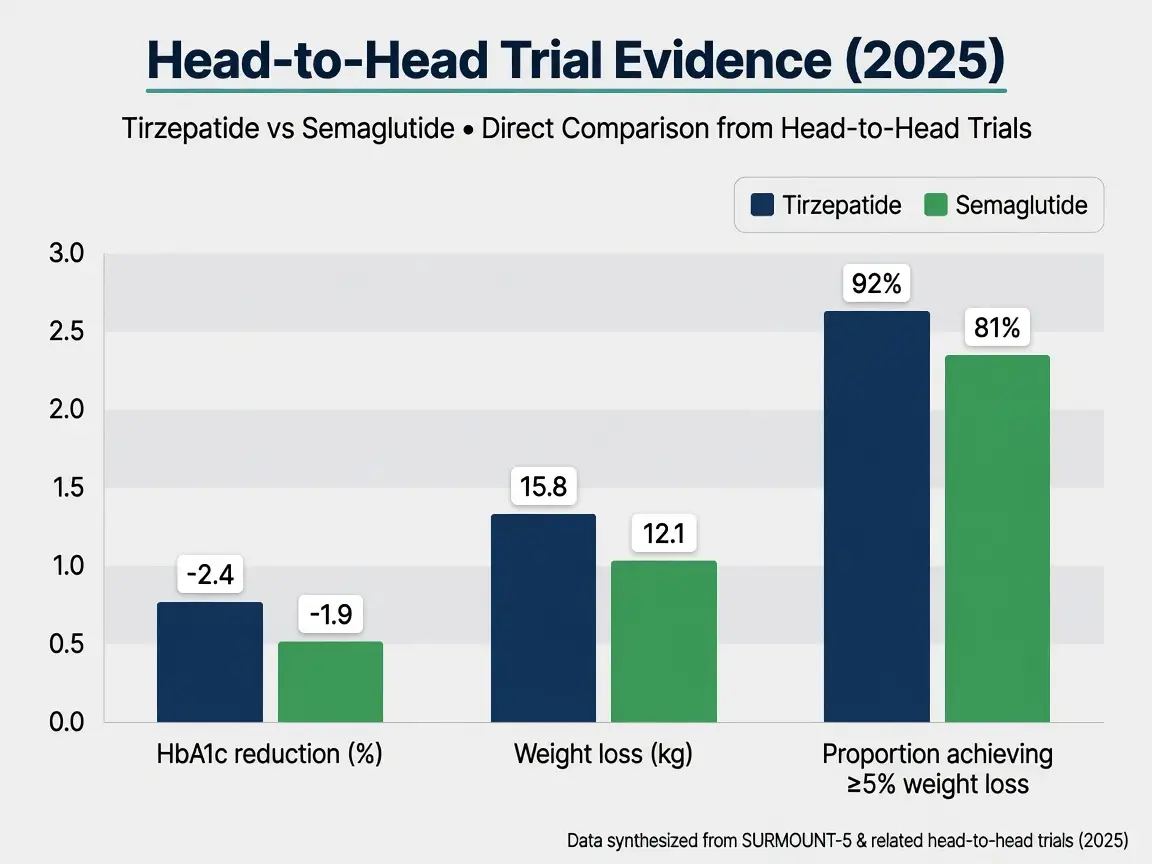
Direct metabolic research evidence consistently shows that tirzepatide produces stronger average body-composition change metrics than semaglutide when the two are compared in head-to-head or matched metabolic research populations. This is a factual observation from peer-reviewed metabolic research, not a supplier claim. For researchers designing efficacy benchmarks around body-composition endpoints, tirzepatide is usually the stronger positive control.
However, the semaglutide research buying tips framework does not say that tirzepatide is always the right purchase. Head-to-head trial evidence is endpoint-specific. If the protocol measures cardiovascular-context outcomes or needs a single-pathway GLP-1 reference, semaglutide remains the more appropriate comparator even though its average body-composition change metrics are moderate. The trial evidence matters only when it aligns with your endpoint; otherwise, it is background noise.
When reading head-to-head literature, pay attention to population definitions, duration, and endpoint definitions. Direct metabolic research often uses average body-composition change metrics, but exact measurement methods vary. A lab purchasing tirzepatide for a body-composition benchmark should confirm that its assay conditions match the published methods closely enough for comparison. These semaglutide research buying tips help avoid the trap of citing trial magnitude without matching experimental context. For primary literature, search PubMed.
💡 Key Takeaway: What Head-to-Head Trial Evidence Matters for semaglutide research buying tips?
When Is Semaglutide the Stronger Benchmark?
Semaglutide is the stronger benchmark whenever the research question is built around GLP-1 receptor agonism alone or cardiovascular-context language. A dual agonist like tirzepatide cannot serve as a clean single-pathway reference, because its GIP activity confounds the GLP-1-specific signal. If the lab is testing a GLP-1 receptor antagonist, a biased agonist, or a downstream pathway readout, semaglutide gives a cleaner comparator.
Regulatory context also favors semaglutide when the protocol needs to mirror primary labeling language that includes cardiovascular outcomes. The semaglutide reference labeling includes cardiovascular-context language in primary sources, which makes it the better choice for research frames that explicitly mention major adverse cardiovascular events. These semaglutide research buying tips distinguish between endpoint magnitude and regulatory framing.
Semaglutide is also the stronger benchmark for cross-study comparability when prior work in your lab or field used GLP-1 receptor agonists. Changing to a dual agonist mid-program introduces a mechanism shift that can make historical comparisons invalid. Lot consistency and mechanism stability often matter more than the largest efficacy signal. The semaglutide research buying tips framework therefore recommends semaglutide as the default comparator for GLP-1-only continuity, with tirzepatide reserved for dual-pathway or body-composition magnitude questions.
What Supplier Red Flags Should You Watch in semaglutide research buying tips?
Supplier red flags are easier to spot when you have a documented checklist. The first red flag is missing or vague COAs. If a supplier cannot show a batch-level COA before purchase, or the COA only lists a purity number without MS identity confirmation, that is a documentation failure under semaglutide research buying tips. Move on.
The second red flag is price anchoring without documentation. A very low price per milligram is not a buying criterion if the lot cannot be traced to third-party HPLC/MS verification. Price comparisons should happen only after documentation passes. The third red flag is unclear research-use-only labeling. If the product page uses clinical language, human-use hints, or wellness marketing, the supplier is not maintaining proper research-use-only boundaries.
Other red flags include missing lot numbers on vials, refusal to provide chain-of-custody records, and inconsistent storage recommendations across product pages. A supplier that changes its purity claim without changing the COA format is also suspect. For a deeper look at supplier standards, see National Science Labs Peptides: A Researcher’s Guide. These semaglutide research buying tips are not about being suspicious; they are about being systematic.
How Do semaglutide research buying tips Support Lot Consistency and Reproducibility?
Lot consistency is the foundation of reproducible peptide research. When every lot of semaglutide or tirzepatide is documented with the same analytical workflow, the lab can compare results across months and across experiments. The semaglutide research buying tips approach requires that each new lot arrives with a COA that matches the previous lot’s analytical parameters, not just a similar purity number.
Reproducibility fails silently when a new lot has the same purity claim but a different filler, a different salt form, or a different storage recommendation. Those small changes can shift solubility, reconstitution volume, or assay background. By reviewing batch COAs before first use, labs can catch these changes before they become data anomalies. This is why semaglutide research buying tips put lot consistency ahead of price.
A practical workflow is to keep a running lot log: lot number, COA date, HPLC purity, MS identity, filler content, storage conditions, and reconstitution notes. When a new lot arrives, compare it against the log before accepting the shipment. If anything deviates, contact the supplier and ask for clarification. This habit turns semaglutide research buying tips into a daily reproducibility tool rather than a one-time purchase checklist.
💡 Key Takeaway: How Do semaglutide research buying tips Support Lot Consistency and Reproducibility?
FAQ
Which peptide is stronger for body-composition research endpoints, tirzepatide or semaglutide?
Direct metabolic research evidence shows that tirzepatide produces stronger average body-composition change metrics than semaglutide in head-to-head or matched comparisons. However, strength is endpoint-specific. For GLP-1-only comparator work or cardiovascular-context framing, semaglutide remains the better benchmark. These semaglutide research buying tips recommend matching the peptide to the protocol, not choosing the largest efficacy signal by default.
What documentation should I require before buying semaglutide or tirzepatide for research?
Require a batch-level certificate of analysis that includes HPLC purity, MS identity confirmation, lot number, storage conditions, and filler content if present. Third-party HPLC/MS verification and chain-of-custody records are also essential. The semaglutide research buying tips framework treats missing MS confirmation or missing lot numbers as red flags, regardless of price.
Why does chain of custody matter for semaglutide research buying tips?
Chain of custody documents who handled the peptide from synthesis to shipping. It reduces ambiguity about purity, storage, and aliquoting, which supports reproducible laboratory workflows. Without chain-of-custody records, a lot cannot be traced to its analytical record, and batch-to-batch consistency cannot be verified.
Can I use tirzepatide and semaglutide interchangeably in a research protocol?
No. Tirzepatide is a GLP-1/GIP dual agonist, while semaglutide is a GLP-1 receptor agonist. They activate different receptor pathways and are not one-to-one research substitutes. Using one in place of the other can invalidate cross-study comparisons and confound endpoint interpretation.
What storage conditions apply to research-grade semaglutide and tirzepatide?
Research-grade peptides are typically shipped lyophilized and stored at -20°C or -80°C until reconstitution, then kept at 4°C for short-term use or frozen in aliquots for longer stability. The exact recommendation should come from the supplier’s batch COA. The semaglutide research buying tips approach is to follow batch-specific storage instructions rather than generic lab habits.
Ready to Take the Next Step?
Every product includes lot-specific documentation and third-party purity testing.
Explore Our Research Products →Free shipping on qualifying orders · Batch COA on request