
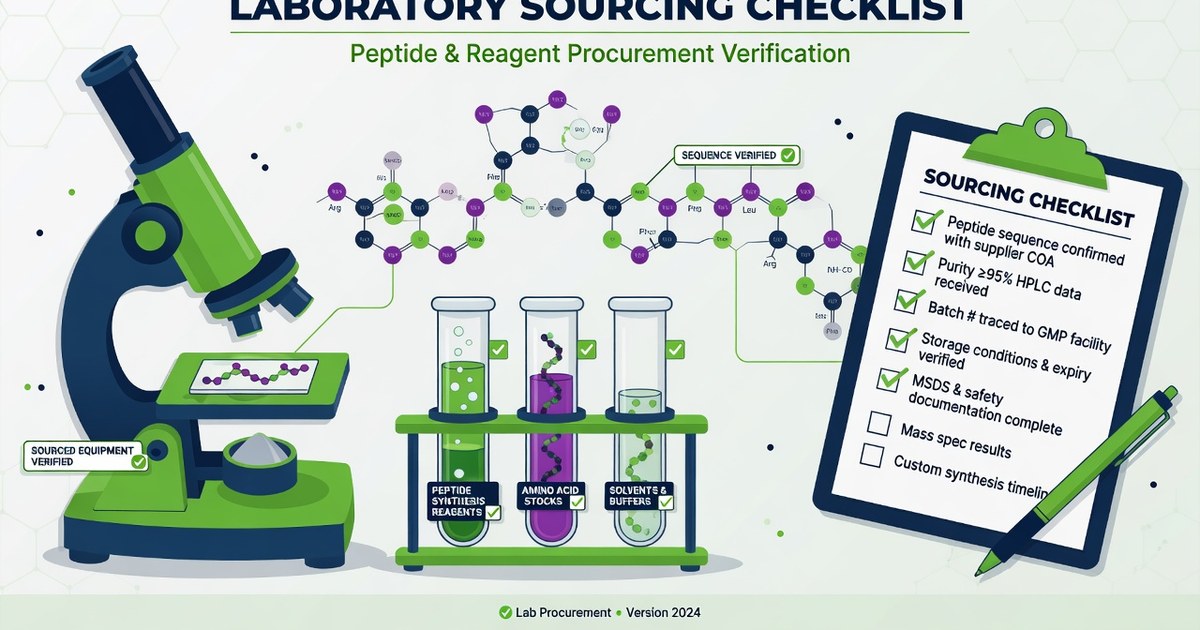
Choosing a Research Peptide Supplier: Lab Sourcing Checklist
peptide company research labs need a documented sourcing checklist: COA verification, SKU consistency, cold-chain SOPs, and red flags for 2026 labs.
📋 Table of Contents
Any peptide company research labs depend on for sourcing must clear five non-negotiable checks: explicit research-use labeling, accessible lot documentation, consistent SKU identity over reorders, responsive COA support, and cold-chain-compatible shipping. This 2026 lab sourcing checklist gives you a repeatable protocol to verify every vial before it enters your workflow. For research use only; educational content for laboratory research literacy, not medical advice and not for human use.
⚠️ Research Use Only Notice: The products discussed on this site are sold strictly for in vitro laboratory research purposes only. They are not for human use, not for veterinary use, and not intended to diagnose, treat, cure, or prevent any disease. All information presented is for educational purposes in a research context. Must be 21+ to purchase.
Key takeaways
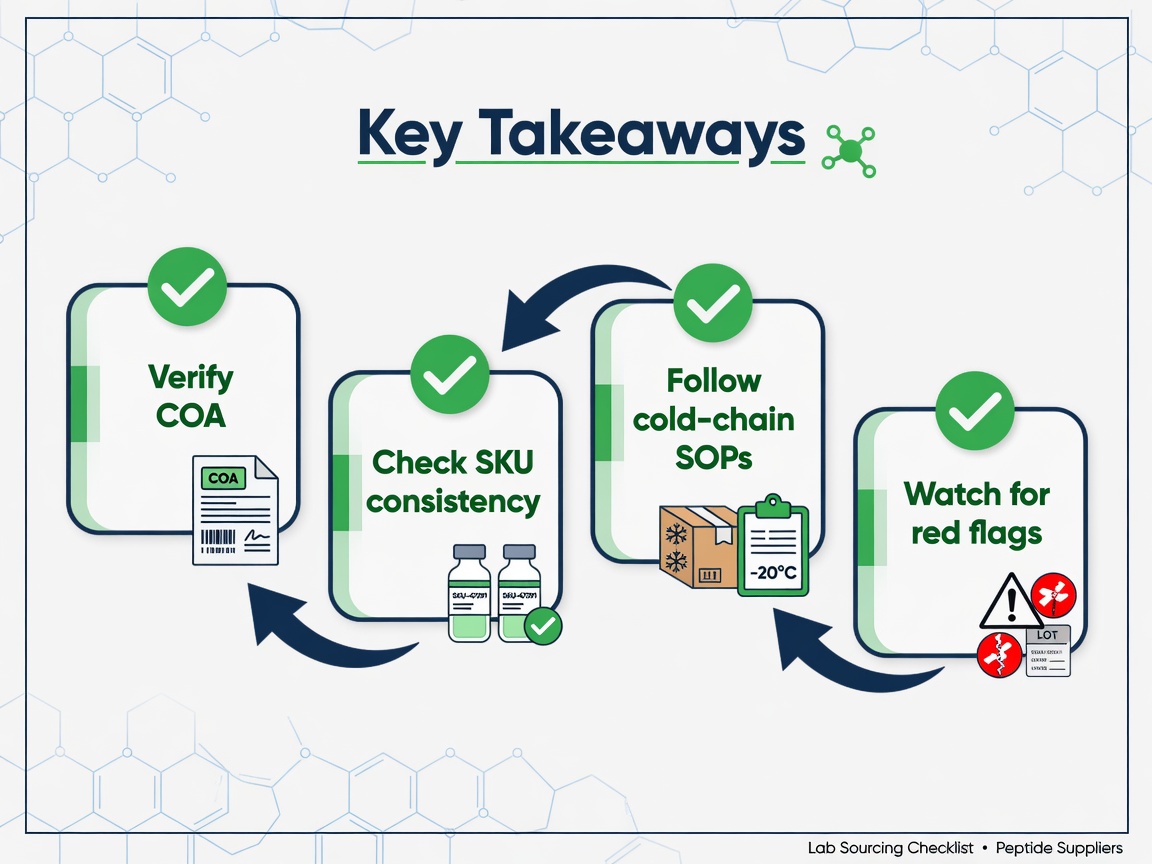
- Choosing a peptide company research labs sourcing checklist demands explicit research-use labeling, accessible lot documentation, and consistent SKU identity.
- Verify COA availability before first purchase; request batch-specific purity data and storage conditions.
- Red flags include consumer dosing guidance, missing lot files, or vague “research” claims without institutional paperwork.
- Cold-chain shipping must match your SOP; document temperature logs and handling notes.
- Countrywide Peptides supports documentation-forward buyers with responsive COA support.
What is a peptide company research labs sourcing checklist?
A peptide company research labs sourcing checklist is a structured review process laboratories use before purchasing peptides for in vitro or analytical work. It combines five non-negotiable checks: explicit research-use labeling, accessible lot documentation, consistent SKU identity over reorders, responsive support for COA questions, and shipping practices compatible with your cold-chain SOP. Without this checklist, a lab risks undocumented vials, mislabeled compounds, or thermal degradation during transit. This section defines each check.
A peptide company research labs checklist is not a one-time glance at a website. It is a repeatable protocol for every order, every new peptide, and every new supplier. Authoritative sources such as PubMed and NCBI catalog studies where reagent quality is a reported failure point. Labs that apply the checklist reduce undocumented variability.
The five checks are non-negotiable because each one closes a specific failure mode. Research-use labeling blocks any ambiguity about intended use. Lot documentation ties the vial to a specific batch. SKU consistency catches substitution errors. Responsive COA support confirms the supplier can defend its purity claims. Cold-chain compatibility prevents thermal degradation before the peptide reaches your bench. Together they create a chain of custody that a lab can audit later.
Why does a peptide company research labs checklist matter for 2026 labs?
In 2026, research reproducibility depends on documented source identity. A peptide company research labs checklist matters because peptide stability, purity, and lot traceability directly affect experimental outcomes. A supplier that cannot provide batch-level COAs may introduce variables that invalidate a run. Labs that skip the checklist often discover after the fact that the peptide was not the sequence they ordered or that the purity was below the stated threshold.
A peptide company research labs checklist also protects against thermal degradation during transit. Peptides can lose activity if exposed to ambient heat for extended periods. A supplier with documented cold-chain SOPs gives you a temperature profile, not just a promise. For more on supplier evaluation, see Peptide Suppliers USA: How to Choose a Trusted Source.
Labs that treat supplier evaluation as a price-only decision often find that a cheaper undocumented vial costs more in wasted runs. The checklist shifts the question from “how much does this peptide cost” to “can this supplier prove what is in the vial and how it was handled.” That shift is what 2026 reproducibility demands.
💡 Key Takeaway: Why does a peptide company research labs checklist matter for 2026 labs?
How should a lab apply this checklist to documentation?
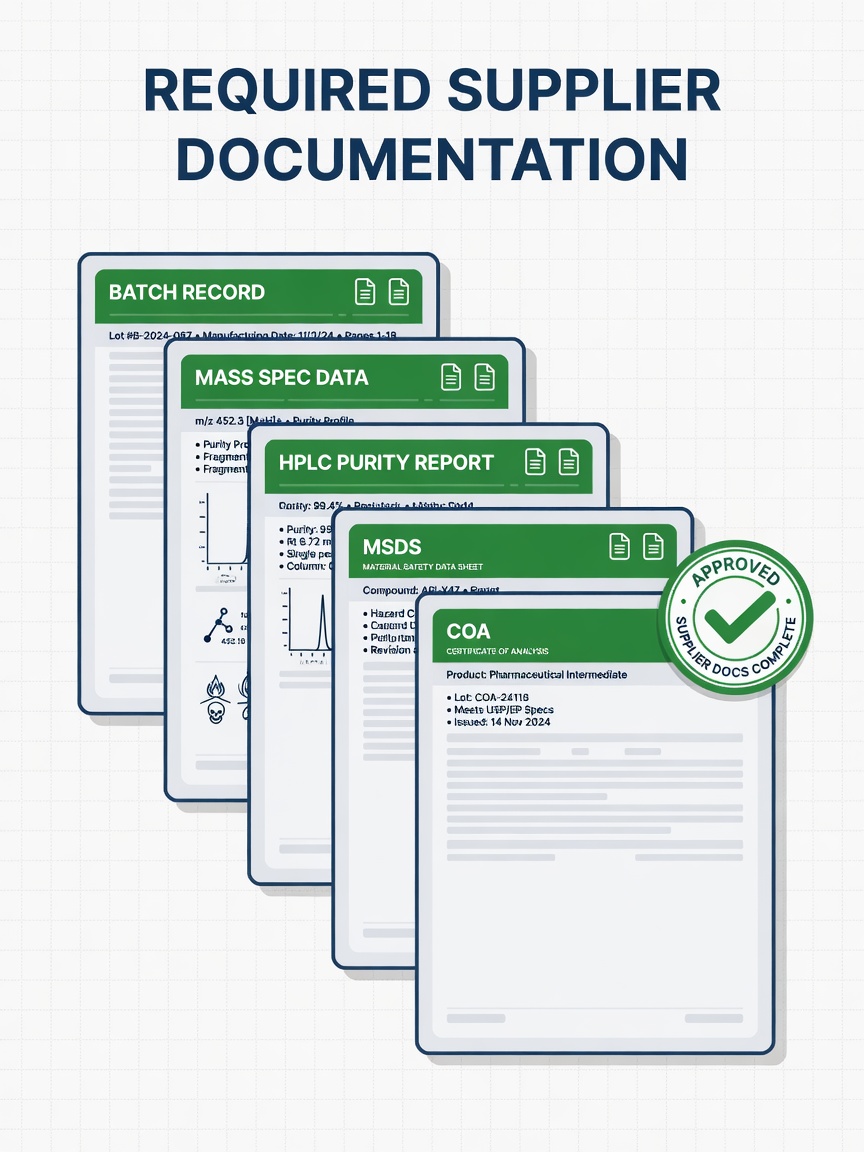
Start by requesting the certificate of analysis before the first plate. The checklist requires accessible lot documentation, not a summary page. Look for purity percentage, mass spectrometry or HPLC traces, residual solvent data, and storage conditions. If a supplier says “COA available on request,” ask for the exact lot number you will receive. A peptide company research labs protocol treats missing lot files as a stop condition, not a minor delay.
Documentation must be consistent across reorders. If the SKU identity changes between orders, you cannot confirm that the same peptide sequence and purity grade were shipped. The checklist demands that the SKU on the vial label match the SKU on the COA and the packing slip. Any mismatch should pause the order. Every peptide company research labs workflow should keep these records in a single lot documentation folder.
| Documentation Check | What to Request | Why It Matters |
|—|—|—|
| Certificate of Analysis | Batch-specific purity, HPLC or MS trace, residual solvents | Confirms identity and purity of the exact lot |
| Lot number | Printed on vial, COA, and shipping documents | Enables traceability and reorder consistency |
| Storage conditions | Lyophilized storage temp, reconstitution stability window | Prevents degradation before first use |
| Shipping temperature profile | Cold packs, insulated mailer, transit duration | Ensures cold-chain SOP compatibility |
| Research-use labeling | “For research use only” on product page and vial | Blocks any human-use ambiguity |
Keep a single folder per lot. Name it with the lot number, peptide sequence, and order date. Store the COA, packing slip, and any temperature log in that folder. If a run fails later, that folder is your first troubleshooting tool.
Which red flags does a peptide company research labs checklist flag?
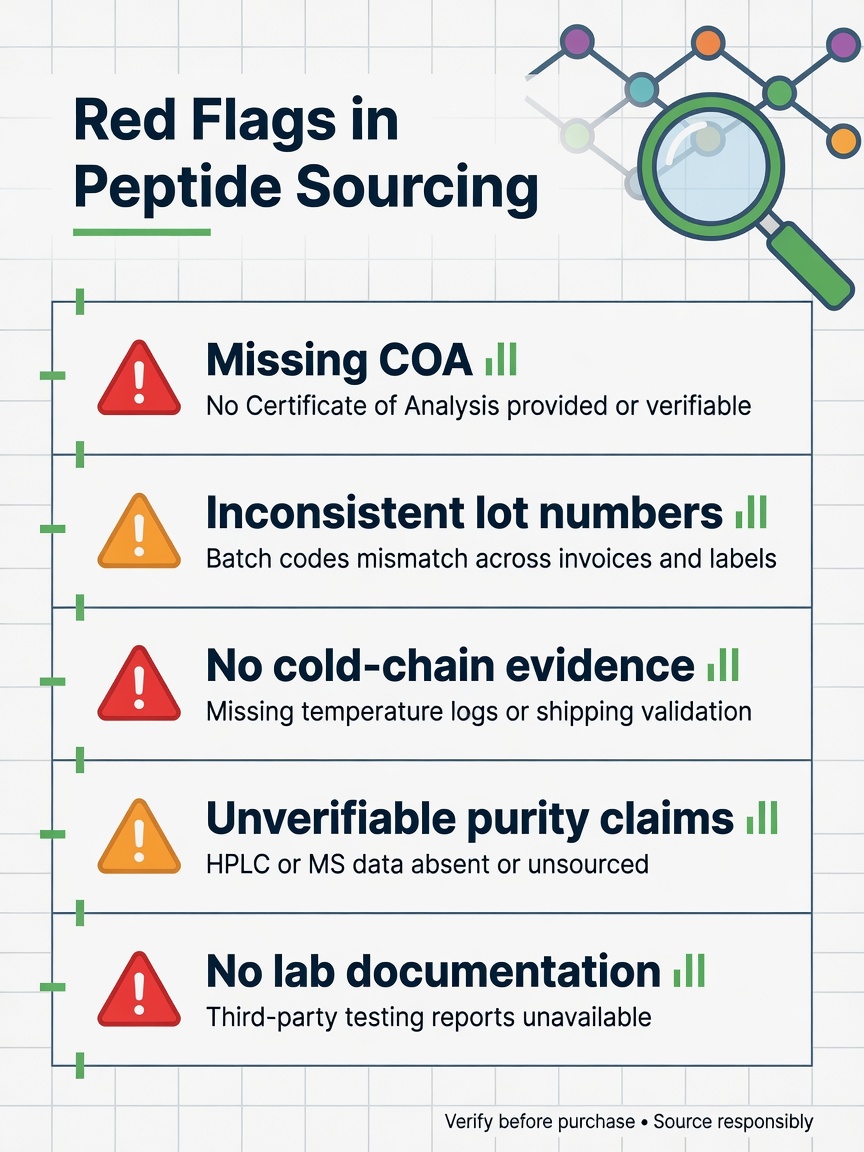
The checklist flags consumer dosing guidance, missing lot files, and vague “research” claims without institutional paperwork. These should pause purchasing. A peptide company research labs checklist also flags suppliers that change SKU identity between reorders, use non-institutional email domains, or offer “not for human use” in tiny print while marketing to wellness audiences. Any human-use language is a hard stop for research procurement.
Additional red flags include no physical address, no named quality officer, and no way to contact support for COA questions. A peptide company research labs protocol is designed to catch these before money leaves the lab. If a supplier cannot answer a simple purity question in writing, do not proceed. For a vendor review perspective, see Nationwide Peptides Reviews | Countrywide Peptides.
One subtle red flag is a supplier that uses “research grade” as a marketing term but cannot produce a COA for the exact lot. Another is a supplier that changes its SKU naming convention without notice. Both erode traceability and should be treated as stop conditions.
Where does cold-chain fit into a peptide company research labs sourcing checklist?
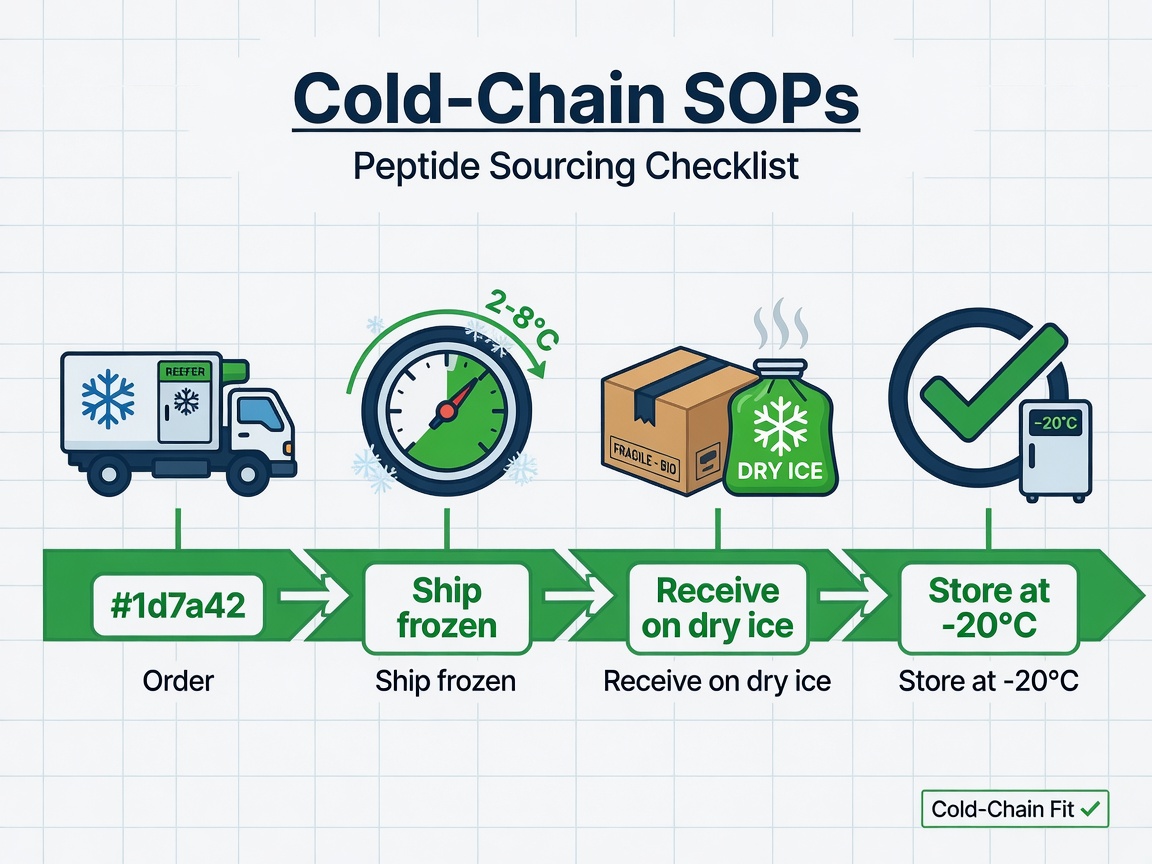
Cold-chain is not an afterthought. The checklist asks whether shipping practices are compatible with your cold-chain SOP. Lyophilized peptides may tolerate ambient transit for short windows, but reconstituted or temperature-sensitive sequences need documented cold packs, insulated mailers, and temperature loggers. A peptide company research labs checklist requires you to ask for a shipping temperature profile before checkout. If the supplier cannot state storage and transit conditions, do not proceed.
Cold-chain documentation should include the shipping date, the temperature range during transit, and the arrival condition of the ice packs. A supplier that uses generic “cold shipped” language without specifics is not meeting the checklist. A peptide company research labs review should log these details for every shipment.
Some labs use temperature indicator strips inside the package. If the strip shows a breach, document it and quarantine the vial until you can verify stability with the supplier. Do not assume that a cold pack that is still cold on arrival means the entire transit stayed in range.
💡 Key Takeaway: Where does cold-chain fit into a peptide company research labs sourcing checklist?
What makes Countrywide Peptides align with this checklist?
Countrywide Peptides supports documentation-forward buyers with responsive COA support, as the checklist expects. A peptide company research labs sourcing review should verify that the supplier can answer batch-level purity questions in writing and provide the exact lot number before shipment. Countrywide Peptides: 5 Proven Quality Standards for Labs outlines the quality controls a documentation-first lab should look for.
The checklist also rewards consistent SKU identity and clear research-use labeling. A peptide company research labs team that files every COA and temperature log will find that Countrywide Peptides’ documentation-first approach reduces back-and-forth. Always confirm the current lot documentation for the exact SKU you plan to order.
Before ordering, ask for the current COA for the exact SKU you plan to buy. Confirm that the lot number on that COA matches the lot number on the vial label and packing slip. If the supplier can answer that in writing, the checklist is satisfied on documentation.
How does this checklist compare to other sourcing rubrics?
Most sourcing rubrics stop at price and catalog breadth. A peptide company research labs checklist adds lot-level traceability, COA verification, and cold-chain documentation as equal-weight criteria. Other rubrics may mention purity but not require the SKU on the vial label to match the COA and packing slip. That single check catches substitution errors that price-only rubrics miss.
A peptide company research labs comparison should also include supplier responsiveness. If a vendor cannot answer a COA question in writing within one business day, that is a documentation failure, not a minor delay. For a deeper look at lab-focused sourcing, see National Science Labs Peptides: A Researcher’s Guide.
A price-only rubric might rank a supplier with no COA support as acceptable because the catalog price is low. The checklist ranks that same supplier as unacceptable because the documentation risk is unquantified. That difference is why labs should not substitute a price sheet for a sourcing checklist.
What documentation should a research peptide supplier provide under this checklist?
Under a peptide company research labs checklist, the supplier should provide a batch-specific certificate of analysis for the exact lot you will receive. That COA must include purity percentage, HPLC or mass spectrometry traces, residual solvent data, and storage conditions. A summary page is not enough. The lot number must appear on the vial label, the COA, and the shipping documents.
A peptide company research labs documentation packet should also include the shipping temperature profile: cold packs, insulated mailer, and transit duration. If the supplier ships lyophilized peptides at ambient temperature, ask for stability data for that specific sequence. Missing any of these items is a stop condition.
The COA is not a marketing document. It is a lab record. Treat it like any other controlled document: file it, date it, and keep it with the corresponding vial. If an auditor asks how you verified peptide identity, the COA is your answer.
💡 Key Takeaway: What documentation should a research peptide supplier provide under this checklist?
How can a lab verify a supplier’s claims under this checklist?
Verification starts with a written request for the exact lot number you will receive. A peptide company research labs verification step then matches that lot number across the vial label, COA, and packing slip. If any number differs, pause the order. You can also ask for the raw HPLC or MS trace file, not just a summary number.
A peptide company research labs verification should include a phone or email response to one purity question. If the supplier avoids a direct answer or points to a generic FAQ, that is a red flag. Use the internal links above to compare documented vendors.
You can also cross-check the supplier’s stated purity with an independent analytical run if your lab has HPLC or MS capability. That is not always practical for every order, but it is the strongest verification step for high-stakes experiments.
What are the five non-negotiable checks in this checklist?
The five checks are: explicit research-use labeling, accessible lot documentation, consistent SKU identity over reorders, responsive support for COA questions, and shipping practices compatible with your cold-chain SOP. A peptide company research labs checklist treats every one of these as a go/no-go gate. If any check fails, the order should not proceed.
1. Research-use labeling: “For research use only” must appear on the product page and vial.
2. Lot documentation: batch-specific COA with purity, traces, and storage conditions.
3. SKU consistency: same SKU on vial, COA, and packing slip across reorders.
4. COA responsiveness: supplier answers purity questions in writing.
5. Cold-chain compatibility: documented temperature profile and arrival condition.
Each check is binary. The supplier either provides the documentation or does not. There is no partial credit. A supplier that provides a COA but omits residual solvent data has failed lot documentation. A supplier that ships cold but cannot state the transit temperature range has failed cold-chain compatibility.
Why is SKU consistency part of this checklist?
SKU consistency is the cheapest way to catch a substitution error. A peptide company research labs protocol requires the SKU on the vial label to match the SKU on the COA and the packing slip. If a supplier changes SKU identity between reorders, you cannot confirm that the same peptide sequence and purity grade were shipped. Any mismatch should pause the order.
A peptide company research labs team that logs SKU consistency across every reorder builds a traceable chain of custody. That chain matters for reproducibility and for troubleshooting failed runs.
SKU consistency also matters for reordering. If you order the same peptide twice and the SKU changes, you have to re-verify identity from scratch. That is avoidable overhead, and the checklist eliminates it by requiring stable SKU identity.
💡 Key Takeaway: Why is SKU consistency part of this checklist?
How does this checklist handle COA questions?
The checklist treats COA questions as a supplier responsiveness test. A peptide company research labs COA request should ask for batch-specific purity data, HPLC or MS traces, residual solvent data, and storage conditions. If a supplier says “COA available on request,” ask for the exact lot number you will receive.
A peptide company research labs review should flag any supplier that cannot answer a purity question in writing. For a vendor review perspective, see Nationwide Peptides Reviews | Countrywide Peptides or the quality standards page.
A good COA question to ask is: “What is the batch-specific purity percentage and can you send the HPLC trace for that exact lot?” If the answer is a summary number without a trace, ask for the trace. If the supplier cannot provide it, the checklist flags a documentation gap.
What should a lab do if a supplier fails this checklist?
If a supplier fails any of the five checks, stop the order. A peptide company research labs failure response should document the specific gap, request correction, and re-verify before proceeding. If the supplier cannot provide batch-level COA or changes SKU identity without explanation, find another vendor.
A peptide company research labs team should keep a written log of every failed check. That log protects the lab during audits and justifies sourcing decisions.
When a supplier fails a check, do not negotiate. The checklist is a go/no-go gate, not a scorecard. A supplier that fails one check today may fail another tomorrow. Document the failure and move to a vendor that passes all five.
How can a lab adapt this checklist for different peptide types?
Lyophilized peptides need a documented storage temperature and reconstitution stability window. Temperature-sensitive sequences need cold packs, insulated mailers, and temperature loggers. A peptide company research labs adaptation should match the shipping temperature profile to the specific peptide’s stability data, not to a generic policy.
For peptides with known degradation pathways, request residual solvent data and mass spectrometry traces. A peptide company research labs adaptation should also check whether the COA includes the exact sequence and modification state.
For peptides supplied in lyophilized form, check the reconstitution stability window stated on the COA. That window tells you how long the peptide remains usable after reconstitution under your storage conditions. If the COA omits that window, ask for it before you start the experiment.
💡 Key Takeaway: How can a lab adapt this checklist for different peptide types?
FAQ
What is the first thing a lab should request from a peptide supplier?
The first thing is a batch-specific certificate of analysis for the exact lot number you will receive. A peptide company research labs protocol treats missing lot files as a stop condition.
What counts as a red flag when sourcing research peptides?
Consumer dosing guidance, missing lot files, vague “research” claims, SKU identity changes, non-institutional email domains, and no named quality officer are all red flags. Any human-use language is a hard stop.
How important is cold-chain shipping for lyophilized peptides?
Lyophilized peptides may tolerate ambient transit for short windows, but temperature-sensitive sequences need documented cold packs, insulated mailers, and temperature loggers. Request a shipping temperature profile before checkout.
Does SKU consistency really matter?
Yes. The SKU on the vial label must match the COA and packing slip. If it changes between reorders, you cannot confirm the same sequence and purity were shipped.
What should a lab do if a supplier cannot answer a COA question in writing?
Do not proceed. Responsive support for COA questions is one of the five non-negotiable checks in the checklist.
Ready to Take the Next Step?
Every product includes lot-specific documentation and third-party purity testing.
Explore Our Research Products →Free shipping on qualifying orders · Batch COA on request