
Synthetic and Bioactive Peptide Labels: What Labs Should Clarify
Synthetic peptide labels often confuse labs. Learn which COA details, identity tests, purity data, and research-use-only wording to clarify.
📋 Table of Contents
Synthetic peptide labels often combine the terms “synthetic” and “bioactive” without explaining what documentation should accompany the lot. Labs should clarify synthetic status against the certificate of analysis (COA), identity tests, purity data, and intended-use language before any bench release. This article details the exact questions to ask and the workflow to follow for research-use-only synthetic peptides.
Key takeaways
- Synthetic and bioactive are catalog descriptors, not substitutes for COA data; verify each synthetic lot against its specification.
- Ask for identity tests, explicit research-use-only language, and purity or related-substance data before release.
- Hold ambiguous synthetic material in quarantine until paperwork matches the protocol’s acceptance criteria.
- Escalate mismatches to catalog support rather than improvising at the bench.
- Document storage conditions, lot number, and COA version for every synthetic peptide received.
What Does a Synthetic Peptide Label Actually Mean?
In peptide research procurement, the word synthetic typically means the peptide was assembled through solid-phase peptide synthesis (SPPS) or solution-phase chemistry rather than isolated from a biological source. A synthetic label alone does not state purity, sequence fidelity, counterion content, residual solvent levels, or endotoxin status. Countrywide Peptides recommends clarifying the synthetic label against the COA and product specification—not marketing copy alone.
Many catalog entries pair synthetic with bioactive, which can confuse intake teams. Bioactive may describe observed activity in a specific assay, but that activity depends on sequence, modification, purity, and handling. A synthetic peptide can be bioactive in one model and inert in another, so the label cannot be treated as a universal performance claim.
Why Must Labs Clarify Synthetic and Bioactive Wording Before Bench Release?
Assay interpretation depends on knowing what was actually received. Ambiguous catalog language should be resolved with documentation before experiments start. The synthetic descriptor tells you the production route, but the bioactive descriptor tells you only that someone observed a response somewhere. Neither replaces identity testing.
A synthetic lot may arrive with a COA that lists sequence, purity, mass, and storage. A bioactive lot may arrive with a cell-based assay summary. If intake teams accept the combined phrase “synthetic bioactive peptide” without separating the two claims, they may miss missing data. For example, a synthetic peptide sold as bioactive may lack the specific assay conditions, positive control, or EC50 information needed to reproduce the result.
💡 Key Takeaway: Why Must Labs Clarify Synthetic and Bioactive Wording Before Bench Release?
Which Identity Tests Should Accompany a Synthetic Peptide Lot?
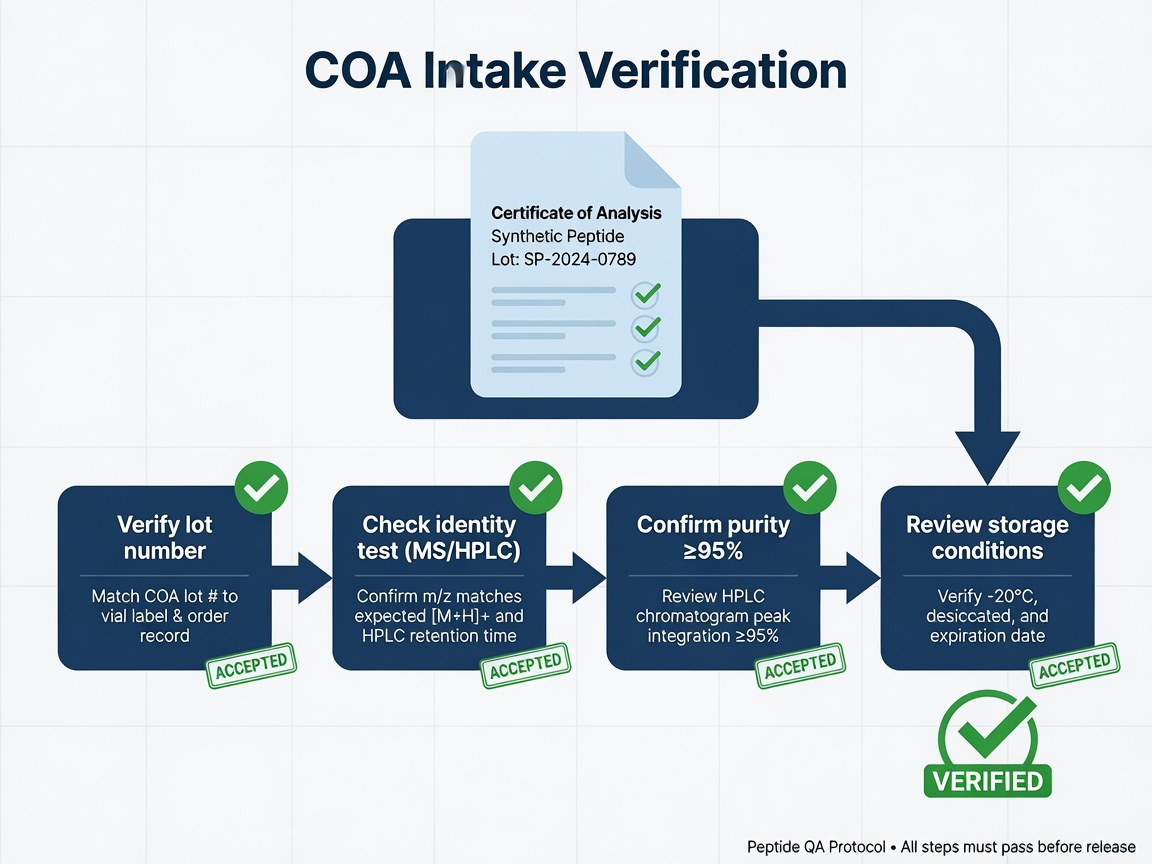
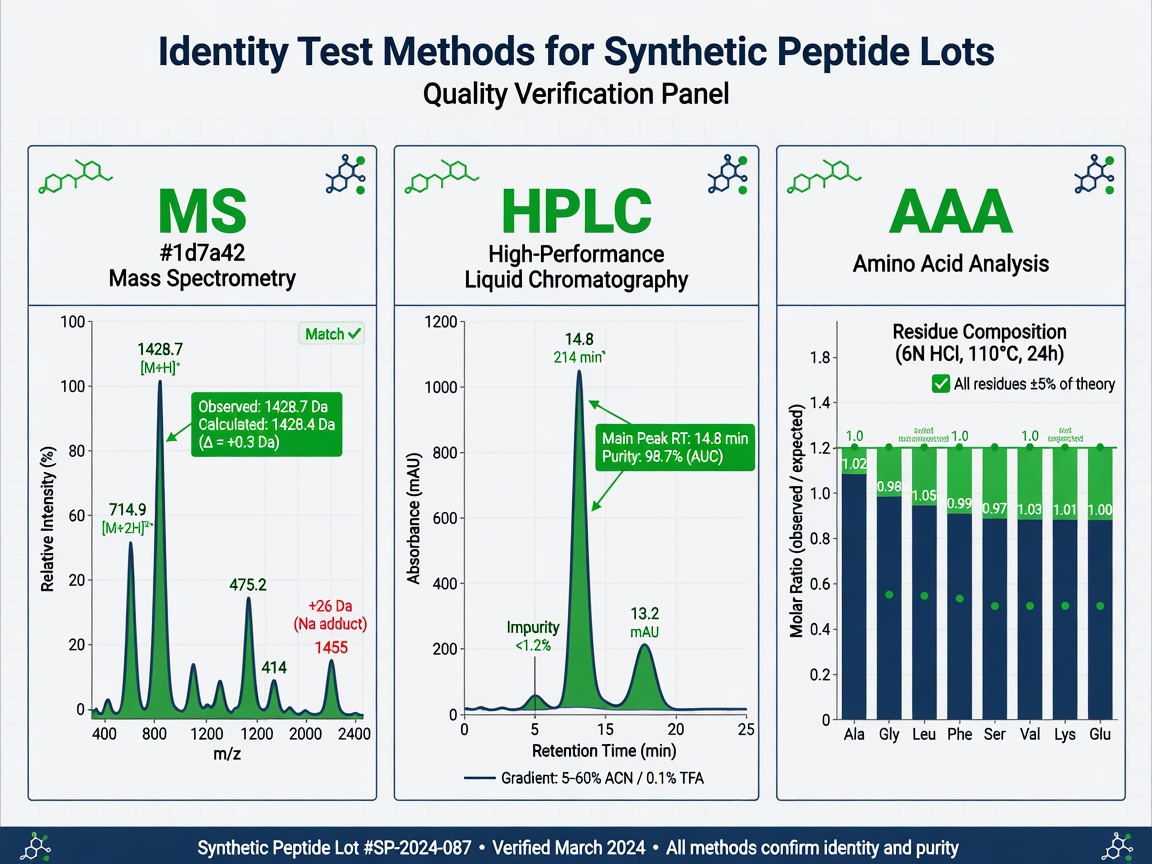
Identity tests confirm that the synthetic sequence matches the requested sequence. Common methods include high-performance liquid chromatography (HPLC) retention time comparison against a reference standard, mass spectrometry (MS or LC-MS), and amino acid analysis. Labs should ask: what identity tests accompany the lot?
For a synthetic peptide, the minimum acceptable identity documentation is usually an HPLC trace and a mass spectrum. Peptide mapping or tandem MS may be required for modified or cyclic synthetic sequences. If the COA only says “synthetic peptide” without an attached chromatogram or spectrum, request the raw data before release.
What Purity Data Should Be on File for Synthetic Peptides?
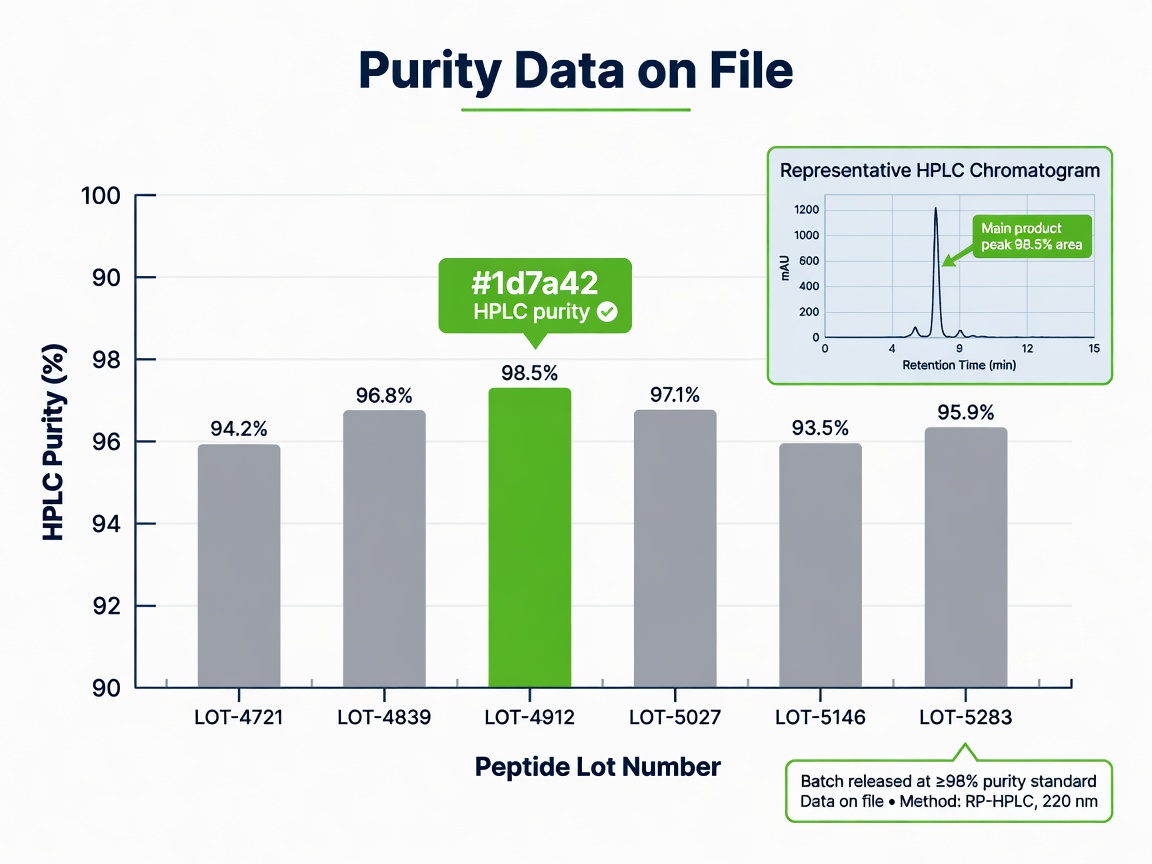
Purity data describe the percentage of the target synthetic sequence relative to other peptide-related impurities. Labs should ask which purity or related-substance data are on file. HPLC purity at 214 nm or 220 nm is common, but it may not detect all impurities. Orthogonal methods such as UPLC, capillary electrophoresis, or ion-exchange chromatography strengthen the synthetic purity claim.
A synthetic peptide COA should state the purity percentage, the analytical method, the column type, and the detection wavelength. Without these details, a “>95% pure synthetic peptide” statement is not verifiable. Countrywide Peptides recommends storing the full COA with the lot number and checking that the purity value matches the protocol’s acceptance criteria.
How Should Intake Teams Verify a Synthetic Peptide COA?
A COA review for a synthetic peptide should follow a checklist: lot number matches the vial, sequence matches the order, purity meets protocol, identity method is listed, storage conditions are stated, and intended use is explicitly research-only. Labs should ask: is the intended use explicitly research-only?
If the COA lacks a research-use-only statement, the synthetic material may be intended for another context. Countrywide Peptides labels all products for research use only, but not every supplier does. Cross-check the catalog language and the COA against the internal use case before signing off.
What Storage and Handling Notes Apply to Synthetic Peptide Lots?
Chemically assembled peptides are often lyophilized and should be stored at -20°C or -80°C, protected from light and moisture, until reconstitution. The COA should state recommended storage for the lot. After reconstitution, stability depends on solvent, pH, and temperature; labs should document these conditions.
The label rarely includes storage details, so intake teams must request them. Improper storage can degrade the peptide sequence and create related substances that were not present at release. Keep the original container, desiccant, and batch record together.
How Should Labs Quarantine Ambiguous Synthetic Material?
Process recommendation: hold material in quarantine until paperwork matches the protocol’s acceptance criteria. Escalate mismatches to catalog support rather than improvising on the bench. An ambiguous synthetic lot may have a COA that says “bioactive” but no activity data, or a purity value without a method.
Quarantine does not mean indefinite storage. It means the synthetic material stays in a labeled, segregated area while the intake team requests missing documents. For Countrywide Peptides orders, support can provide additional COA details or lot-specific data. Do not thaw, aliquot, or use the synthetic peptide until the paperwork is complete.
💡 Key Takeaway: How Should Labs Quarantine Ambiguous Synthetic Material?
What Operational Mistakes Arise from Unclear Peptide Labels?
One common mistake is assuming that a bioactive descriptor equals a validated assay result. Another is releasing a peptide to the bench without confirming the lot-specific purity. Assay interpretation depends on knowing what was actually received; ambiguous catalog language should be resolved with documentation before experiments start.
Teams sometimes treat the catalog page as the primary source of truth. That page may contain marketing language, not analytical data. The COA and product specification are the authoritative documents. If the catalog page and COA conflict, the COA wins, but the conflict itself should be escalated.
How Do Peptide Production Labels Differ?
A chemically assembled peptide is usually labeled with the production-route descriptor, while a peptide isolated from tissue is labeled natural or extracted. A peptide expressed in a host organism is labeled recombinant. Bioactive is not a production route; it is a functional descriptor. Each label carries different documentation expectations.
Which Documentation Gaps Are Most Common for Bioactive Peptides?
Common gaps include missing assay conditions, lack of positive controls, absent EC50 values, and undefined reference standards. A bioactive descriptor without a method section is not reproducible. Labs should request the full activity report, including buffer, temperature, incubation time, and readout. If the supplier cannot provide this, treat the bioactive claim as unverified.
💡 Key Takeaway: Which Documentation Gaps Are Most Common for Bioactive Peptides?
What Should Labs Ask Before Accepting a Peptide Shipment?
Before sign-off, ask: Does the COA lot number match the vial? Is the sequence correct? What purity method was used? Is the storage recommendation explicit? Is the intended use research-only? Are related substances listed? If any answer is missing, hold the shipment in quarantine until documentation arrives.
A Practical COA Review Checklist for Peptide Lots
Use this checklist at intake:
- Lot number on COA matches vial label.
- Sequence and modification match the purchase order.
- Purity percentage and analytical method are stated.
- Identity test data (HPLC, MS) are attached.
- Related substances above threshold are listed.
- Storage conditions are explicit.
- Research-use-only statement is present.
- Endotoxin or bioburden data are provided if required.
- Expiration or retest date is listed.
- Supplier contact for discrepancies is documented.
Comparison Table: Production Route vs Functional Descriptor
| Label type | Meaning | Documentation expected |
|—|—|—|
| Chemically assembled | Produced by SPPS or solution phase | COA with sequence, purity, identity, storage |
| Natural or extracted | Isolated from tissue or biological source | Source certificate, extraction method, purity |
| Recombinant | Expressed in host organism | Expression system, purification, endotoxin |
| Bioactive | Observed activity in an assay | Assay conditions, positive control, EC50 or equivalent |
Note: A single peptide lot may carry multiple descriptors; each claim requires separate verification.
💡 Key Takeaway: Comparison Table: Production Route vs Functional Descriptor
How to Escalate Label Discrepancies
If the COA conflicts with the catalog page, do not release the material. Email the supplier’s quality or support team with the lot number and a screenshot of the discrepancy. Ask for a corrected COA or a written clarification. For Countrywide Peptides orders, support can provide additional COA details or lot-specific data. Escalate mismatches to catalog support rather than improvising at the bench.
Why Research-Use-Only Wording Matters on Peptide Labels
Research-use-only wording confirms that the material is not intended for human or veterinary use and not for diagnostic or therapeutic applications. This statement protects the lab’s compliance posture and clarifies the scope of use. If a peptide label lacks this statement, the intended use may be ambiguous. Cross-check the catalog language and the COA against the internal use case before signing off. All products on Countrywide Peptides are sold strictly for in vitro laboratory research purposes only.
Detailed COA Components for Peptide Lots
A certificate of analysis should include more than a single purity number. Review each component below.
Lot Number and Traceability
The lot number links the vial to the batch record and the analytical data. Without it, the COA cannot be verified against the received material. Record the lot number in the lab notebook and on the storage container.
Sequence and Modifications
The COA should state the full amino acid sequence, including any modifications such as acetylation, amidation, or disulfide bridges. Compare this sequence to the purchase order. Even a single amino acid substitution can change assay results.
Purity and Analytical Method
Purity should be reported with the method, column, and detection wavelength. HPLC purity at 214 nm is common, but orthogonal methods provide stronger evidence. If only one method is reported, ask for a second method or raw chromatograms.
Identity Confirmation
Identity tests may include mass spectrometry, HPLC retention time, or amino acid analysis. The COA should attach the actual spectrum or chromatogram, not just a statement. Raw data allow independent verification.
Related Substances and Impurities
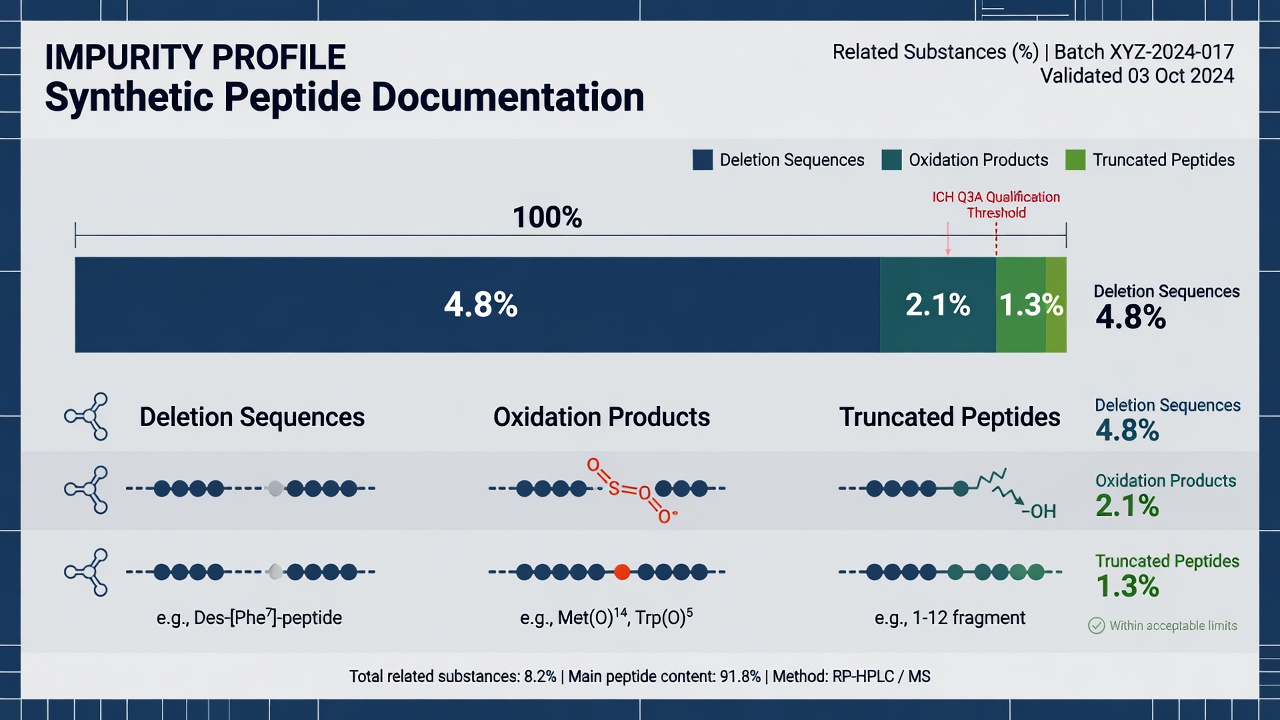
The COA should list related substances above the reporting threshold. Deletion sequences, oxidation products, and epimers can affect assay interpretation. Request the related-substance profile even if the purity is high.
Storage and Stability
Recommended storage conditions should be explicit. Lyophilized peptides are typically stored at -20°C or -80°C. After reconstitution, stability depends on solvent and pH. Document all conditions.
Intended Use Statement
The COA should include a research-use-only statement. This confirms the material is for in vitro laboratory research only, not for human or veterinary use.
💡 Key Takeaway: Detailed COA Components for Peptide Lots
Common Impurities Found in Peptide Lots
Peptide synthesis can produce several classes of impurities. Understanding them helps labs interpret COA data.
Deletion Sequences
Deletion sequences occur when one or more amino acids are missing from the target sequence. They can be difficult to separate by HPLC alone. Mass spectrometry can detect deletions that co-elute with the target peptide.
Truncations
Truncations are shorter peptide chains resulting from incomplete coupling. They may retain partial activity, which can confound bioassays. A related-substance profile should quantify truncations.
Oxidation Products
Methionine and cysteine residues are prone to oxidation. Oxidized peptides may lose activity or alter binding. Store lyophilized peptides under inert gas if oxidation is a concern.
Epimers
Epimerization can occur at certain residues during synthesis. Epimers have the same mass but different stereochemistry, so HPLC may not separate them. Chiral chromatography or other methods may be needed.
Residual Solvents and Counterions
Residual solvents from synthesis or lyophilization, such as acetonitrile or trifluoroacetic acid, may be present. Counterions like acetate or chloride affect peptide weight and solubility. COAs should state counterion content.
How to Document Peptide Receipt and Storage
Proper documentation prevents later confusion. Follow these steps at intake.
Receipt Checklist
Verify the vial label against the COA lot number. Check the physical condition of the vial: no cracks, no moisture, desiccant intact. Record the date of receipt and the storage location.
Storage Log
For lyophilized peptides, store at -20°C or -80°C in a desiccated container. After reconstitution, aliquot to avoid repeated freeze-thaw cycles. Log each aliquot with the date and solvent.
Reconstitution Notes
Use the solvent recommended by the supplier or the protocol. Record the solvent, pH, and concentration. Some peptides may require acidic or basic conditions for solubility. Document any precipitation.
Stability Monitoring
If the peptide is stored for long periods, consider periodic analytical checks. HPLC or MS can detect degradation. Keep the original COA for comparison.
Questions to Ask the Supplier Before Ordering
Before placing an order, ask these questions to reduce label ambiguity.
Can you provide a full COA before shipment?
A supplier that cannot provide a COA before shipment may not have lot-specific data. Request the COA in advance and review it against the protocol.
Which analytical methods are used for identity and purity?
Ask for the specific methods, not just “HPLC” or “MS.” The method details matter for reproducibility. If the supplier cannot name the method, treat the data as incomplete.
Are related substances reported?
Some suppliers only report purity, not related substances. For quantitative assays, related substances are critical. Ask for the reporting threshold and the list of identified impurities.
What is the intended use statement?
Confirm that the material is labeled for research use only. If the supplier cannot state this clearly, consider another source.
How are discrepancies handled?
Ask about the process for COA discrepancies or missing data. A reliable supplier will have a documented escalation path.
💡 Key Takeaway: Questions to Ask the Supplier Before Ordering
Internal Link Context: How Quality Standards Apply
Countrywide Peptides maintains quality standards that align with the COA review process described here. The article Countrywide Peptides: 5 Proven Quality Standards for Labs explains how lot-specific documentation is maintained. When choosing a supplier, refer to Peptide Suppliers USA: How to Choose a Trusted Source for additional criteria. Reviews from other researchers can also inform your decision; see Nationwide Peptides Reviews | Countrywide Peptides for context.
Troubleshooting Common COA Problems
Even with a COA, problems can arise. Here is how to handle them.
Missing Identity Data
If the COA lacks a mass spectrum or HPLC trace, request the raw data. Without identity confirmation, the peptide cannot be verified. Hold the lot until data arrive.
Purity Below Protocol Threshold
If the purity is below the protocol’s acceptance criteria, do not use the peptide. Contact the supplier for a replacement or a refund. Document the discrepancy in the lab notebook.
Sequence Mismatch
If the sequence on the COA does not match the order, quarantine the vial immediately. A sequence mismatch may indicate a labeling error or a synthesis error. Escalate to the supplier with the lot number and order number.
Storage Instructions Missing
If storage instructions are absent, do not guess. Contact the supplier. Most lyophilized peptides should be stored at -20°C or -80°C, but some may have specific requirements.
Research-Use-Only Statement Absent
If the COA lacks a research-use-only statement, ask for clarification. The material may be intended for a different use. Do not release it until the intended use is explicit.
The Role of Third-Party Testing
Some labs send peptide lots for independent verification. Third-party testing can provide orthogonal data.
When to Use Third-Party Testing
If the supplier’s COA seems incomplete or if the peptide will be used in high-stakes assays, independent testing adds confidence. Common tests include HPLC, MS, amino acid analysis, and endotoxin.
How to Arrange Third-Party Testing
Select a laboratory experienced with peptide analysis. Provide the lot number, storage conditions, and the supplier’s COA. Request a report that includes the same parameters as the original COA.
Interpreting Third-Party Results
Compare third-party results with the supplier’s COA. Minor differences in purity or retention time may be acceptable due to method variation. Significant differences warrant escalation.
💡 Key Takeaway: The Role of Third-Party Testing
Documentation Retention for Peptide Lots
Keep all peptide documentation for the life of the study and beyond.
What to Retain
Retain the COA, purchase order, shipping documents, storage log, and any correspondence with the supplier. For regulated research, retention periods may be specified by the institution.
How to Organize
Store documents electronically and physically. Use the lot number as the primary key. Include the date of receipt and the storage location. Back up electronic files regularly.
Audit Readiness
If an audit occurs, the lab should be able to produce the full documentation trail for any peptide lot. Missing COAs or storage logs can raise compliance concerns.
Key Differences Between Research Use Only and Other Labels
Some peptide labels may not explicitly state research use only. Understand the differences.
Research Use Only
Research use only means the material is intended for in vitro laboratory research, not for human or veterinary use, and not for diagnostic or therapeutic applications. This is the standard for Countrywide Peptides.
For Laboratory Use Only
Similar to research use only, but sometimes used interchangeably. Check the exact wording on the COA.
Not for Human Use
A label may state “not for human use” without saying “research use only.” This is acceptable but less specific. Ask for a full intended-use statement.
No Intended Use Statement
If the label lacks any intended-use statement, the material’s scope is ambiguous. Do not release it until the supplier clarifies.
External and Internal Resources for Peptide Quality
For further reading on peptide identity and purity, see the National Center for Biotechnology Information at https://www.ncbi.nlm.nih.gov/ and the PubMed record on peptide synthesis quality control at https://pubmed.ncbi.nlm.nih.gov/28613794/. These sources provide peer-reviewed context on analytical methods.
Internal resources include Countrywide Peptides: 5 Proven Quality Standards for Labs and Peptide Suppliers USA: How to Choose a Trusted Source. Both articles explain how COA review fits into supplier selection.
💡 Key Takeaway: External and Internal Resources for Peptide Quality
FAQ
What does a COA for a peptide lot usually include?
A COA typically lists the lot number, sequence, purity percentage, analytical method, storage conditions, and a research-use-only statement. Some COAs also include identity test data and related substances. Always request the full COA rather than a summary.
How can labs verify a bioactive claim?
Request the assay conditions, positive control, EC50 or equivalent, and reference standard. Without these details, a bioactive descriptor cannot be reproduced. Treat unverified bioactive claims as preliminary.
What should a lab do if the COA is missing storage instructions?
Do not release the peptide. Hold it in quarantine and contact the supplier for the storage recommendation. Improper storage can degrade the peptide and create related substances not present at release.
Why is research-use-only language important on a peptide label?
Research-use-only language clarifies that the material is for in vitro laboratory research only, not for human or veterinary use. This statement protects compliance and ensures the lab’s use case matches the supplier’s intended scope.
What is the first step when a peptide lot arrives?
Verify that the lot number on the vial matches the COA. Then check sequence, purity, identity data, storage, and intended-use language. If any item is missing or mismatched, hold the material in quarantine and escalate to support.
Ready to Take the Next Step?
Every product includes lot-specific documentation and third-party purity testing.
Explore Our Research Products →Free shipping on qualifying orders · Batch COA on request