
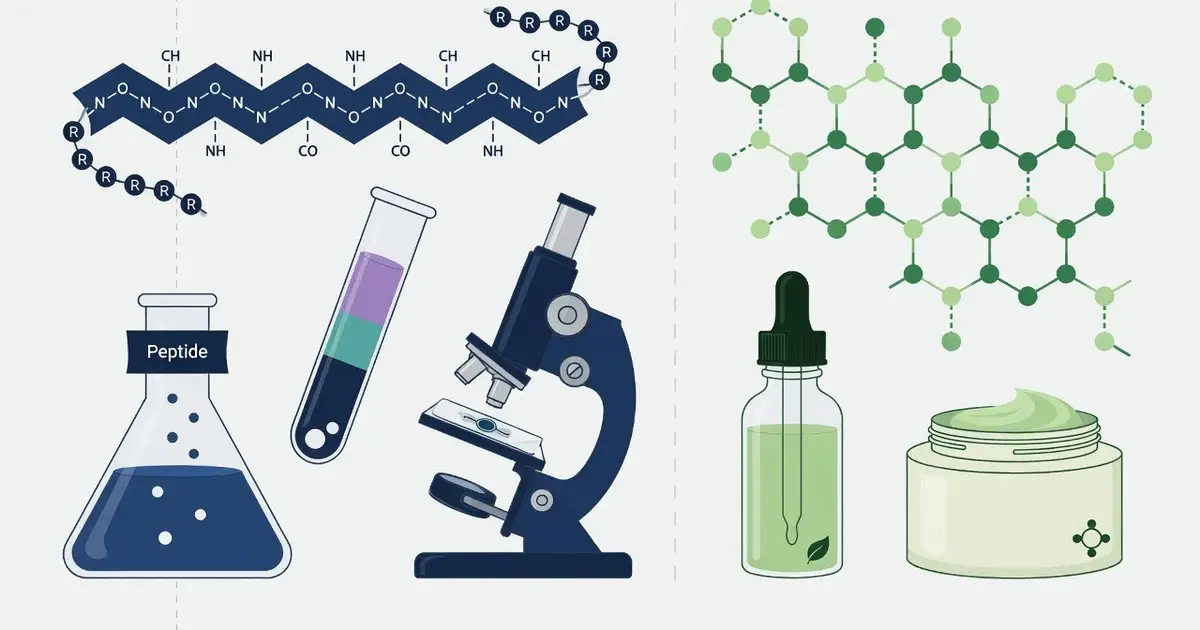
Research Peptides vs Cosmetic Peptides: Lab Basics
Research peptides cosmetic peptides compared: purity, CoA, storage, and FDA rules for lab use. See 2026 lab standards, safety data, and trusted supplier checks.
📋 Table of Contents
⚠️ Research Use Only Notice: The products discussed on this site are sold strictly for in vitro laboratory research purposes only. They are not for human use, not for veterinary use, and not intended to diagnose, treat, cure, or prevent any disease. All information presented is for educational purposes in a research context. Must be 21+ to purchase.
Research peptides cosmetic peptides are not interchangeable: research peptides are laboratory-grade raw materials judged by sequence identity, purity, and analytical documentation for in vitro or pre-clinical work, while cosmetic peptides are skin-care formulation actives judged by safety in labeled use, stability, and barrier-limited delivery. The practical split comes down to purpose, testing, and regulatory context, not amino-acid chemistry alone. All materials referenced here remain strictly research-use-only compounds, never for human or veterinary use.
Key takeaways
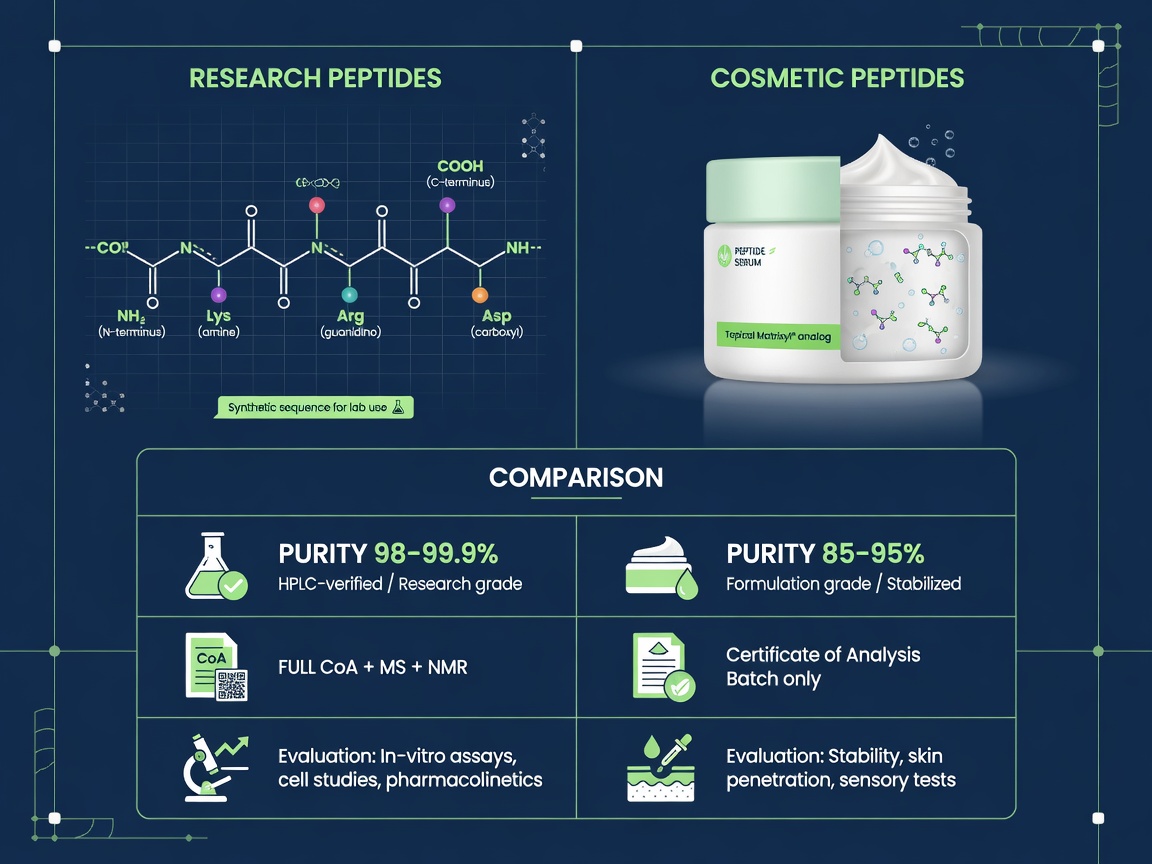
- Research peptides cosmetic peptides serve different workflows: lab-grade analytical tools vs finished topical actives.
- Research peptides require identity, purity, CoA data, and batch traceability for in vitro and pre-clinical work.
- Cosmetic peptides depend on formulation stability, safety in labeled use, and skin delivery, not raw sequence alone.
- The stratum corneum barrier limits hydrophilic peptide penetration, making delivery the central technical challenge for cosmetic actives.
- FDA does not require premarket approval for most cosmetic ingredients, but safety responsibility remains with the marketer under labeled use.
What Are Research Peptides Cosmetic Peptides in a Lab Setting?
The 2024 review defines peptides as molecules made of at least two amino acids linked by peptide bonds. From that starting point, research peptides cosmetic peptides split into two distinct workflows. One path leads to controlled laboratory tools and pre-clinical screening. The other leads to topical formulation, consumer claims, and skin-delivery questions.
Cosmetic peptides are a subset of peptides used in skin-care formulations. They are typically selected for cosmetic goals related to the appearance or condition of skin, not for laboratory assay development or pre-clinical screening as stand-alone research materials. A peptide name on a label does not tell you how well it survives in the formula, how much is present, whether it remains stable over time, or whether it can move through the outer skin barrier.
A Cleveland Clinic review aimed at consumers makes this point clearly: peptides may support collagen and elastin-related skin processes, yet the presence of peptides alone does not guarantee a strong product outcome. The formula matters. The delivery system matters. The use pattern matters. This distinction is central to understanding research peptides cosmetic peptides in a practical lab context.
The same amino acid sequence can appear in both categories, but the material context changes everything. A raw lyophilized peptide with a CoA is a research tool. The same sequence inside a cosmetic serum with preservatives, emulsifiers, and pH adjusters is a formulated active. The chemical identity may be identical, but the safety data, stability profile, and intended use are not.
A few basics help frame research peptides cosmetic peptides correctly: amino-acid sequences, skin-care formulation ingredients, barrier-limited topical actives, and safety tied to labeled use. Common research peptide examples include sequences studied for wound healing or cellular signaling in vitro, while common cosmetic peptide trade names include palmitoyl pentapeptide-4 and acetyl hexapeptide-8, always used in finished topical formulations. None of these examples imply human use; all remain research-use-only materials when supplied as raw peptides.
How Do Research Peptides Cosmetic Peptides Differ in Evaluation and Use?
Research peptides cosmetic peptides differ less by chemistry alone and more by intended use, documentation, and context. A research peptide is usually supplied for in vitro work, analytical use, assay development, or other pre-clinical applications. It is not a finished consumer product and should not be treated like one. For labs, the raw material itself is the focus. Buyers want sequence identity, purity data, batch consistency, and reliable analytical documentation. Certificates of Analysis, third-party testing, and traceable production details carry real weight because the peptide may be entering a controlled experimental workflow.
With cosmetic peptides, the peptide is only one part of the story. The finished formulation becomes central. A peptide that looks promising on paper may perform poorly in a serum or cream if the vehicle is weak, the ingredient is unstable, or delivery through the skin is limited. One peptide sequence can sit near the border of both categories, but the category is shaped by how it is prepared, presented, tested, and used. For research peptides cosmetic peptides, the evaluation lens shifts from raw material to finished product.
Labs should not use cosmetic product reviews as evidence of raw peptide quality. Consumer feedback about a cream does not validate sequence identity or purity. Conversely, a high-purity research peptide does not indicate that the same sequence will perform well in a topical vehicle. Purity levels for research peptides commonly range from 95% to 99% as measured by HPLC, but cosmetic formulations rarely disclose peptide purity at all.
| Aspect | Research Peptides | Cosmetic Peptides |
|—|—|—|
| Primary purpose | Laboratory and pre-clinical use | Skin-care formulation use |
| Evaluation focus | Identity, purity, reproducibility, analytical data | Safety in use, formulation stability, skin delivery, finished-product performance |
| Typical format | Raw peptide material | Peptide embedded in a cosmetic vehicle |
| Key documentation | CoA, purity profile, batch traceability, independent testing | Ingredient review, formulation data, safety support, product labeling |
| Main technical question | Is this peptide suitable for controlled research work? | Can this peptide reach its skin target safely and effectively? |
| Regulatory context | Research-use context, not consumer cosmetic marketing | Cosmetic product rules and ingredient safety obligations |
💡 Key Takeaway: Research peptides cosmetic peptides separate at the evaluation stage: one is a raw analytical tool, the other a formulated skin-care active. Labs should not apply finished-product claims to raw research material.
💡 Key Takeaway: How Do Research Peptides Cosmetic Peptides Differ in Evaluation and Use?
Why Do Skin Delivery Limits Matter for Research Peptides Cosmetic Peptides?
The biggest technical challenge for cosmetic peptides is not naming them. It is getting them where they need to go. Human skin is built to keep things out. The stratum corneum, the outermost barrier layer, is especially resistant to the entry of many active ingredients. A 2024 review noted that diffusion of highly hydrophilic substances, including peptides, through the stratum corneum remains under active discussion. That is a careful way of saying the barrier problem is still very real. Research peptides cosmetic peptides face this barrier problem differently depending on the intended use.
This is why research peptides cosmetic peptides often become a formulation challenge when moved from a lab context into a cosmetic vehicle. Even if a peptide has a sequence associated with useful skin-related effects, it still has to remain stable in the product and reach the relevant site in or on the skin. If it stays mostly at the surface or degrades too quickly, the practical value may be modest.
A 2025 review on skin-penetrating peptides adds another piece to the picture. It describes certain peptides as permeation enhancers that can help with macromolecule delivery across the skin and increase permeability by helping larger molecules cross the stratum corneum. That does not remove the challenge, but it shows where cosmetic peptide research is pushing: smarter delivery systems rather than simple ingredient addition. For current peer-reviewed work, see this PubMed search for cosmetic peptide skin penetration studies.
Skin-penetrating peptide research often distinguishes between cosmetic surface effects and deeper dermal targets. The 2025 review describes permeation enhancers that may help macromolecules cross the stratum corneum, but that does not turn a research peptide into a cosmetic active by itself. Delivery, formulation, and stability remain separate questions. Hydrophilic peptides with low logP values struggle most, while lipophilic modifications or carrier systems may improve skin partitioning.
Which Safety and FDA Rules Govern Research Peptides Cosmetic Peptides?
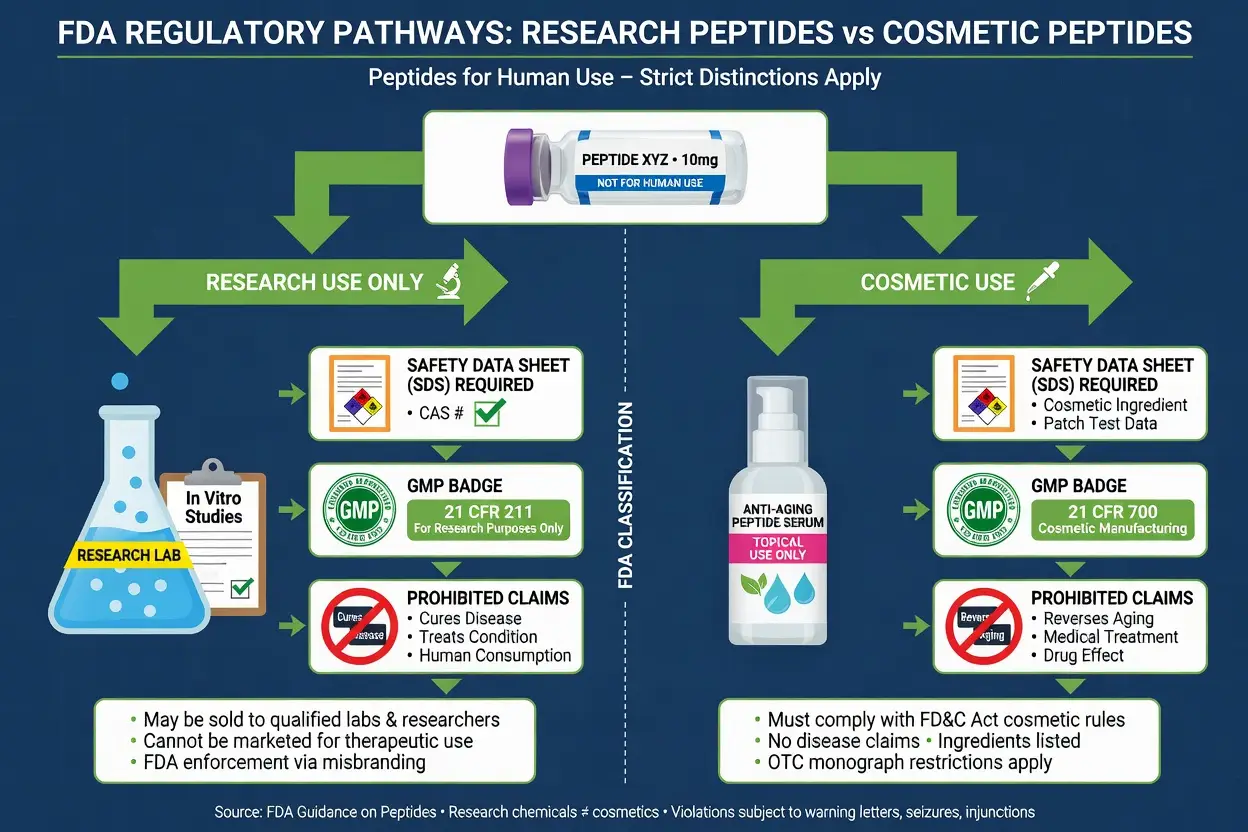
Research peptides cosmetic peptides operate under different regulatory expectations. Research peptides sold for laboratory use are not consumer cosmetics and are not intended for application to human skin. They are supplied with a research-use-only designation and must not be used for human or veterinary purposes. Labs handling these materials follow institutional protocols for chemical and biological safety, waste disposal, and documentation.
Cosmetic peptides, when formulated into finished skin-care products, fall under the Federal Food, Drug, and Cosmetic Act. The FDA does not require premarket approval for most cosmetic ingredients or products, but the marketer is responsible for ensuring safety under labeled or customary conditions of use. That safety responsibility includes ingredient selection, formulation stability, microbial quality, and labeling. A peptide that is fine as a raw research reagent is not automatically safe or stable inside a cosmetic product. The regulatory gap between research peptides cosmetic peptides is often misunderstood.
The FDA regulatory information for cosmetic products confirms that cosmetic firms are legally responsible for substantiating the safety of their products. No premarket approval step exists for standard cosmetics, but that does not lower the safety obligation. Research peptides cosmetic peptides therefore sit in two different compliance zones: one governed by laboratory research norms and the other by cosmetic product rules.
What Formulation Quality Factors Affect Research Peptides Cosmetic Peptides?
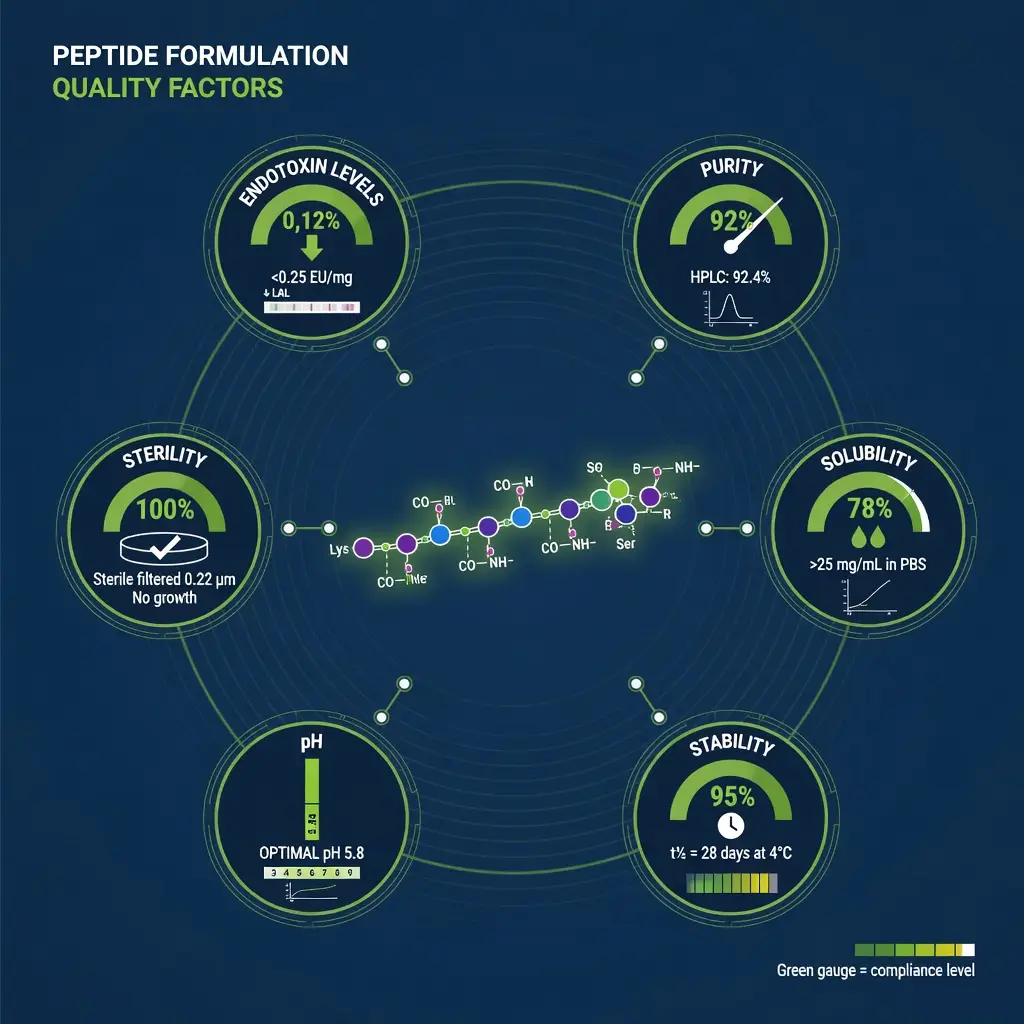
For research peptides, the key formulation question is usually about the raw material itself: lyophilized powder stability, reconstitution solvent, storage temperature, and protection from light and moisture. A lyophilized peptide with a clear CoA can still degrade if mishandled. Labs verify the peptide identity before use, often by mass spectrometry or HPLC, and track batch numbers.
For cosmetic peptides, the formulation quality factors are broader. The peptide must remain chemically stable inside a water-based serum, oil-based cream, or emulsion with preservatives, chelators, pH buffers, and other actives. pH extremes, oxidation, and microbial growth can destroy peptide integrity. The vehicle also determines how much peptide reaches the skin surface and how much remains on the outer layer. A peptide that is stable as a lyophilized powder may degrade in a serum at pH 5.5 or in a cream with high water activity. When comparing research peptides cosmetic peptides, formulation stability becomes a deciding factor.
Research peptides cosmetic peptides share one quality principle: documentation matters. For a research peptide, that means CoA, HPLC purity, mass spec confirmation, and batch traceability. For a cosmetic peptide, that means formulation records, stability data, preservative efficacy, and safety support. Neither category should rely on label claims alone. Lyophilized research peptides also need moisture-barrier packaging, while cosmetic actives need preservative systems that do not interfere with peptide activity.
💡 Key Takeaway: What Formulation Quality Factors Affect Research Peptides Cosmetic Peptides?
What Should Labs Verify Before Comparing Research Peptides Cosmetic Peptides?
Labs should verify the following before using any peptide material in a comparison or experimental workflow:
- Sequence identity: Confirm the amino acid sequence via mass spectrometry or HPLC against the expected sequence.
- Purity: Check the CoA for HPLC purity, usually expressed as a percentage. Research peptides often require ≥95% purity, but some applications need ≥98%.
- Batch traceability: Record the lot number, production date, and storage conditions from the supplier.
- Counterion and salt form: Peptides may be supplied as acetate, trifluoroacetate, or hydrochloride salts, which affects mass and solubility.
- Residual solvents and TFA content: Review analytical data for residual trifluoroacetic acid if the peptide was purified by reversed-phase HPLC.
- Storage requirements: Confirm whether the peptide must be stored at -20°C, -80°C, or protected from light.
When comparing research peptides cosmetic peptides, labs should not assume that a cosmetic ingredient listing provides any of the above. Cosmetic labels typically list peptide trade names or INCI names, not purity, batch identity, or residual solvent data. For supplier quality benchmarks, review Countrywide Peptides: 5 Proven Quality Standards for Labs and Peptide Suppliers USA: How to Choose a Trusted Source.
How Do Testing Documents Separate Research Peptides Cosmetic Peptides?
Testing documents are the clearest line between the two categories. A research peptide should come with a Certificate of Analysis that includes HPLC purity, mass spectrometry data, sequence confirmation, and sometimes amino acid analysis or water content. This CoA is tied to a specific batch and allows the lab to reproduce experimental conditions.
A cosmetic peptide rarely comes with a batch-specific CoA for the consumer. Instead, the finished product may have an ingredient list, a product specification sheet, or a safety assessment, but these documents do not prove the purity of the peptide inside the formula. A cosmetic manufacturer may hold internal quality data, but that data is not normally shared with end users. Research peptides cosmetic peptides rarely share the same documentation path.
For labs evaluating research peptides cosmetic peptides, the practical rule is simple: if you cannot obtain a batch-specific CoA with identity and purity data, treat the material as unverified for research purposes. Independent third-party testing adds confidence. See National Science Labs Peptides: A Researcher’s Guide for lab documentation standards and nationalsciencelabs.com: 5 Proven Lab Standards (2026) for supplier verification steps.
What Storage and Handling Rules Apply to Research Peptides Cosmetic Peptides?
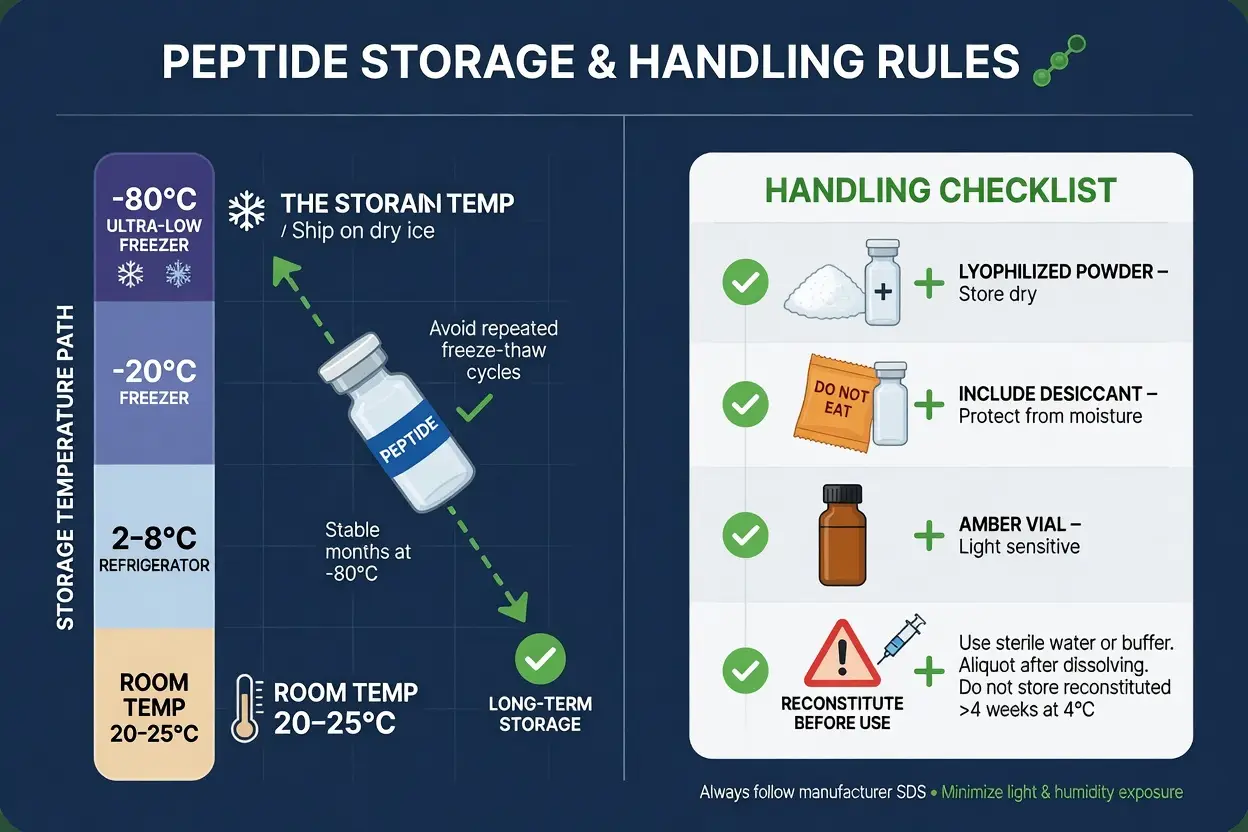
Research peptides are typically shipped as lyophilized powder and require cold storage. The exact temperature depends on the peptide sequence and stability profile. Many lyophilized peptides are stored at -20°C for short-term use or -80°C for long-term storage. Once reconstituted, the peptide solution should be aliquoted to avoid repeated freeze-thaw cycles, which degrade peptide integrity. Light and moisture accelerate degradation, so vials should remain sealed and desiccated. Proper handling of research peptides cosmetic peptides starts with storage conditions.
Cosmetic peptides inside finished products have different storage rules. The cosmetic formulation itself is designed to remain stable at room temperature for months or years, but the peptide inside may slowly degrade. Opened cosmetic products are exposed to air, light, and microbial contamination, which can reduce peptide activity. Manufacturers add preservatives and antioxidants to slow this process, but no cosmetic peptide remains stable indefinitely.
Research peptides cosmetic peptides therefore require different handling protocols: lab reagents need controlled cold storage and batch logs, while cosmetic actives need shelf-life testing and preservative efficacy data under labeled storage conditions. Labs should never treat a cosmetic product as a source of research-grade peptide.
💡 Key Takeaway: What Storage and Handling Rules Apply to Research Peptides Cosmetic Peptides?
What Common Mistakes Occur When Comparing Research Peptides Cosmetic Peptides?
Several mistakes appear repeatedly when researchers and formulators compare research peptides cosmetic peptides:
- Assuming purity from a cosmetic label: A cosmetic product listing a peptide at 1% concentration does not mean the peptide is 98% pure or even intact after formulation.
- Using cosmetic reviews as lab evidence: Consumer testimonials about a cream or serum do not validate sequence identity, batch purity, or stability.
- Ignoring the skin barrier: A peptide that works in cell culture may fail in a topical product because it cannot penetrate the stratum corneum.
- Overlooking salt form and counterion: The same peptide sequence can have different molecular weights and solubility depending on whether it is an acetate, TFA, or HCl salt.
- Storing research peptides at room temperature: Lyophilized peptides degrade faster at ambient temperature, especially in humid conditions.
- Applying finished-product safety to raw material: A cosmetic ingredient deemed safe at low concentrations is not automatically safe as a concentrated research reagent, and vice versa.
The nationwide peptides review — : 7 Proven Facts (2026) highlights several supplier red flags that labs should avoid when sourcing research materials. Those red flags apply directly to any comparison of research peptides cosmetic peptides.
FAQ
What is the main difference between research peptides and cosmetic peptides?
Research peptides cosmetic peptides differ by intended use, documentation, and regulatory context. Research peptides are raw laboratory materials with batch-specific CoA, purity data, and sequence confirmation for in vitro or pre-clinical work. Cosmetic peptides are formulated actives inside skin-care products, judged by safety in labeled use, formulation stability, and skin delivery. All research peptides remain strictly for in vitro laboratory research only.
Do research peptides cosmetic peptides have the same chemical structure?
Yes, the same amino acid sequence can appear in both categories. A lyophilized peptide with a CoA is a research tool, while the same sequence inside a cosmetic serum is a formulated active. The chemical identity may be identical, but the safety data, stability profile, and intended use are not. Labs should not assume that a cosmetic ingredient listing proves research-grade purity or identity.
Why is skin delivery a bigger challenge for cosmetic peptides than for research peptides?
Research peptides are used in controlled in vitro assays where delivery is not the primary question. Cosmetic peptides must cross or interact with the stratum corneum barrier, which resists hydrophilic molecules. A 2024 review noted that diffusion of highly hydrophilic substances through the stratum corneum remains under active discussion. A 2025 review describes skin-penetrating peptides as potential permeation enhancers, but delivery remains the central technical hurdle.
Does the FDA require premarket approval for cosmetic peptides?
No. The FDA does not require premarket approval for most cosmetic ingredients or products. However, the marketer is responsible for ensuring safety under labeled or customary conditions of use. Research peptides cosmetic peptides sit in different compliance zones: research peptides are not consumer cosmetics and must not be used on human skin, while cosmetic peptides follow cosmetic product rules.
What should a lab check before buying research peptides cosmetic peptides?
Labs should verify sequence identity via mass spectrometry or HPLC, check the CoA for purity (≥95% for most research applications), confirm batch traceability, note the counterion and salt form, review residual solvent data, and follow storage requirements at -20°C or -80°C. Cosmetic peptide labels do not provide these data points, so labs should only source research peptides from suppliers with batch-specific documentation.
Ready to Take the Next Step?
Every product includes lot-specific documentation and third-party purity testing.
Explore Our Research Products →Free shipping on qualifying orders · Batch COA on request