
Top Growth Hormone Peptides for Laboratory Research
Peptides for laboratory research: compare sermorelin, ghrelin, GHRP-6, GHRP-2, hexarelin, and ipamorelin by receptor, purity, and FDA status. Research use only.
📋 Table of Contents
The most studied peptides for laboratory research in GH signaling are sermorelin, ghrelin, GHRP-6, GHRP-2, hexarelin, and ipamorelin, split by GHRHR versus GHSR-1a receptor action. No growth hormone secretagogue has FDA approval for adult GHD, and only sermorelin carries pediatric regulatory precedent; Countrywide Peptides documents 99%+ purity, third-party testing, and public CoAs for these research-use-only peptides.
Key takeaways
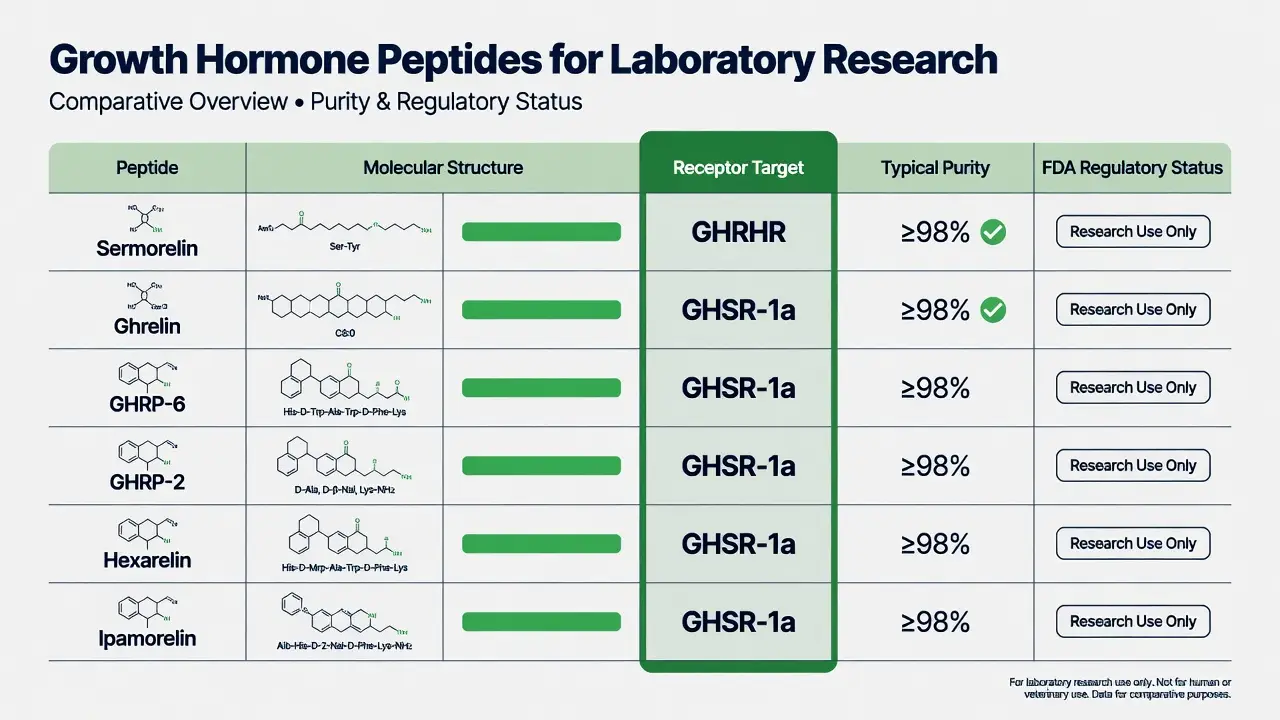
- The six most studied peptides for laboratory research in GH signaling are sermorelin, ghrelin, GHRP-6, GHRP-2, hexarelin, and ipamorelin, split by GHRHR versus GHSR-1a pathways.
- FDA precedent is compound-specific: only sermorelin has pediatric GHD approval history; no growth hormone secretagogues are approved for adult GHD, and ipamorelin lacks diagnostic or treatment data.
- Countrywide Peptides supplies research-use-only peptides for laboratory research with 99%+ purity claims, third-party testing, and publicly accessible CoAs.
- Receptor target, endpoint selection, and comparator logic should guide any study design for peptides for laboratory research.
- All compounds remain in vitro research tools, not human or veterinary therapeutics.
What are growth hormone peptides for laboratory research?
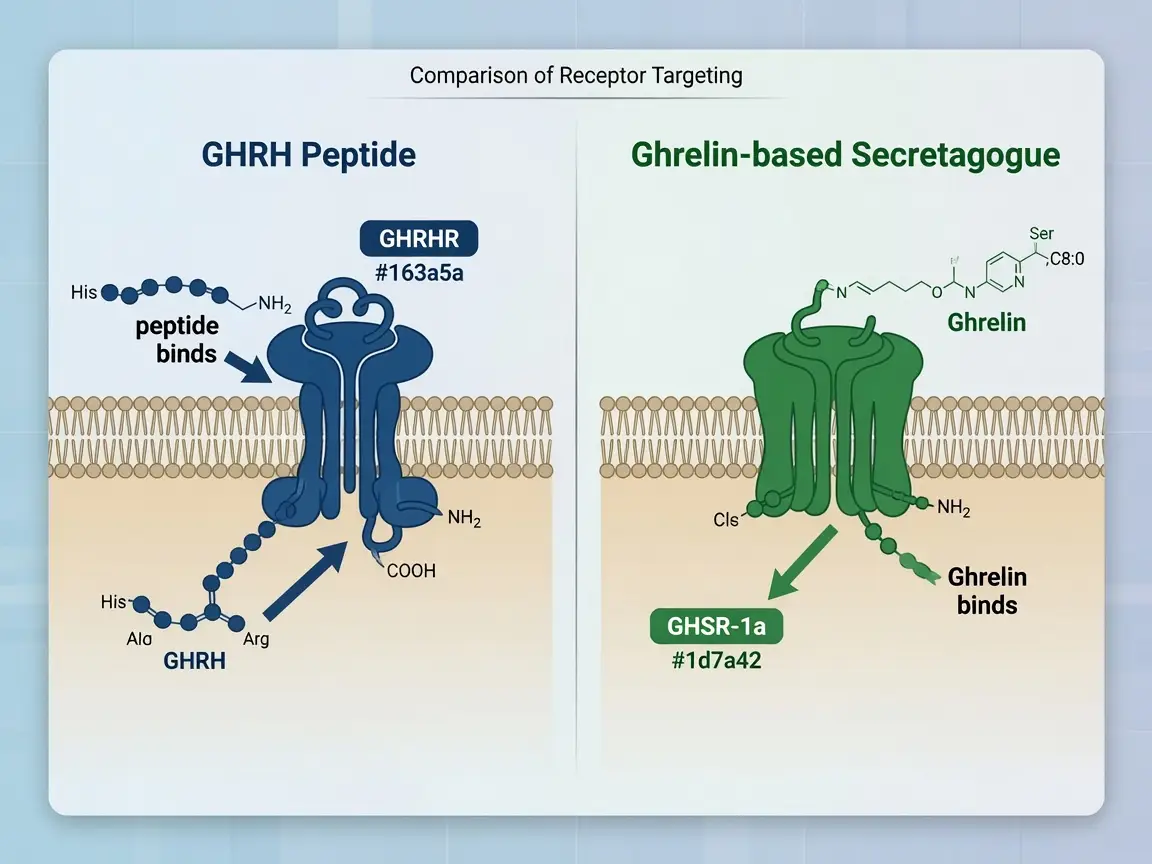
Growth hormone peptides for laboratory research are signaling peptides that either stimulate GH release through GHRHR or trigger secretagogue signaling through GHSR-1a. In lab practice, that means GHRH analogs, ghrelin, and GHRPs belong in related but separate experimental buckets.
The basic split comes from receptor biology. GHRH binds the pituitary GHRH receptor, while ghrelin and synthetic growth hormone secretagogues activate GHSR-1a. Endotext also frames the systems differently at a functional level: ghrelin may be more involved in releasing stored GH, while the GHRH and GHRHR axis is more tied to de novo GH production.
Countrywide Peptides states 99%+ purity standards, third-party testing, and publicly accessible CoAs for every peptide, which fits the documentation needs of laboratory peptide work. That is why the phrase growth hormone peptides is useful only when it is followed by a mechanistic qualifier. For peptides for laboratory research, a mechanistic qualifier prevents misclassification.
A peptide that acts on GHSR-1a is not just a stronger or weaker version of a GHRH analog. It is a different experimental signal. Researchers who treat all growth hormone peptides as interchangeable risk contaminating their dataset with mixed receptor outputs.
How do GHRH peptides and ghrelin-based secretagogues differ in receptor targets?
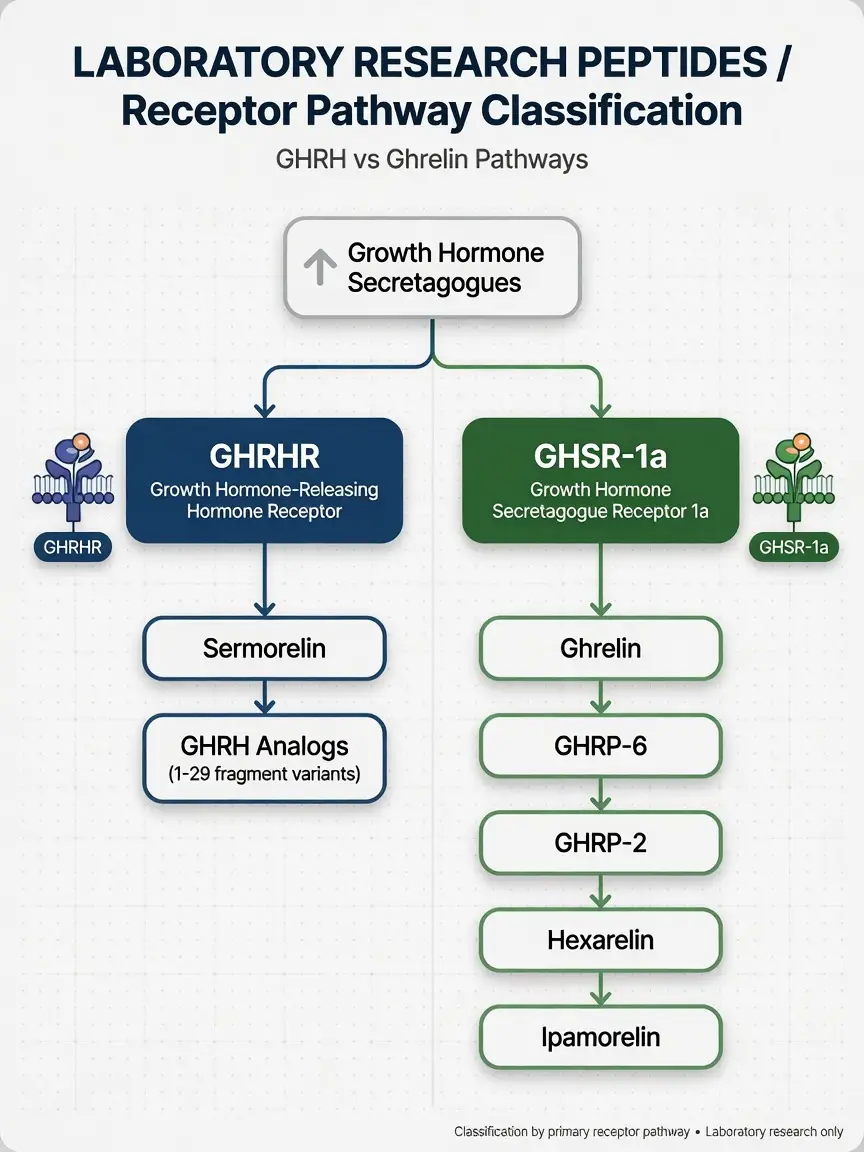
They differ at the receptor level and often at the study objective level. GHRH peptides act through GHRHR, while ghrelin and synthetic secretagogues act through GHSR-1a, so the right comparator depends on whether a lab is testing pituitary release, secretagogue signaling, or combination effects.
Endotext and PubMed-indexed reviews support this split clearly. GHRHR is a G-protein coupled receptor, and Endotext describes the receptor gene on chromosome 7p15 with 13 exons encoding a 423-amino-acid protein. Ghrelin, by contrast, is the endogenous ligand tied to GHSR-1a signaling, and synthetic GHSs were built around that biology. You can verify the receptor details in the Endotext chapter and browse related receptor studies on PubMed.
A common mistake is treating all GH-releasing peptides as if they answer the same question. If the goal is receptor mapping, then GHRHR studies and GHSR-1a studies should not be merged casually. If the goal is acute GH release, then secretagogues may be the more direct model. If the goal is upstream pituitary physiology, GHRH analogs can be the cleaner starting point. For peptides for laboratory research, receptor class should be the first filter.
💡 Key Takeaway: How do GHRH peptides and ghrelin-based secretagogues differ in receptor targets?
What are the main growth hormone peptides labs study?
The main peptides for laboratory research in growth hormone studies are sermorelin, ghrelin, GHRP-6, GHRP-2, hexarelin, and ipamorelin. They matter because each name points to a specific receptor pathway, historical research track, or regulatory discussion.
A practical way to sort them is by asking what they represent in the literature rather than by asking which one is best. In this category, best usually means best matched to the hypothesis. When ranking peptides for laboratory research, receptor pathway matters more than name recognition.
Here is a research map for the six compounds:
- Sermorelin: a GHRH analog and the clearest regulatory reference point in GH-related peptide discussions.
- Ghrelin: the native 28-amino-acid octanoylated peptide that activates GHSR-1a.
- GHRP-6: a classic peptide secretagogue often cited in the older GHRP literature.
- GHRP-2: another established GHRP used in comparative secretagogue work.
- Hexarelin: a potent peptide member of the GHRP and GHS family.
- Ipamorelin: a newer, widely discussed secretagogue with research interest but limited regulatory precedent.
This is not an exhaustive list, and it should not be read as a clinical ranking. It is a research map for peptides for laboratory research.
Why is sermorelin different from ipamorelin in FDA regulatory context?
Sermorelin and ipamorelin are not equivalent from an FDA precedent standpoint. FDA materials distinguish older pediatric-approved sermorelin from newer secretagogues like ipamorelin, for which FDA says it did not identify data supporting diagnosis or treatment of GHD.
That matters because many readers blend mechanism and regulatory status into the same decision. FDA states that among growth hormone secretagogues, only sermorelin was approved for treatment of short stature associated with growth hormone deficiency in pediatric patients. FDA also states there are no GHSs approved for treating adult GHD or childhood-onset GHD in adults.
The sermorelin record also has historical depth. FDA records list sermorelin acetate under the trade name Geref, with orphan designation dated September 14, 1988, for idiopathic or organic growth hormone deficiency in children with growth failure. That history does not automatically generalize to ipamorelin acetate or other newer secretagogues.
The practical takeaway is simple: regulatory precedent is compound-specific. A family label like growth hormone secretagogue does not transfer evidence evenly across every member. For peptides for laboratory research, regulatory status should not be inferred from class membership.
How should a lab classify peptides for laboratory research before study design?
A lab should classify a candidate growth hormone peptide by receptor target, experimental endpoint, and comparator strategy before it writes the protocol. That three-step filter prevents many avoidable study design errors.
Step 1 is receptor identity. Ask whether the peptide acts through GHRHR, GHSR-1a, or both in certain models. Step 2 is endpoint selection: are you measuring acute GH release, receptor binding, gene expression, or downstream signaling? Step 3 is comparator logic: choose a positive control, a negative control, and a same-class reference peptide where possible.
This classification matters because peptides for laboratory research often look similar on supplier pages but behave differently in assay systems. A clear receptor label keeps raw data interpretable and prevents mixing outputs from distinct pathways.
💡 Key Takeaway: How should a lab classify peptides for laboratory research before study design?
How do GHRP-6, GHRP-2, and hexarelin fit into GH secretagogue research?
GHRP-6, GHRP-2, and hexarelin are synthetic growth hormone secretagogues that act primarily through GHSR-1a. They are often used as comparators in secretagogue studies because their potency, stability, and historical literature differ enough to generate meaningful datasets.
GHRP-6 is a classic peptide secretagogue often cited in the older GHRP literature. GHRP-2 is another established GHRP used in comparative secretagogue work. Hexarelin is a potent peptide member of the GHRP and GHS family, and its stronger GHSR-1a engagement makes it a common positive control in receptor activation assays.
For peptides for laboratory research, these three compounds belong in the same mechanistic bucket but are not interchangeable. Researchers should document the exact peptide, batch, and supplier when reporting results because small differences in synthesis or counterion can shift in vitro activity.
How can ghrelin and GHRH produce synergistic GH release in research models?
Ghrelin and GHRH can produce synergistic GH release in research models because they activate separate receptor pathways that converge on somatotroph secretion. Ghrelin and synthetic secretagogues trigger GHSR-1a, while GHRH analogs bind GHRHR, and combined activation can amplify the GH output beyond either signal alone.
Endotext notes that ghrelin may be more involved in releasing stored GH, while the GHRH axis is more tied to de novo GH production. That functional distinction is why combination studies are common in peptide research. A dual-arm design with a GHRH analog and a GHSR-1a secretagogue can isolate additive or synergistic effects.
When using peptides for laboratory research in synergy experiments, labs should include single-agent arms, a vehicle arm, and a fixed-ratio combination arm. This design separates additivity from true synergy and keeps receptor-level conclusions clean.
Which peptides for laboratory research act through GHRHR vs GHSR-1a?
Sermorelin is the primary GHRHR agonist in this group, while ghrelin, GHRP-6, GHRP-2, hexarelin, and ipamorelin act through GHSR-1a. This binary split is the first filter for any peptide comparison.
GHRHR is a G-protein coupled receptor whose gene sits on chromosome 7p15 and contains 13 exons encoding a 423-amino-acid protein. GHSR-1a is the ghrelin receptor, and synthetic GHSs were designed around ghrelin’s octanoylated 28-amino-acid structure. These are distinct receptor systems with different downstream coupling.
A practical table for peptides for laboratory research would list receptor target, native ligand, and typical in vitro use. That table prevents the common error of calling all GH peptides GHRH-like or all secretagogues ghrelin-like without checking the receptor map.
💡 Key Takeaway: Which peptides for laboratory research act through GHRHR vs GHSR-1a?
What documentation and purity standards should labs require for peptides for laboratory research?
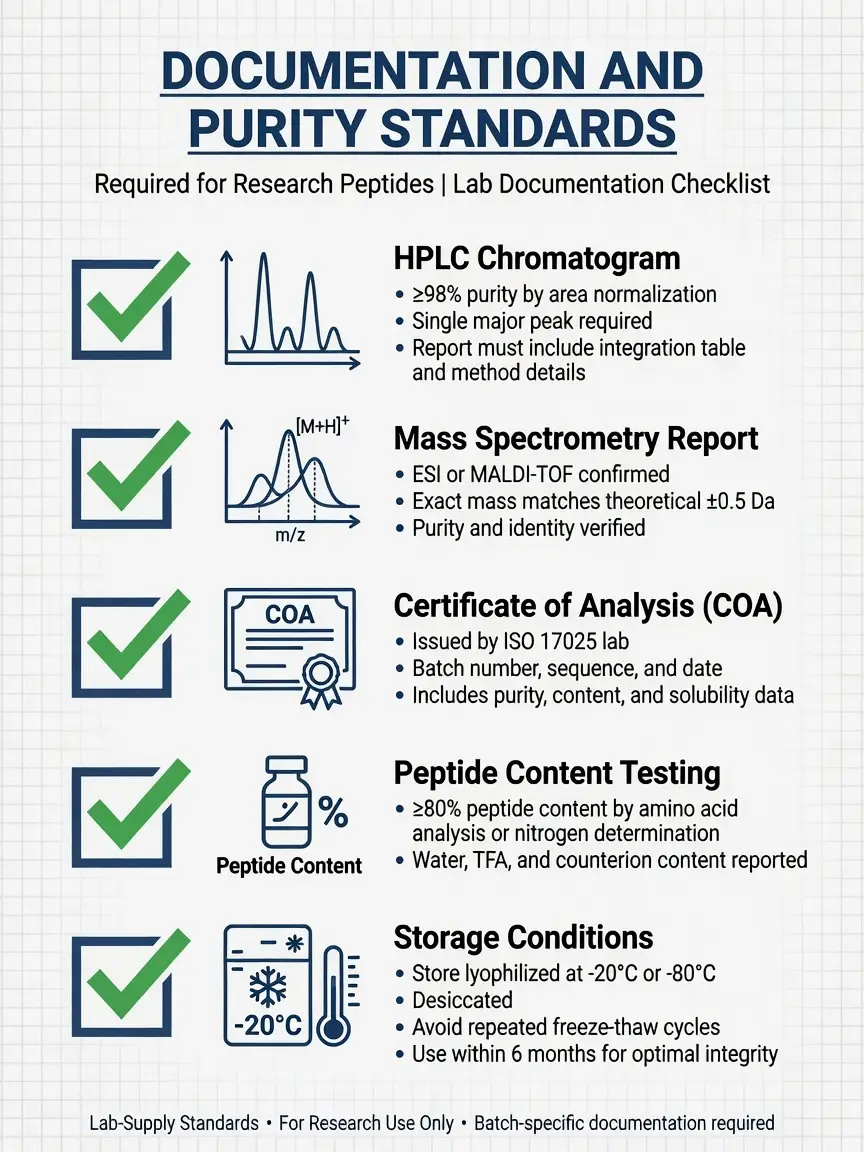
Labs should require a certificate of analysis (CoA), third-party purity testing, and a clear statement of peptide content and storage conditions for every peptide used in research. Countrywide Peptides states 99%+ purity, third-party testing, and publicly accessible CoAs for its research-use-only peptides for laboratory research.
Purity claims alone are not enough. A CoA should list the exact analytical method, such as HPLC or UPLC, the observed purity percentage, and the residual solvent or counterion profile. For peptides for laboratory research, mass spectrometry confirmation of molecular weight adds another layer of confidence.
Storage conditions also matter. Lyophilized peptides should be stored at -20°C or below, and reconstituted peptides should be aliquoted and kept at -80°C to minimize degradation. These measurable attributes protect assay reproducibility and reduce batch-to-batch variability.
What are common mistakes when comparing peptides for laboratory research?
The most common mistake is treating all growth hormone peptides as interchangeable. Researchers who merge GHRHR agonists and GHSR-1a secretagogues into one GH peptide group contaminate their dataset with mixed receptor outputs.
Another mistake is comparing purity claims without checking CoA methods. A 99% purity claim from one supplier may not be comparable to 99% from another if the analytical methods differ. For peptides for laboratory research, method transparency is part of the comparison.
A third mistake is inferring regulatory status from class membership. Only sermorelin has pediatric GHD approval history; no growth hormone secretagogue is approved for adult GHD, and ipamorelin lacks diagnostic or treatment data. Regulatory precedent is compound-specific.
How can researchers design a comparator study with multiple GH peptides?
Researchers should design a comparator study with at least four arms: vehicle control, GHRHR agonist, GHSR-1a secretagogue, and a combination arm. This design allows direct receptor-level comparison without confounding pathway effects.
For peptides for laboratory research, each arm should use matched molar concentrations and identical vehicle conditions. If the goal is receptor mapping, include a selective antagonist for each receptor where available. If the goal is GH release, include time-course sampling because peak release timing can differ between GHRH analogs and ghrelin-based secretagogues.
Documentation should include batch numbers, purity percentages, and storage history. That level of detail makes the comparison reproducible and lets other labs audit whether the observed differences came from the peptide or from handling.
💡 Key Takeaway: How can researchers design a comparator study with multiple GH peptides?
How do peptide blends and bulk orders support multi-arm studies?
Peptide blends and bulk orders support multi-arm studies by reducing supplier-level variability and simplifying logistics. When a lab orders multiple peptides for laboratory research from one documented source, it can align CoAs, storage conditions, and analytical methods across all arms.
Bulk orders also allow a lab to pre-test one lot for purity and receptor activity before committing to a full study. For example, a lab running a GHRP-2 versus hexarelin versus ipamorelin comparison can order all three from the same batch series and validate them once. Countrywide Peptides public CoAs and third-party testing support this kind of pre-study qualification.
Blends should be avoided in mechanistic comparator studies unless the blend composition is exactly specified and independently verified. For clean receptor-level data, single-peptide arms are usually better than pre-mixed blends. For peptides for laboratory research, clarity of composition is non-negotiable.
What role does ghrelin’s octanoylation play in research models?
Ghrelin is a 28-amino-acid peptide with a unique octanoyl modification on Ser3. That octanoylation is required for high-affinity GHSR-1a binding and is a key structural feature that synthetic secretagogues often mimic or bypass.
In research models, des-acyl ghrelin shows much weaker or absent GHSR-1a activity, so labs should confirm the acylated state before using ghrelin in receptor assays. For peptides for laboratory research, this means checking the CoA for octanoylation status or ordering the explicitly acylated form.
The octanoyl group also affects solubility and stability. Acylated ghrelin is more lipophilic than des-acyl ghrelin, so vehicle preparation and storage conditions need to match the peptide’s chemistry. Mislabeling acylated and des-acyl forms is a common source of failed experiments.
What should researchers know about FDA and Endotext sources for peptides for laboratory research?
Researchers should know that FDA materials are compound-specific and that Endotext chapters are the most detailed open-access reference for GH receptor biology. FDA records list sermorelin acetate under Geref with orphan designation dated September 14, 1988, for pediatric growth hormone deficiency. Endotext describes the GHRHR gene on chromosome 7p15 with 13 exons and 423 amino acids.
For peptides for laboratory research, these sources should be cited separately: FDA for regulatory status, Endotext for receptor and pathway biology. Mixing them leads to category errors, such as assuming a receptor mechanism implies a clinical approval.
PubMed-indexed reviews also support the GHRHR versus GHSR-1a split. A good practice is to link every peptide claim to its primary source, whether that is an FDA label, an Endotext chapter, or a peer-reviewed receptor study.
💡 Key Takeaway: What should researchers know about FDA and Endotext sources for peptides for laboratory research?
What is the regulatory boundary for growth hormone secretagogues in research use only?
The regulatory boundary is simple: no growth hormone secretagogue is FDA-approved for adult GHD, and only sermorelin has pediatric approval history. Everything else, including ipamorelin, GHRP-6, GHRP-2, hexarelin, and ghrelin, remains an in vitro research tool or an unapproved compound outside that context.
FDA states that it did not identify data supporting diagnosis or treatment of GHD for ipamorelin. That does not mean ipamorelin is unsafe in a dish; it means there is no regulatory pathway that turns it into a human therapeutic. For peptides for laboratory research, this boundary keeps study design honest and prevents overinterpretation of preclinical signals.
All products discussed here are sold strictly for in vitro laboratory research use only. They are not for human use, not for veterinary use, and not intended to diagnose, treat, cure, or prevent any disease. Must be 21+ to purchase.
How do researchers validate peptide purity and receptor activity in vitro?
Researchers validate peptide purity with HPLC or UPLC plus mass spectrometry, and they validate receptor activity with cell-based assays that report GHRHR or GHSR-1a activation. A purity CoA is necessary but not sufficient; it tells you what is in the vial, not what the peptide does in your assay.
For GHSR-1a, a common readout is calcium mobilization or cAMP modulation in cells expressing the receptor. For GHRHR, cAMP accumulation is the standard signal. When testing peptides for laboratory research, include a known agonist and a vehicle control in every plate.
Batch-to-batch validation should use the same assay conditions and the same reference standard. If a new batch shows a shift in EC50 or maximal response, check the CoA for purity, salt form, and residual solvents before repeating the experiment.
How should labs compare Countrywide Peptides with other suppliers for peptides for laboratory research?
Labs should compare suppliers on five measurable attributes: purity documentation, third-party testing, public CoA access, storage and shipping conditions, and batch-to-batch consistency. Countrywide Peptides states 99%+ purity, third-party testing, and publicly accessible CoAs for every research peptide.
A Countrywide Peptides quality standards review shows why public CoAs matter: they let a lab verify purity before purchase instead of relying on marketing language. A Nationwide Peptides review adds context on supplier comparisons, and the Peptide Suppliers USA guide outlines how to choose a trusted source for research peptides.
For peptides for laboratory research, the comparison should also include how the supplier handles research-use-only compliance, age verification, and shipping temperature. A supplier that cannot produce a CoA on request is not comparable to one that posts CoAs publicly.
💡 Key Takeaway: How should labs compare Countrywide Peptides with other suppliers for peptides for laboratory research?
FAQ
What are the six main peptides for laboratory research in GH signaling?
Sermorelin, ghrelin, GHRP-6, GHRP-2, hexarelin, and ipamorelin. They split into GHRHR agonists (sermorelin) and GHSR-1a secretagogues (ghrelin, GHRP-6, GHRP-2, hexarelin, ipamorelin).
Is any growth hormone peptide FDA-approved for adult GHD?
No. FDA states no growth hormone secretagogues are approved for adult GHD or childhood-onset GHD in adults. Only sermorelin has pediatric approval history under the trade name Geref, with orphan designation dated September 14, 1988.
What purity standards does Countrywide Peptides document for research peptides?
Countrywide Peptides states 99%+ purity, third-party testing, and publicly accessible CoAs. Labs should also verify analytical methods and storage conditions for peptides for laboratory research.
Why is ghrelin’s octanoylation important in receptor assays?
The octanoyl group on Ser3 of the 28-amino-acid ghrelin peptide is required for high-affinity GHSR-1a binding. Des-acyl ghrelin shows much weaker activity, so labs must confirm the acylated form before use.
What is the regulatory boundary for growth hormone secretagogues?
They are research-use-only compounds. No GHS is approved for adult GHD, and only sermorelin has pediatric regulatory precedent. All products are for in vitro laboratory research only, not human or veterinary use.
Ready to Take the Next Step?
Every product includes lot-specific documentation and third-party purity testing.
Explore Our Research Products →Free shipping on qualifying orders · Batch COA on request