
Peptide Suppliers USA: How to Choose a Trusted Source
Peptide suppliers usa: evaluate COAs, 98%+ HPLC purity, domestic warehousing, and red flags. A research-use-only guide to finding a trusted US source.
📋 Table of Contents
The most trustworthy peptide suppliers usa share a small set of verifiable traits: batch-specific, third-party-verified Certificates of Analysis (COAs), guaranteed purity of 98 percent or higher confirmed by HPLC and mass spectrometry, genuine domestic inventory, and strict research-use-only positioning. Vetting suppliers against these measurable criteria—rather than price or marketing claims—is the fastest way to find a trusted domestic source for laboratory research peptides.
Key takeaways
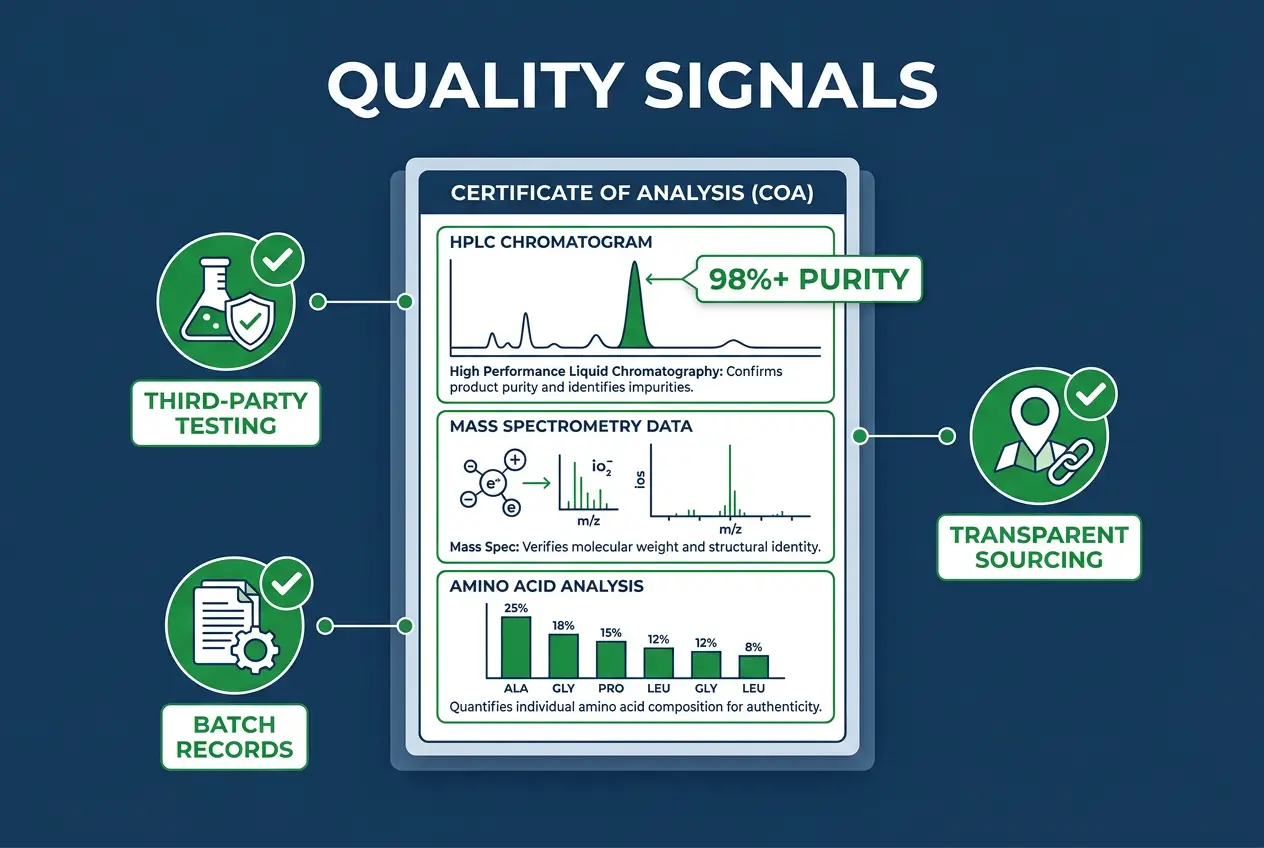
- Batch-specific, third-party-verified COAs are the single most important quality signal any peptide suppliers usa can provide.
- Research-grade purity is 98 percent or higher, confirmed by high-performance liquid chromatography (HPLC), with mass spectrometry (MS) used alongside to verify molecular weight and compound identity.
- Domestic warehousing enables delivery in two to five business days, protects cold chain integrity, and eliminates customs risk entirely.
- Suspiciously low prices, missing lot numbers, vague business details, and marketing that implies human use are serious red flags when comparing peptide suppliers usa.
- All peptides sold by US research suppliers are intended for in-vitro laboratory research only and are not approved for human or veterinary use.
The market for research peptides has expanded rapidly, and a quick search for peptide suppliers usa now returns dozens of companies—all claiming top purity, fast shipping, and unbeatable prices. For laboratories, institutions, and independent researchers, the real challenge is not finding a supplier; it is figuring out which ones actually deliver on those promises. This guide breaks down the criteria that matter most when vetting a domestic peptide supplier.
Why should you source from peptide suppliers usa?
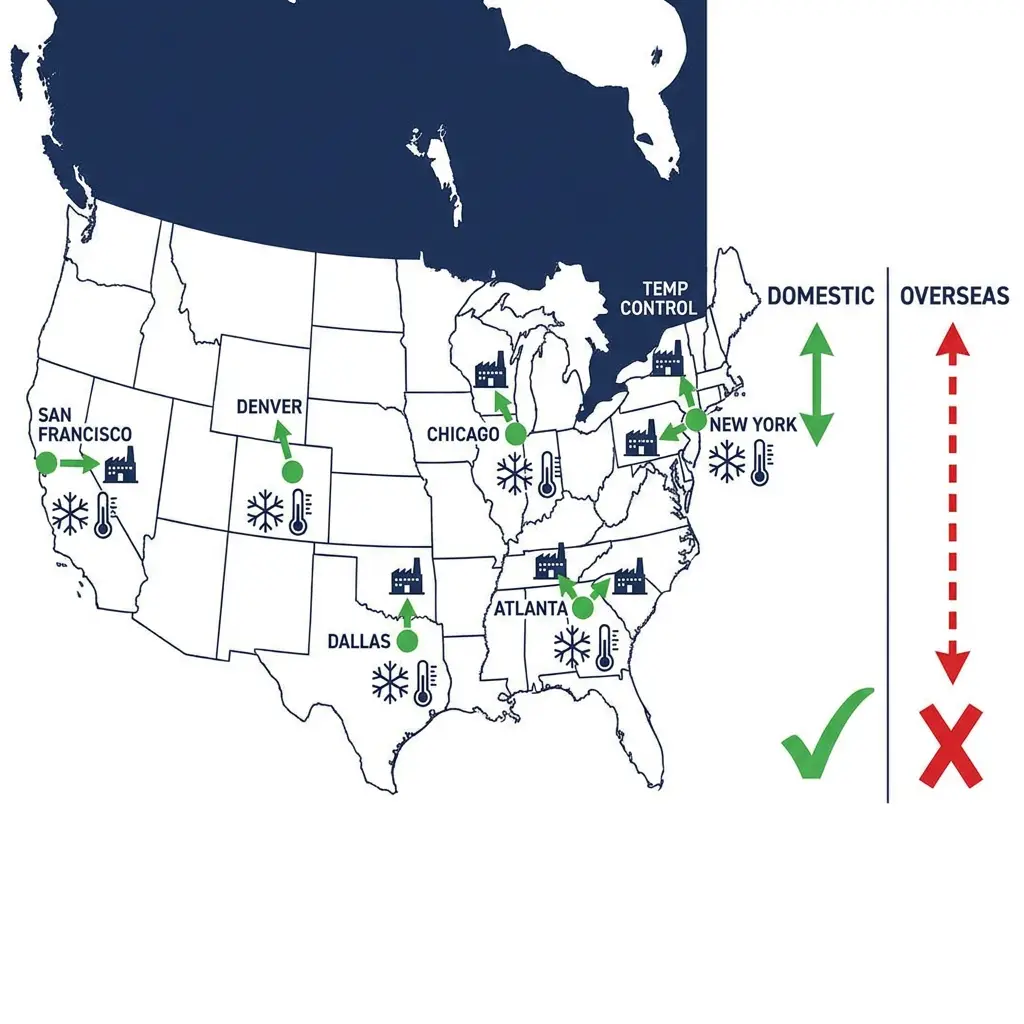
Buying from a US-based supplier is about more than convenience. It directly affects the quality and usability of the peptides you receive. Choosing peptide suppliers usa over overseas vendors changes the entire logistics and accountability profile of your order.
Faster, more predictable shipping
Domestic orders typically arrive in two to five business days rather than two to four weeks. Shorter transit times mean less exposure to temperature fluctuations that can degrade sensitive compounds. A peptide that sits in a warehouse or cargo hold for three weeks has far more opportunity to lose stability than one delivered in three days.
No customs risk
International shipments of peptides can be delayed, inspected, or seized at the border. Ordering domestically eliminates that uncertainty entirely. Peptide suppliers usa with physical US inventory never subject your order to customs review, import holds, or seizure risk.
Easier communication and accountability
A supplier with a US address, US-based support staff, and domestic business registration is far easier to reach—and far more accountable—than an anonymous overseas operation. If a problem arises, you want a real company you can call, email, or even verify through state business records.
Cold chain integrity
Many peptides are lyophilized (freeze-dried) for stability, but they still benefit from climate-controlled storage and careful packaging. Domestic fulfillment makes proper handling much easier to maintain. Lyophilized peptides are stable at ambient temperature for short periods, but prolonged exposure to heat or humidity can degrade them. Peptide suppliers usa with genuine domestic warehousing can store vials in climate-controlled conditions and ship with appropriate insulation.
What quality signals separate serious peptide suppliers usa from the rest?
Not all peptide suppliers usa operate to the same standard. These are the markers worth checking before you spend a dollar. A supplier that cannot demonstrate these quality signals is not a serious contender for your laboratory research.
Do they provide batch-specific Certificates of Analysis?
A Certificate of Analysis (COA) is the single most important document a supplier can provide. It confirms the identity and purity of a specific batch—not a generic sample from months ago. Reliable peptide suppliers usa publish COAs for every lot they sell, ideally verified by an independent third-party laboratory rather than produced in-house.
When reviewing a COA, check that it includes the batch or lot number, the testing date, the analytical method used, and a purity percentage. If a supplier cannot produce a batch-specific COA on request, treat that as a serious warning sign. A COA that lacks a lot number is nearly worthless because you cannot connect the document to the vial in your hand.
For a deeper look at how a reputable supplier structures its quality program, review Countrywide Peptides: 5 Proven Quality Standards for Labs.
Is purity verified through HPLC and mass spectrometry?
The industry standard for research-grade peptides is purity of 98 percent or higher, confirmed by high-performance liquid chromatography (HPLC). Mass spectrometry (MS) should be used alongside HPLC to confirm the molecular weight and identity of the compound. Together, these two methods tell you that the vial contains the correct peptide at the stated purity. Suppliers who invest in both tests—and share the results openly—are demonstrating a genuine commitment to quality control.
HPLC measures purity by separating the peptide from impurities. Mass spectrometry confirms the molecular weight matches the expected sequence. Without both, you cannot be certain the product is what it claims to be. Serious peptide suppliers usa understand that HPLC alone cannot distinguish between two peptides of similar retention time, and MS alone cannot quantify purity. The combination is what gives you confidence.
What manufacturing and handling standards do they follow?
Ask where and how the peptides are synthesized and handled. Reputable peptide suppliers usa work with established synthesis facilities, lyophilize their products for shelf stability, seal vials under controlled conditions, and label every unit with a lot number for traceability. Proper labeling is a small detail that reveals a great deal about how a company operates behind the scenes.
Look for suppliers that use USP-grade or equivalent raw materials, employ sterile filtration before lyophilization, and package vials under inert gas when appropriate. These are not marketing gimmicks; they are standard practices in serious peptide manufacturing. A supplier that cannot describe its synthesis and handling process in detail is likely cutting corners somewhere.
💡 Key Takeaway: What quality signals separate serious peptide suppliers usa from the rest?
Why does domestic warehousing matter for peptide suppliers usa?

Some companies present themselves as American suppliers while actually drop-shipping from overseas. The storefront is in the US; the inventory is not. This arrangement reintroduces every problem domestic sourcing is supposed to solve—long transit times, customs exposure, and inconsistent storage conditions.
A supplier with genuine domestic inventory, like the stock held in a dedicated peptide warehouse in the USA, can fulfill orders the same or next business day, maintain climate-controlled storage, and replace any compromised product quickly. Before ordering, it is worth asking a supplier directly where their inventory is physically located. The answer is often revealing.
Domestic warehousing also allows for batch retention samples. A supplier that keeps retained samples from each lot can retest if a question arises about a specific batch. Overseas drop-shippers typically cannot do this. For researchers comparing peptide suppliers usa, physical domestic inventory is a strong indicator of operational maturity.
A useful comparison is available in National Science Labs Peptides: A Researcher’s Guide, which discusses how domestic logistics affect research timelines.
What questions should you ask before choosing among peptide suppliers usa?
A few minutes of due diligence can save you from a frustrating—and expensive—mistake. Before committing to a new supplier, ask these five questions. The speed and substance of the answers will tell you almost everything you need to know about how the company treats its customers after the sale.
Five pre-order questions for peptide suppliers usa
1. Are COAs published for every batch, and are they third-party verified? If the supplier hesitates or offers only a generic COA, move on.
2. What purity level is guaranteed, and which analytical methods confirm it? Look for 98 percent or higher via HPLC plus MS, not a vague promise.
3. Where is inventory stored, and how is it packaged for shipping? Domestic warehousing and insulated packaging are non-negotiable.
4. What is the replacement or refund policy if a product arrives damaged or fails testing? A supplier that stands behind its product will answer this clearly.
5. How quickly does the support team respond to pre-sale questions? If they are slow before you pay, they will be slower after.
These questions work for any supplier, but they are especially important when you are comparing multiple peptide suppliers usa. A supplier that cannot answer all five in writing within one business day is not ready for your business.
Which red flags should you watch for with peptide suppliers usa?
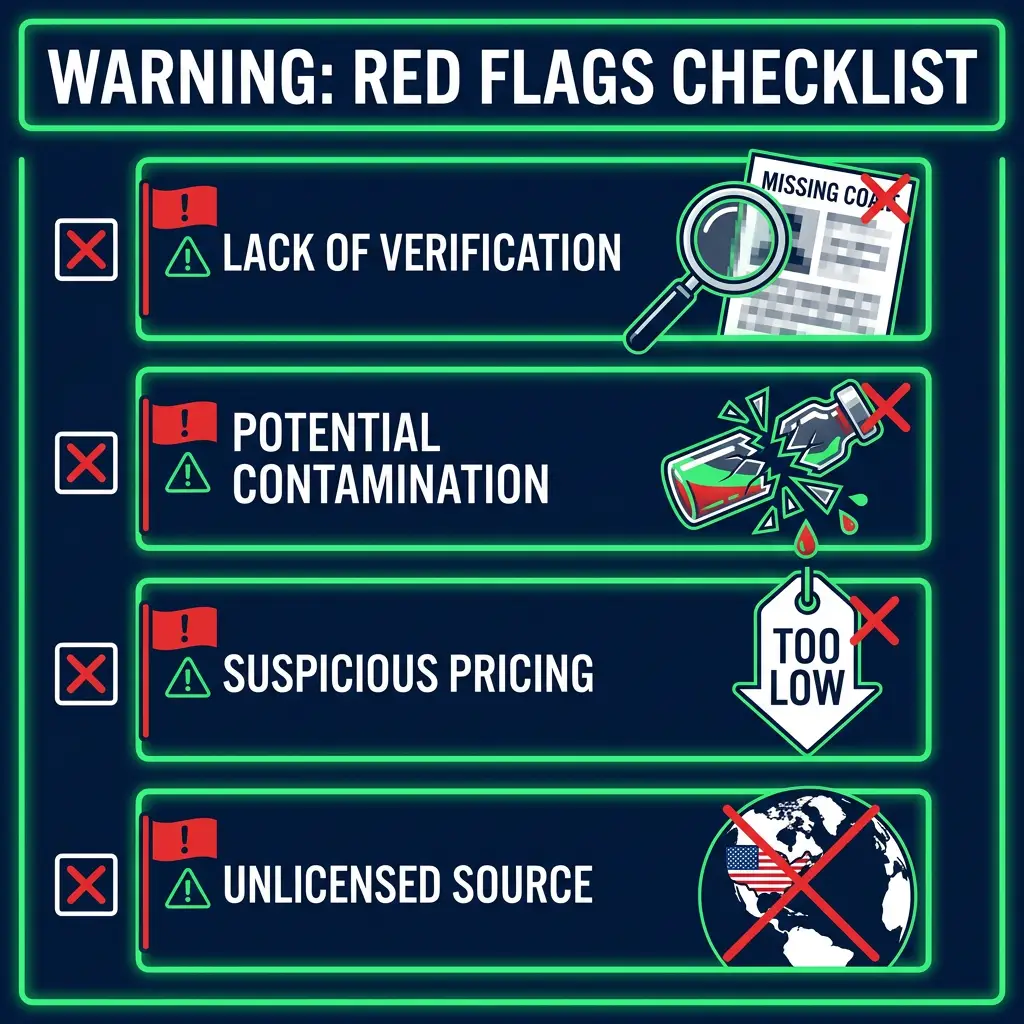
Just as there are positive signals to look for, there are warning signs that should send you elsewhere. Recognizing these red flags early can save you time, money, and compromised research.
Five red flags to avoid
- No COAs, or generic COAs with no batch number. This suggests testing is not actually being performed per lot.
- Prices dramatically below market rate. Peptide synthesis, purification, and analytical testing carry real costs. Suspiciously cheap products are often underdosed, impure, or mislabeled.
- Vague business details. No physical address, no phone number, and no identifiable company registration are all reasons for caution.
- Marketing that implies human use. Legitimate peptide suppliers usa sell peptides strictly for laboratory research purposes. A company making wellness or therapeutic claims is signaling poor compliance practices—and potentially putting buyers at risk.
- No lot numbers on vials. Without traceability, there is no way to connect your product to its test results.
If you encounter even one of these red flags, do not place an order. If you encounter two or more, remove that supplier from your list entirely. Checking independent feedback can also help; Nationwide Peptides Reviews | Countrywide Peptides offers one perspective on what researchers look for in a domestic supplier.
💡 Key Takeaway: Which red flags should you watch for with peptide suppliers usa?
How should you weigh price vs. value among peptide suppliers usa?
It is tempting to sort suppliers by price and pick the cheapest option. But with research peptides, the sticker price reflects a chain of decisions: synthesis quality, purification rigor, analytical testing, storage conditions, and fulfillment speed. A supplier charging slightly more may be covering third-party testing and domestic warehousing, while a cheaper competitor may be skipping both.
The most useful comparison is not price per vial but cost per verified milligram of pure, correctly identified peptide—delivered intact and on time. By that measure, the cheapest listing is rarely the best value. A vial that is only 90 percent pure, or that degrades during a three-week international shipment, costs you far more in wasted experiments than the few dollars you saved.
A simple value equation for peptide suppliers usa
Consider two hypothetical suppliers. Supplier A charges 20 percent less per vial but provides no COA, ships from overseas, and takes three weeks. Supplier B charges more but provides third-party-verified COAs, ships from US inventory in three days, and guarantees 98 percent purity. If Supplier A’s product fails to meet specification, you must repeat the experiment, losing time and reagents. Supplier B’s cost per verified milligram is lower because every milligram is actually usable. That is the correct comparison.
What compliance standards apply to US peptide suppliers?
Peptide suppliers usa must operate within a strict research-use-only framework. This is not optional. The products are sold for in vitro laboratory research only—not for human use, not for veterinary use, and not intended to diagnose, treat, cure, or prevent any disease. Suppliers that ignore this boundary are not compliant and should be avoided.
Key compliance markers include clear research-use-only labeling on every product page and vial, no therapeutic or wellness claims, age verification for purchasers (21+), and domestic business registration. A supplier that markets peptides as “for research purposes only” but then uses language implying human benefit is sending mixed signals. Legitimate peptide suppliers usa keep their positioning unambiguous.
For regulatory context, researchers can refer to authoritative sources such as FDA and NCBI for guidance on laboratory research standards and analytical validation. These resources do not endorse any specific supplier, but they define the scientific and regulatory baseline that serious suppliers follow.
How to build a shortlist of peptide suppliers usa
Instead of evaluating dozens of suppliers at once, build a structured shortlist. Start with the five pre-order questions above. Then apply the red flags checklist. Finally, compare only the suppliers that pass both stages.
A practical evaluation checklist
| Criterion | Acceptable | Unacceptable |
|———-|————|————–|
| COA availability | Batch-specific, third-party verified, published | Generic, missing, or no lot number |
| Purity verification | 98%+ by HPLC plus MS | No method stated, or purity below 98% |
| Inventory location | Domestic warehouse, climate-controlled | Drop-shipped from overseas |
| Shipping time | 2–5 business days | 2–4 weeks or unknown |
| Business transparency | US address, phone, registration | No address, anonymous |
| Marketing language | Research-use-only, no human claims | Wellness or therapeutic implications |
| Lot traceability | Lot number on every vial | No lot numbers |
Use this table as a scorecard. A supplier that fails any single row should be removed. A supplier that passes all rows is worth considering. This approach works for any peptide suppliers usa, regardless of size or marketing budget.
💡 Key Takeaway: How to build a shortlist of peptide suppliers usa
Why batch-to-batch consistency matters for peptide suppliers usa
Even if a supplier passes all initial checks, consistency over time is what separates a one-time good batch from a reliable long-term partner. Peptide synthesis is a complex process, and minor variations in raw materials, temperature, or purification can affect the final product.
Batch-specific COAs are not just a one-time requirement; they are how you monitor consistency. If every COA shows 98.5 percent purity by HPLC and the expected mass by MS, the supplier is stable. If purity fluctuates between 95 and 99 percent, that variability may affect your experiments. Reliable peptide suppliers usa maintain tight process controls to keep batch-to-batch variation minimal.
Ask a supplier how they handle out-of-specification batches. A serious supplier will reject or rework them, not ship them anyway. A supplier that cannot describe its quality control process in detail is probably not monitoring consistency at all.
What role does lyophilization play in peptide stability?
Lyophilization, or freeze-drying, removes water from the peptide solution to create a stable powder. This process is standard for research peptides because it allows storage at controlled temperatures without degradation. However, lyophilization is not a substitute for proper storage after delivery.
Lyophilized peptides should be stored according to the supplier’s instructions, typically in a freezer at -20°C or below for long-term stability. Repeated freeze-thaw cycles can damage the peptide, so researchers should aliquot the product after reconstitution. Peptide suppliers usa that provide clear storage and handling instructions demonstrate that they understand the product’s lifecycle.
When you receive a vial, check that the lyophilized cake is intact and not collapsed or discolored. A collapsed cake may indicate improper lyophilization or moisture exposure. This is a quality signal you can assess yourself before even running an analytical test.
How do third-party COAs differ from in-house testing?
A COA produced by the same company that sells the peptide is not worthless, but it is less trustworthy than a COA from an independent laboratory. In-house testing can be biased, or the supplier may lack the sophisticated equipment needed for accurate HPLC and MS analysis.
Third-party verification means an external lab that has no financial interest in the sale performed the testing. This creates accountability. Serious peptide suppliers usa invest in third-party testing for every batch and publish the results openly. If a supplier refuses to name the testing laboratory or claims that third-party testing is “unnecessary,” that is a red flag.
Some suppliers use a hybrid model: in-house HPLC for routine monitoring and third-party MS for final confirmation. This is acceptable as long as the third-party COA is batch-specific and available. The key is independent verification of identity and purity, not who performed the initial separation.
💡 Key Takeaway: How do third-party COAs differ from in-house testing?
What should you do if a peptide arrives damaged or fails testing?
Even the best peptide suppliers usa occasionally have a shipping or handling issue. The difference is how they respond. Before you order, know the supplier’s replacement or refund policy. A trustworthy supplier will replace a product that arrives damaged, leaked, or fails to match its COA—provided you report the issue promptly with documentation.
If you suspect a peptide is degraded, document the condition of the vial, the shipping packaging, and any temperature indicators. Contact the supplier immediately. If the supplier is unresponsive or demands that you prove a negative, that is a strong signal to find another source.
For independent verification, you can send a sample to a third-party analytical lab for HPLC and MS testing. This is an additional cost, but it protects your research from bad data. Peptide suppliers usa that encourage independent verification are confident in their product; those that discourage it are not.
How do shipping and packaging affect peptide quality?
Shipping is not just a logistics detail; it is a quality parameter. Lyophilized peptides are relatively stable at ambient temperature for short periods, but prolonged heat or humidity can cause degradation. Domestic shipping in two to five business days minimizes this exposure compared with international transit of two to four weeks.
Look for suppliers that use insulated mailers, cold packs when necessary, and protective vial packaging. Some peptides are more temperature-sensitive than others, and a supplier that ships everything in a plain envelope is not paying attention. Peptide suppliers usa with domestic warehouses can also ship faster and with more predictable temperature control.
Check the packaging when your order arrives. The vial should be intact, the cap secure, and the label legible with a lot number. If the packaging is damaged or the vial is warm to the touch after a long delay, contact the supplier before using the product.
Why does traceability matter for peptide suppliers usa?
Traceability means you can connect a specific vial to a specific COA, a specific synthesis batch, and a specific testing date. This is why lot numbers on vials are non-negotiable. Without a lot number, a COA is just a piece of paper that could apply to any vial on the shelf.
Traceability also matters for long-term research. If you publish a result using a specific peptide lot, you need to be able to reference that lot in your methods section. If a problem arises months later, traceability lets you identify which experiments may have been affected. Peptide suppliers usa that label every vial with a lot number and archive COAs for every batch make this possible.
Ask a supplier how long they retain COAs and whether they can provide a COA for a vial you purchased six months ago. A serious supplier will say yes. A supplier that cannot is not managing traceability.
💡 Key Takeaway: Why does traceability matter for peptide suppliers usa?
How can you verify a supplier’s business legitimacy?
Before ordering from any peptide suppliers usa, verify that the company is a real, registered business. Check for a physical address, a phone number, and a state business registration. Many states have online databases where you can search for a company by name. A supplier that is not registered in any US state is not a domestic supplier in any meaningful sense.
Look for a clear “About Us” page that names the company, describes its facilities, and explains its quality program. A supplier that hides behind a PO box and an email address only is not accountable. You can also check third-party reviews, but be aware that reviews can be manipulated. Independent verification of the business entity is more reliable.
What about customer support response times?
Customer support is a quality signal for peptide suppliers usa. If you email a pre-sale question and receive a vague or automated response days later, that tells you how the company will treat you after you pay. A serious supplier responds within one business day with specific, knowledgeable answers.
Test the support team before ordering. Ask a technical question about a specific peptide’s storage conditions or COA. If the answer is generic or evasive, move on. The best peptide suppliers usa have support staff who understand peptide chemistry, not just order processing.
How should you store peptides after delivery?
Proper storage after delivery is your responsibility, but the supplier should provide clear instructions. Lyophilized peptides should typically be stored at -20°C or below, protected from light and moisture. Once reconstituted, peptides should be used promptly or aliquoted and frozen to avoid repeated freeze-thaw cycles.
Ask the supplier for a storage and handling datasheet. If they cannot provide one, that is a red flag. Peptide suppliers usa that care about research outcomes will include storage instructions with every order, not just a packing slip.
💡 Key Takeaway: How should you store peptides after delivery?
FAQ
What is the minimum purity I should accept from peptide suppliers usa?
For research-grade peptides, the minimum acceptable purity is 98 percent or higher, confirmed by HPLC with mass spectrometry used alongside to verify molecular weight and identity. A supplier that cannot document this purity with a batch-specific COA should be avoided.
Why are third-party COAs better than in-house testing?
Third-party COAs are produced by an independent laboratory with no financial interest in the sale, which removes bias. In-house testing can be useful for routine monitoring, but final confirmation should come from an external lab. Serious peptide suppliers usa publish third-party-verified COAs for every batch.
What are the biggest red flags when comparing peptide suppliers usa?
The biggest red flags are missing or generic COAs, prices dramatically below market rate, vague business details with no physical address or phone number, marketing that implies human use, and vials without lot numbers. Any one of these should disqualify a supplier.
How fast should a domestic peptide supplier ship?
A supplier with genuine US inventory should be able to deliver in two to five business days. International drop-shipping typically takes two to four weeks and introduces customs risk. Domestic warehousing is essential for cold chain integrity and predictable delivery.
Are peptides from US suppliers approved for human use?
No. All peptides sold by peptide suppliers usa are intended strictly for in vitro laboratory research only. They are not approved for human or veterinary use, not intended to diagnose, treat, cure, or prevent any disease, and are sold only to researchers 21 and older.
Ready to Take the Next Step?
Every product includes lot-specific documentation and third-party purity testing.
Explore Our Research Products →Free shipping on qualifying orders · Batch COA on request