
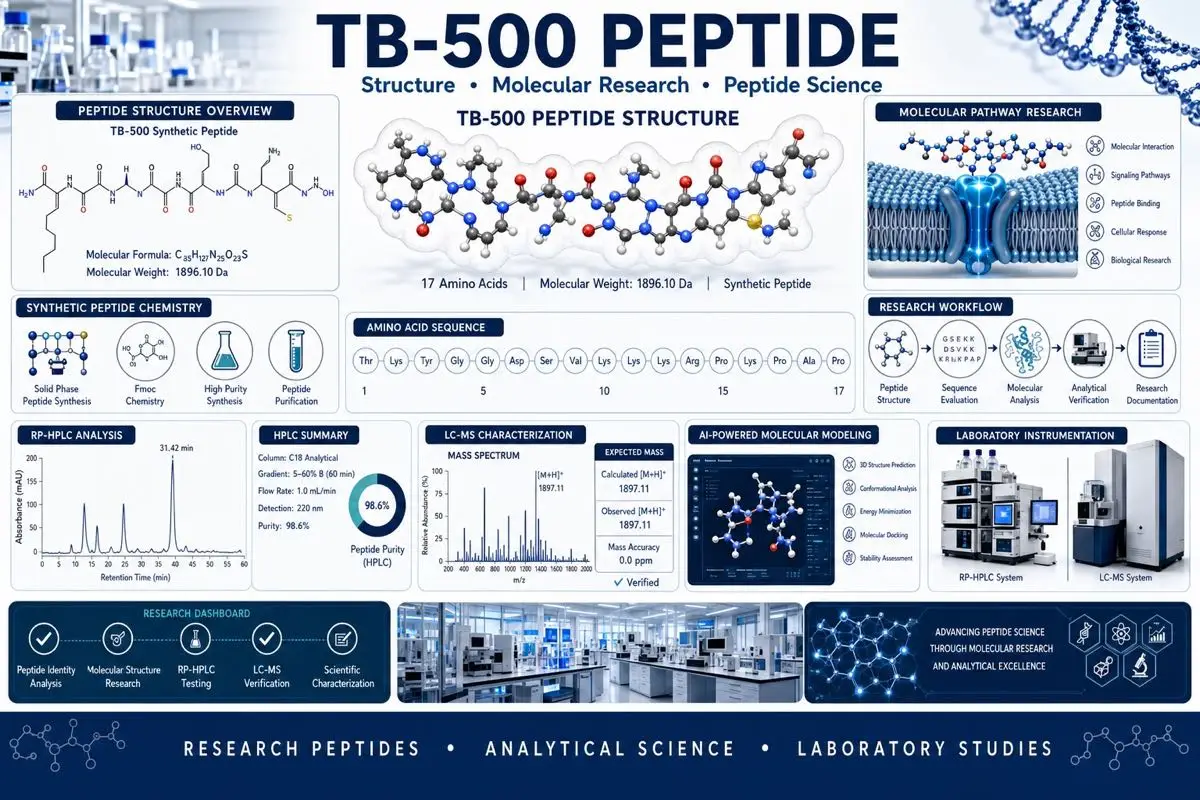
6 Checks Before You Buy TB-500 Online for Research
500 peptide procurement requires batch COA, LCMS/MS purity, and research-only claims. Discover 6 proven checks before you buy TB-500 online for research.
📋 Table of Contents
The safest way to buy a 500 peptide such as TB-500 for research is to require a lot-specific Certificate of Analysis that matches the exact vial, verify the listing stays strictly within research-use-only language, and confirm traceability from lot record to receiving log before you place an order. Price alone cannot establish research-grade identity or purity for a 500 peptide; FDA and WADA materials make analytical proof the first filter. For research use only; not for human use.
Key takeaways
- Require a real batch-specific COA, clear research-use-only positioning, and no human-use claims anywhere on the site before you buy a 500 peptide for research.
- FDA’s safety-risk page lists thymosin beta-4 fragment (LKKTETQ), also called TB-500, as a substance that may pose immunogenicity risk from aggregation and peptide-related impurities; FDA states it has not identified human exposure data for TB-500 drug products.
- A credible TB-500 listing should show the analyte name, batch or lot number, analytical method such as LCMS/MS or HPLC, purity result, and a document that matches the exact item being sold.
- Research-use-only language is not sufficient by itself; FDA warning letters dated December 10, 2024 show websites can be treated as marketing unapproved drugs if they also make dosing, recovery, healing, or body-function claims.
- WADA research on TB-500 makes sequence accuracy, detectability, and naming consistency worth checking, especially for labs in sports science, biomarker testing, or regulated environments.
What should you check first before you buy a 500 peptide online?
Start with the COA and the product page. FDA and WADA materials make analytical proof, research-only positioning, and the absence of human-use claims the first filter for any 500 peptide. A strong first pass uses three signals together: a lot-specific Certificate of Analysis, a page that stays strictly within research language, and seller information that can support traceability.
Review primary literature before procurement: PubMed search for TB-500 and thymosin beta-4 provides a useful baseline for sequence and nomenclature questions for any 500 peptide.
A common misconception is that “research use only” by itself makes a listing compliant or credible. FDA warning letters dated December 10, 2024 say website evidence can override that label when a seller also makes therapeutic or body-function claims. For example: a supplier states TB-500 is sold for research use only, not for human use, and publishes a downloadable Certificate of Analysis for the product. If the seller gives you a batch document, avoids human-use marketing, and shows a real business identity, the 500 peptide listing is worth deeper review.
If the site mixes a disclaimer with recovery, wound, muscle, or dosing language, treat that as a red flag and keep looking. For supplier screening criteria, see Peptide Suppliers USA: How to Choose a Trusted Source.
How do you verify a 500 peptide COA before purchasing?
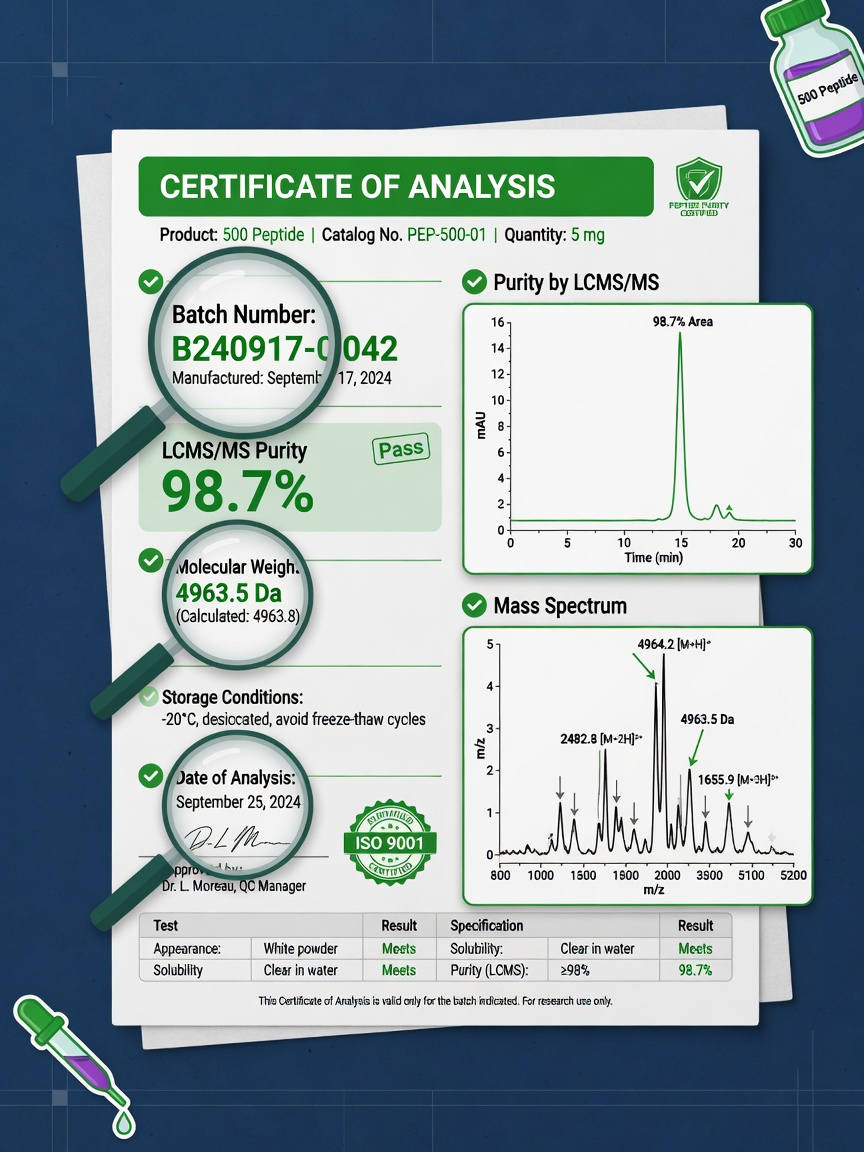
Verify the document against the listing, the lot, and the method. LCMS/MS, HPLC, and a matching batch number are the key checkpoints for any 500 peptide.
Step 1 is document matching. The COA should match the exact product name, lot or batch number, and test date. If the site shows only a generic PDF with no lot reference, you cannot tell whether the analysis belongs to your vial.
Step 2 is method review. A useful COA states the analytical method, the result, and the conditions at a practical level. In the background sources here, a supplier COA reports 97.947% purity and says the purity analysis was conducted using LCMS/MS under standard laboratory conditions. That is stronger than a badge that only says “lab tested” for a 500 peptide.
Step 3 is internal consistency. If the product page claims 99% purity but the attached batch COA shows a lower result, ask which figure applies to the lot you will receive. Pro tip: ask whether the seller can provide the chromatogram or mass data if your SOP requires raw analytical support. For documentation boundaries, review Peptide Research Education: Evidence Boundaries & Documentation (2026).
Key takeaway: check batch match, analytical method, and internal consistency before you buy a 500 peptide.
💡 Key Takeaway: How do you verify a 500 peptide COA before purchasing?
What are the six checks before you buy 500 peptide for research?
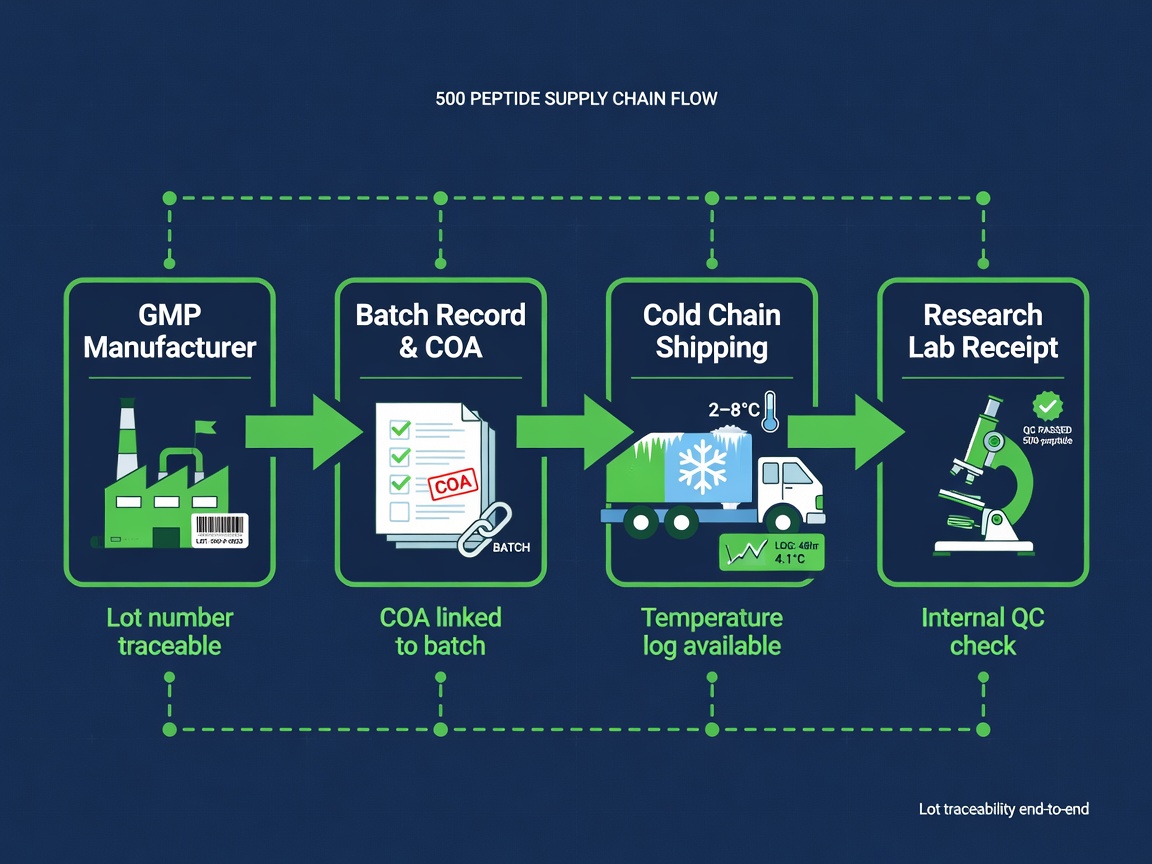
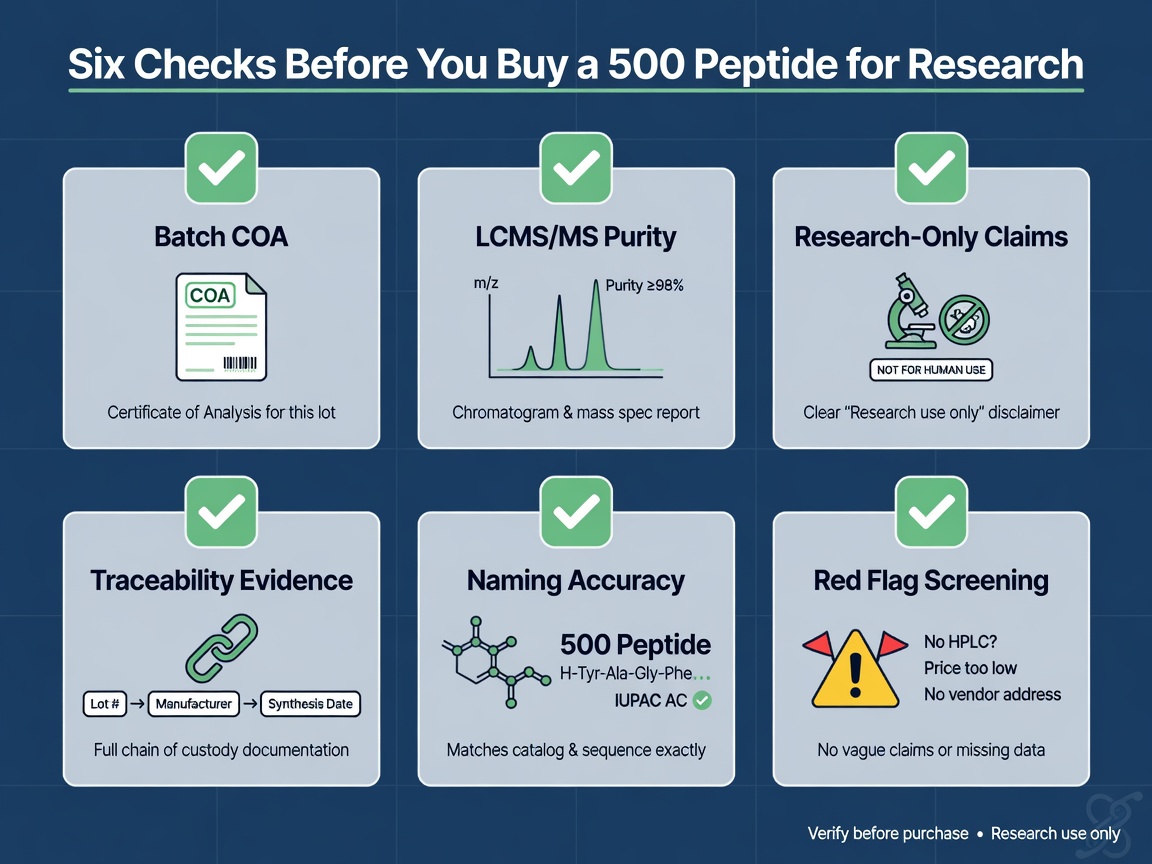
These six checks cover analytical credibility, regulatory risk, and procurement hygiene. They are the fastest way to separate a research-grade TB-500 listing from a high-risk one for any 500 peptide.
1. Confirm the COA is batch-specific and matches the exact product name, lot or batch number, and test date for the 500 peptide you plan to order.
2. Verify the analytical method and result, such as LCMS/MS or HPLC, and require a purity figure tied to the lot.
3. Check internal consistency between the product page claim and the batch COA result.
4. Screen the entire site for therapeutic, dosing, recovery, healing, or body-function claims beyond the product block.
5. Confirm sequence identity and naming consistency between FDA’s LKKTETQ, WADA’s Ac-LKKTETQ 17-23 fragment, and the seller’s spec sheet and COA.
6. Require traceability evidence: supplier identity, batch linkage across vial, invoice, and COA, and chain-of-custody documentation for the 500 peptide.
How do you screen a 500 peptide listing for red flags?
Screen the whole site, not just the product block. FDA treats page copy, FAQs, and linked claims as evidence of intended use for any 500 peptide.
Step 1 is top-down review. Read the product title, short description, footer, FAQ, and blog links.
Step 2 is claim detection. Search the page for disease terms, tissue repair language, body-function claims, and dosing language.
Step 3 is cross-page consistency. If the product page says research use only but an article on the same site tells buyers what effects to expect in the body, that is not a clean research-only presentation for a 500 peptide.
For example: a supplier lists TB-500 as a lyophilized powder and says the product is a research-grade peptide with a full Certificate of Analysis verifying identity and purity. The disclaimer is not the deciding factor if the rest of the site looks like consumer drug marketing. If your lab needs a clean procurement file, archive screenshots of the listing on the order date. For cross-vendor comparison, see Nationwide Peptides Reviews | Countrywide Peptides.
Is TB-500 the same as thymosin beta-4 fragment, and why does naming matter?
They are related labels, not always interchangeable labels. FDA uses thymosin beta-4 fragment (LKKTETQ), while WADA materials discuss Ac-LKKTETQ in anti-doping research. That naming gap matters because sequence and modification define the analyte for any 500 peptide.
WADA’s research page describes the active content of internet-distributed TB-500 as the N-terminal acetylated 17-23 fragment of thymosin beta-4, Ac-LKKTETQ. FDA’s safety-risk page refers to thymosin beta-4 fragment (LKKTETQ), also known as TB-500. Those are close terms, but a lab should still confirm whether the product sequence, acetylation state, and naming are consistent on the spec sheet and COA for the 500 peptide.
A common misconception is that similar names prove a chemically identical material. They do not. If a seller uses “Thymosin Beta-4” loosely while the COA refers only to a short fragment, ask for the exact sequence and identity method before purchase. For sequence baseline, use PubMed search for thymosin beta-4 fragment LKKTETQ.
💡 Key Takeaway: Is TB-500 the same as thymosin beta-4 fragment, and why does naming matter?
Which analytical method is stronger for 500 peptide identity and purity?
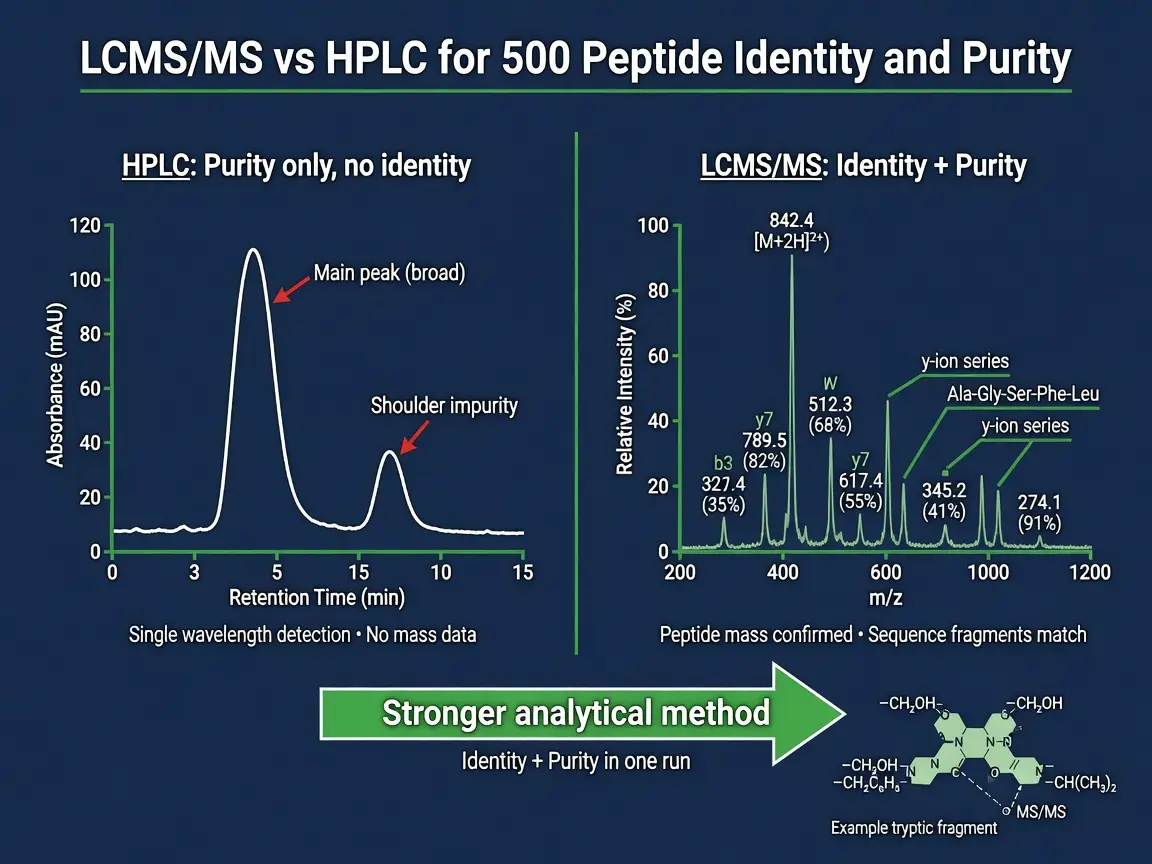
LCMS/MS is the stronger method for 500 peptide identity and purity because it combines chromatographic separation with mass-based detection. That lets a lab confirm both the molecular mass and the sequence fragment, rather than relying on retention time alone.
HPLC is useful for purity and is common in peptide analysis, but it does not independently confirm identity unless paired with a reference standard. In the background sources here, a supplier COA reports 97.947% purity and states the purity analysis was conducted using LCMS/MS under standard laboratory conditions. For a 500 peptide such as TB-500, that kind of result is more informative than an HPLC-only number because it reduces ambiguity about whether the analyte is the correct fragment.
When you evaluate a COA, ask whether the identity method can distinguish Ac-LKKTETQ from LKKTETQ and from other short thymosin beta-4 fragments. If the method is listed only as HPLC with no mass confirmation, request the underlying chromatogram or a second orthogonal test. A stronger analytical package gives you more confidence that the 500 peptide matches the specification you actually need.
What traceability evidence should you require before buying a 500 peptide?
Require supplier identity, batch linkage across vial, invoice, and COA, and chain-of-custody documentation for the 500 peptide. Traceability means you can reconstruct exactly which lot was ordered, which document belonged to that lot, and which vial arrived in your lab.
Start with the supplier identity. A credible source lists a verifiable business name, address, and contact channel. Then check batch linkage: the lot number on the vial must match the lot number on the COA, the invoice, and any packing slip. If the COA is a generic PDF with no lot reference, you cannot establish that the analysis belongs to your 500 peptide.
Finally, keep a chain-of-custody record. Archive the product page screenshot on the order date, save the COA download, and log the received vial’s lot number in your inventory system. If a future audit asks why you purchased a particular 500 peptide, your file should show the document trail from listing to receipt.
Why does FDA’s position on TB-500 make careful procurement of any 500 peptide essential?
FDA’s position makes careful procurement of any 500 peptide essential because the agency has flagged TB-500 as a substance that may pose immunogenicity risk from aggregation and peptide-related impurities, and because FDA warning letters dated December 10, 2024 show websites can be treated as marketing unapproved drugs when they make dosing, recovery, healing, or body-function claims.
FDA states it has not identified human exposure data for TB-500 drug products, which raises the evidentiary bar for research procurement. A lab buying a 500 peptide must rely on analytical proof, sequence confirmation, and research-only documentation rather than vendor reputation or price.
This is why the six checks matter. Batch-specific COA, LCMS/MS or HPLC purity, naming consistency, red-flag screening, traceability, and research-use-only language together reduce regulatory and analytical risk. For additional quality benchmarks, review Countrywide Peptides: 5 Proven Quality Standards for Labs and WADA’s research resources.
💡 Key Takeaway: Why does FDA’s position on TB-500 make careful procurement of any 500 peptide essential?
FAQ
What is the first thing to check before buying a 500 peptide online?
The first thing to check is whether the listing provides a lot-specific Certificate of Analysis that matches the exact product name, batch or lot number, and test date for the 500 peptide. Also confirm the site stays strictly within research-use-only language with no human-use claims.
Why does a batch-specific COA matter for a 500 peptide?
A batch-specific COA matters because a generic PDF with no lot reference cannot tell you whether the analysis belongs to your vial. For a 500 peptide such as TB-500, the COA should match the vial’s lot number, state the analytical method, and report a purity result tied to that lot.
Is LCMS/MS better than HPLC for verifying a 500 peptide?
Yes, LCMS/MS is stronger for 500 peptide identity and purity because it combines chromatographic separation with mass-based detection. HPLC is useful for purity, but LCMS/MS gives more confidence that the analyte is the correct sequence fragment, not a closely related peptide.
Why does naming consistency matter for TB-500 and thymosin beta-4 fragment?
Naming consistency matters because FDA uses thymosin beta-4 fragment (LKKTETQ) while WADA materials discuss Ac-LKKTETQ, the N-terminal acetylated 17-23 fragment. A lab should confirm the exact sequence, acetylation state, and naming on the spec sheet and COA before accepting a 500 peptide as TB-500.
What traceability evidence should I keep after buying a 500 peptide?
Keep supplier identity, batch linkage across vial, invoice, and COA, chain-of-custody documentation, product page screenshots on the order date, and the COA download. This file lets you reconstruct exactly which lot you ordered and which 500 peptide arrived in your lab.
Ready to Take the Next Step?
Every product includes lot-specific documentation and third-party purity testing.
Explore Our Research Products →Free shipping on qualifying orders · Batch COA on request