

7 Things to Check in a Peptide Certificate of Analysis
Learn the 7 things to check in a peptide certificate of analysis—identity, purity, HPLC, MS, impurities, and lot traceability. Research-use guide.
📋 Table of Contents
A peptide certificate of analysis must first prove batch-specific identity, then show quantitative HPLC purity, a defined impurity profile, an assay result when relevant, and clear release documentation for research-use-only peptides. The seven things to check in a peptide certificate are identity evidence, lot traceability, release details, analytical methods, purity, impurity profile, and assay separation. Countrywide Peptides makes these checks practical by publishing publicly accessible CoAs for every research peptide it ships.
All peptides referenced in this guide are sold strictly for in vitro laboratory research use only. They are not for human or veterinary use, and no certificate of analysis should be interpreted as implying any therapeutic application.
Key takeaways
- A strong peptide certificate proves batch-specific identity, not just a headline purity number.
- HPLC and mass spectrometry are complementary: HPLC quantifies purity, MS confirms identity and structural integrity.
- Purity, assay, and impurities are separate quality attributes; do not merge them into one claim on a peptide certificate.
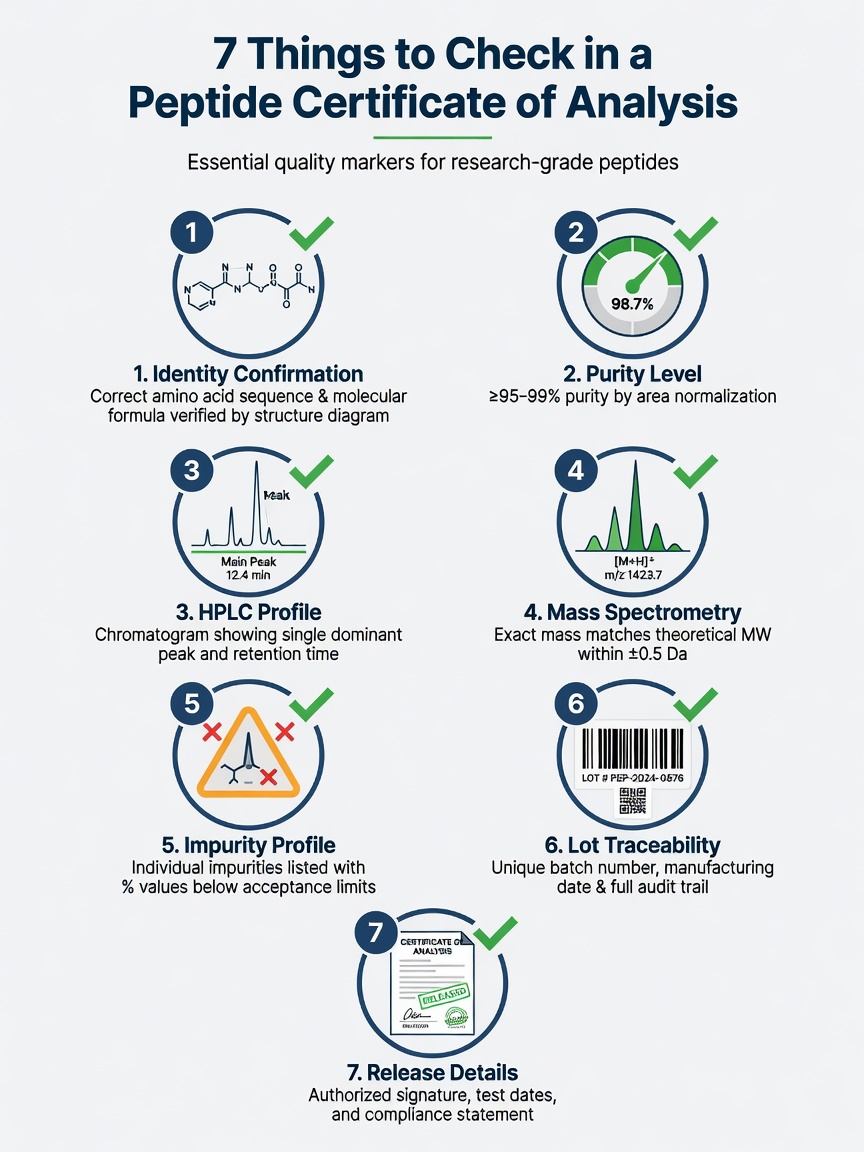
- The seven checks in a peptide certificate are identity, lot traceability, method transparency, purity, impurity profile, assay, and release documentation.
- Countrywide Peptides states 99%+ purity standards, third-party testing by accredited labs, and publicly accessible CoAs, which simplify batch-level review.
- Always verify lot traceability and release date before accepting a purity number.
What Should a Peptide Certificate of Analysis Prove First?
A peptide certificate should first prove identity for a specific batch, then show purity, impurities, and assay as separate quality attributes. FDA materials and peptide characterization literature treat those as distinct checks, so a one-line peptide certificate is usually not enough.
The first question is not whether the peptide looks impressive on a label. It is whether the document is tied to one lot and shows what was actually tested. FDA materials on certificates of analysis point to core fields that matter across active ingredients: name, grade, batch or lot number, release date, each test performed, acceptance limits, and numerical results. For peptides, identity is especially central because purity alone does not confirm sequence correctness or structural integrity.
The FDA Q7 Good Manufacturing Practice Guidance and technical literature describe peptide sameness through primary sequence plus physicochemical properties, and they discuss orthogonal methods, including chromatographic techniques and high-resolution mass spectrometry, when impurity characterization gets more complex. FDA Q7 Guidance
Orthogonal methods are important because no single analytical technique catches every possible issue. Reverse-phase HPLC separates peptides based on hydrophobicity. Ion-exchange HPLC separates based on charge. Size-exclusion chromatography separates based on size. If a certificate uses only one HPLC mode, a charge variant or aggregate may be missed. High-resolution mass spectrometry adds exact mass confirmation and can detect a single amino acid substitution.
When you review the seven things to check in a peptide certificate, identity is the gatekeeper. If a peptide certificate cannot tie the peptide name and sequence to the specific lot, the rest of the numbers lose context. For researchers reviewing multiple lots, the seven checks in a peptide certificate provide a consistent scorecard across suppliers.
Why Is a Single Purity Percentage Not Enough in a Peptide Certificate?
A single purity percentage on a peptide certificate is not enough because it does not tell you how purity was measured, what counted as an impurity, or whether identity was confirmed independently. In peptide QC, the missing context often matters more than the headline number.
A peptide certificate that says “99% purity” without method details leaves major gaps. Was that purity measured by HPLC peak area? Was the identity confirmed by LC-MS or MALDI-TOF-MS? Were closely related impurities, deletion sequences, oxidation products, or aggregation states checked? A high number can still hide a weak analytical package. A common mistake is assuming purity and correctness are the same thing. They are not. A sample may be highly pure relative to one chromatographic method yet still contain a structural issue, a sequence-related impurity, or a concentration problem that shows up under assay or mass analysis. Peptide therapeutics review
Acceptance limits matter because they define what the supplier considers acceptable. A purity of 98.0% may pass one supplier’s limit of ≥95% but fail another supplier’s limit of ≥98.5%. Without the limit, you cannot judge whether the batch met the intended specification. The certificate should also state the analytical method version and column type, because a change in column chemistry can shift peak resolution.
Countrywide Peptides publishes publicly accessible CoAs for every peptide, which gives researchers a direct way to inspect batch-level documentation before ordering. Another misconception is that every impurity shows up cleanly on one chromatogram. FDA discussion of peptide-related impurities points toward orthogonal chromatographic methods with different separation principles when the impurity question is hard. If one supplier only reports a generic purity figure and another shows method names, limits, and results, the second peptide certificate is usually more actionable.
That is why the seven things to check in a peptide certificate go far beyond a single purity percentage. Every check in a peptide certificate is designed to catch a different way a one-line document can mislead.
💡 Key Takeaway: Why Is a Single Purity Percentage Not Enough in a Peptide Certificate?
What Are the 7 Things to Check in a Peptide Certificate of Analysis?
The seven best checks are identity, lot traceability, method transparency, purity, impurity profile, assay, and release documentation. Together, they tell you whether the peptide certificate is batch-specific and analytically meaningful.
Before you read the numbers, scan the structure of the document. A useful peptide certificate should answer seven separate questions, not one. The seven things to check in a peptide certificate are listed below.
| Check | What to Look For on a Peptide Certificate |
|—|—|
| Identity | Peptide name, grade, sequence or product identifier |
| Lot traceability | Lot number matching label, vial, and purchasing record |
| Release details | Release date or issue date specific to that batch |
| Method transparency | HPLC, LC-MS, MALDI-TOF-MS, or UHPLC-HRMS/MS names |
| Purity result | Numerical result plus acceptance limit, e.g., 99.1% by HPLC |
| Impurity profile | Total impurities, related substances, or specific impurity findings |
| Assay separation | Amount or content reported separately from purity |
Each check on a peptide certificate answers a distinct question. Identity tells you the correct molecule was analyzed. Lot traceability links the document to the exact vial in your freezer. Release details prove the peptide certificate was issued for that batch, not reused as a template. Method transparency shows whether the analytical package is strong enough for your research. Purity quantifies the main component. Impurity profile reveals what else is present. Assay separation prevents you from confusing composition with amount.
For example, identity on a certificate might list “BPC-157 acetate, sequence GEPPPGKPADDAGLV, research grade.” Lot traceability might show “Lot CWP-2407-12.” Release details might show “Date of issue: 2025-03-14.” Method transparency might show “RP-HPLC, C18 column, 220 nm, gradient 5-65% acetonitrile in 0.1% TFA.” Purity might show “Main peak area 99.4%, acceptance limit ≥98.0%.” Impurity profile might show “Total related substances 0.6%, largest single impurity 0.2%.” Assay might show “Peptide content 91.2% by quantitative amino acid analysis.” That level of detail makes the seven checks concrete.
Memorize these seven checks in a peptide certificate and you will rarely be fooled by a polished product page.
How Do You Verify Batch/Lot Number and Release Details on a Peptide Certificate?
Start by matching the batch or lot number everywhere it appears on the peptide certificate. Countrywide Peptides matters here because publicly accessible CoAs make it easier to confirm that batch-level paperwork exists rather than assuming a generic document covers all lots.
First, match the lot number on the peptide certificate to the product label, invoice, and any receiving record in your lab. If even one of those differs, stop and resolve the discrepancy before treating the document as valid for that material. Next, check whether the peptide certificate includes a release date or issue date. FDA materials specifically point to release information as part of the batch documentation picture. If the document has no date, no batch identifier, or no signer or authorizing field where your procurement system expects one, that is a signal to ask follow-up questions.
Document control is another sign of a serious quality system. Look for a document number, version, and approval signature. Some suppliers use electronic quality management systems that generate a unique certificate for each lot. If the certificate is a static PDF with no lot-specific fields, it is not a batch document. You should also confirm that the release date falls after the manufacturing date and before or on the shipment date. A release date after your receipt suggests the certificate was generated retroactively.
Last, make sure the peptide certificate is batch-specific rather than a marketing sheet. If the same PDF appears for every lot with no numerical variation, you are not looking at strong traceability. One practical tip: if a supplier cannot quickly produce the matching lot peptide certificate, the stated purity may be real, but the documentation discipline is still weak. When you run through the seven checks in a peptide certificate, lot traceability often exposes weak documentation faster than purity numbers do.
How Do HPLC and Mass Spectrometry Work Together on a Peptide Certificate?
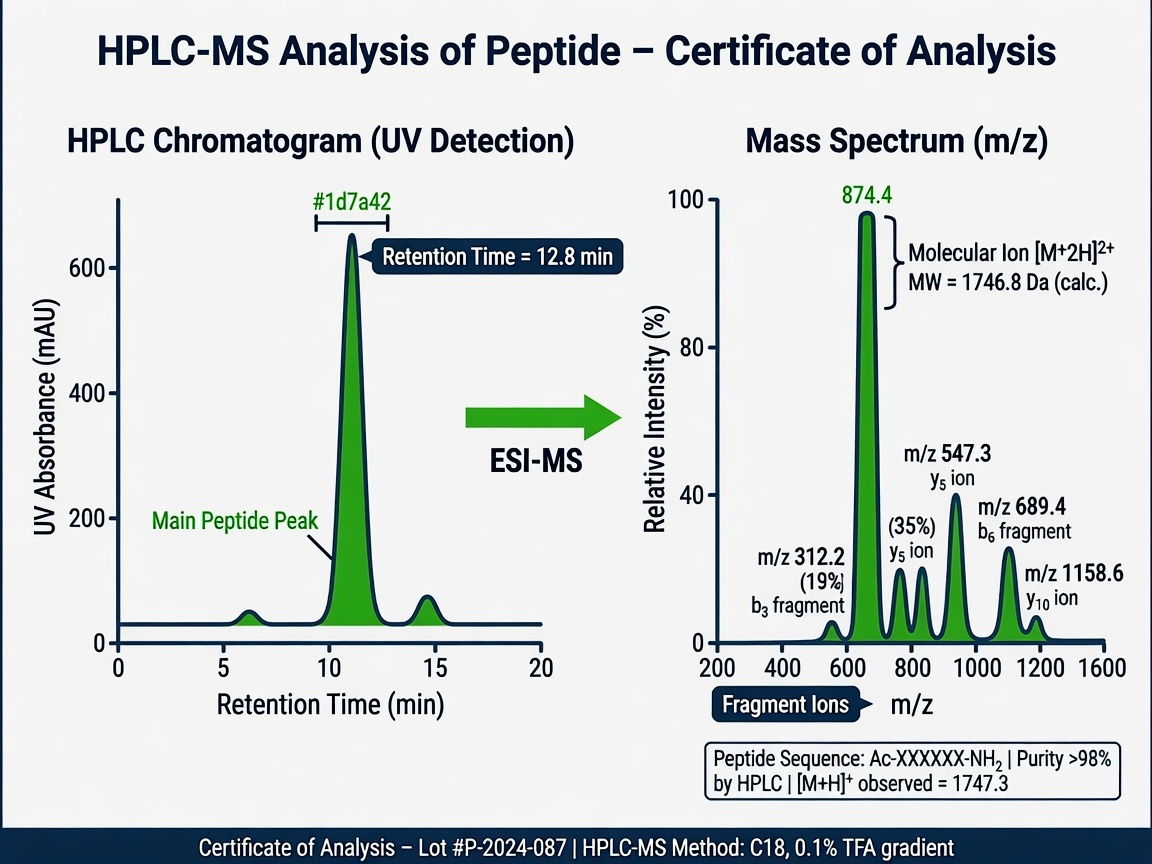
HPLC and mass spectrometry answer different but connected questions on a peptide certificate. HPLC helps quantify purity by separating components and measuring peak areas. Mass spectrometry confirms the exact molecular mass and, with tandem MS, sequence-related identity.
On a strong peptide certificate, you should see both techniques listed. HPLC with UV detection at 214 nm or 220 nm is common for peptide purity because the peptide bond absorbs there. The purity percentage usually reflects the main peak area relative to total integrated peak area. But HPLC alone cannot prove that the main peak is the correct peptide. A deletion sequence or an oxidized form may elute close to the target and inflate the apparent purity.
Mass spectrometry closes that gap. MALDI-TOF-MS gives a quick intact mass check. LC-MS or UHPLC-HRMS/MS provides higher resolution and can fragment the peptide to confirm sequence tags. When a peptide certificate reports both HPLC purity and MS identity, the two methods are orthogonal: HPLC separates based on hydrophobicity or charge, while MS separates based on mass-to-charge ratio. A contaminant that hides under an HPLC peak will usually show up as a second mass in the MS spectrum.
For research peptides, common MS methods include MALDI-TOF-MS for intact mass and ESI-MS or LC-MS/MS for sequence confirmation. A MALDI-TOF spectrum shows a single peak at the expected [M+H]+ or [M+Na]+ mass. An LC-MS/MS spectrum shows fragment ions that match predicted b- and y-ions for the sequence. If the certificate includes the mass spectrum or at least the observed and theoretical masses, that is strong identity evidence. Some suppliers also report peptide content by amino acid analysis, which is an orthogonal assay that can reveal counterion and water content.
For research-use-only peptides, this combination is especially important because you cannot rely on a biological activity assay to confirm identity. The peptide certificate becomes the primary evidence that the vial contains what the label says. See Countrywide Peptides quality standards for how these methods appear in published CoAs.
💡 Key Takeaway: How Do HPLC and Mass Spectrometry Work Together on a Peptide Certificate?
How Should You Read Purity, Assay, and Impurities on a COA Without Mixing Them Up?
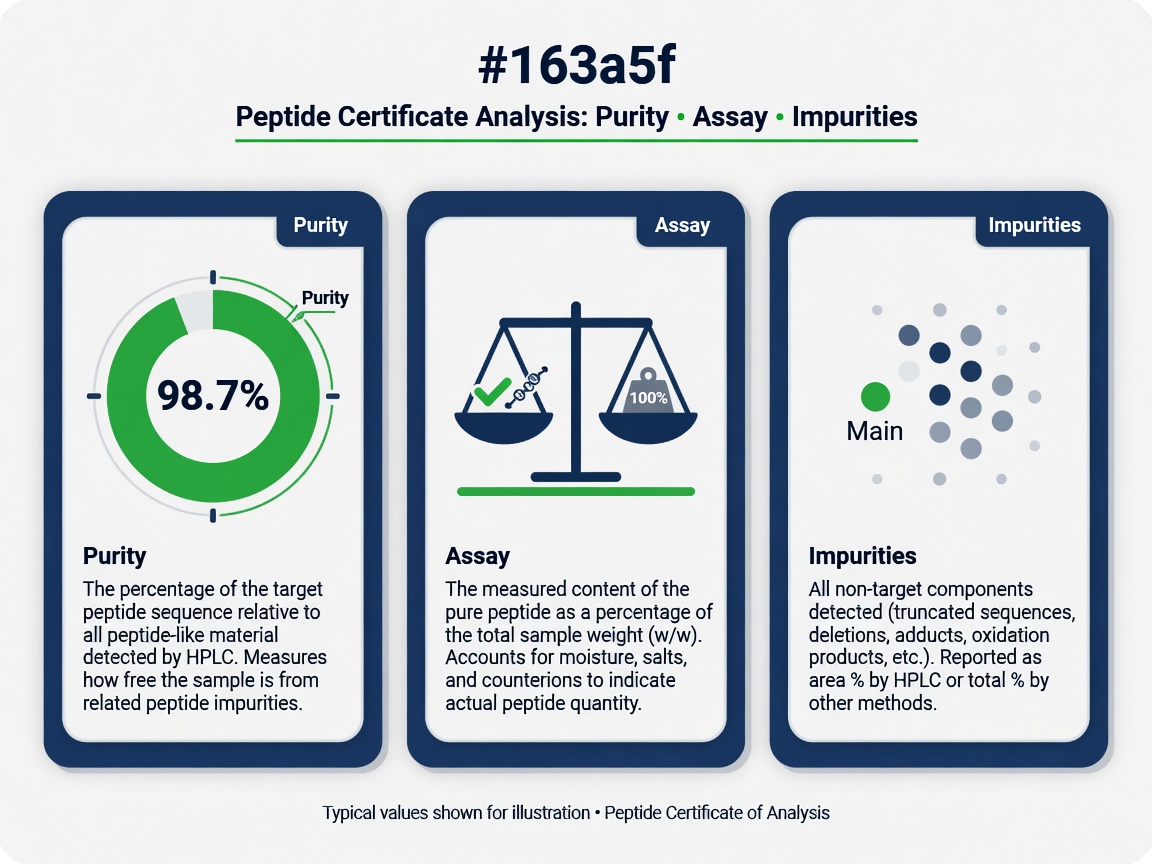
Purity, assay, and impurities are three different quality attributes on a certificate of analysis, and they answer different questions. Purity tells you how much of the main peptide is present relative to other peptide-related components. Assay tells you how much total peptide content is present relative to the label claim or a reference standard. Impurities tell you what else is there and at what levels.
A COA that lists “99.2% purity by HPLC” is giving you a compositional number. It does not automatically mean the vial contains 99.2% of the labeled peptide mass. The assay might be 95.0% because some water, counterions, or non-peptide material is present. Conversely, a high assay with lower purity can occur if a related impurity co-elutes and is counted as peptide. That is why the certificate should keep these values separate.
| Attribute | Question It Answers | Typical Method |
|—|—|—|
| Purity | What fraction of peptide-related material is the target peptide? | HPLC peak area % |
| Assay | How much total peptide is present vs. label claim? | Amino acid analysis, nitrogen content |
| Impurities | What related substances or contaminants are present? | HPLC related substances, LC-MS |
A certificate that lists purity 99.0% and assay 95.0% is telling you that the peptide component is very homogeneous, but the total peptide amount is only 95% of the label because of water, salts, or counterions. That is normal for acetate or trifluoroacetate salts. Researchers who need precise molar concentrations for in vitro assays should use the assay value, not purity, to calculate stock concentrations.
When reading a certificate of analysis, use this order: first confirm identity, then check purity against the acceptance limit, then review the impurity profile for known or unknown related substances, then look at assay if reported. Do not merge the three. A one-number COA that says “99% pure” without specifying whether that is purity or assay is ambiguous. The best certificates state each test, method, acceptance limit, and result in separate rows.
How Do You Apply the Seven Checks to Supplier Comparisons?
Use the seven checks as a scoring rubric when comparing suppliers. Give one point for each check that is clearly satisfied. A supplier that publishes a full COA with lot number, release date, HPLC purity with method, MS identity, impurity limits, and separate assay scores seven. A supplier that provides only a product page claim scores zero.
Countrywide Peptides states 99%+ purity standards, third-party testing by accredited labs, and publicly accessible CoAs. This makes the comparison faster because you can review the actual certificate before ordering. When you compare peptide suppliers in the USA, ask whether the CoA is batch-specific or a static marketing PDF. A static PDF that never changes lot numbers is not a real certificate.
Another useful check is whether the certificate names the analytical method. “HPLC purity 99.3%” is stronger than “purity 99%.” Even better is “RP-HPLC at 220 nm, main peak area 99.3%, related substances ≤0.5%.” That level of detail lets you reproduce the measurement in your own lab if needed. For a side-by-side look at supplier documentation practices, see National Science Labs Peptides vs. Countrywide Peptides.
Create a simple spreadsheet with suppliers as columns and the seven checks as rows. Mark yes or no for each check based on the certificate you can access. Weight identity and lot traceability higher than assay if your primary concern is wrong-sequence risk. Weight impurity profile higher if you work with sensitive cell lines or long-term stability studies. A supplier that scores lower on documentation but higher on purity may still be acceptable if the missing fields are not critical for your specific experiment. However, never accept a missing identity confirmation, because a purity number without identity is meaningless for sequence-specific research.
When suppliers differ, the certificate is the tiebreaker. A supplier with a 98.9% purity but full impurity disclosure may be more trustworthy than one claiming 99.5% with no impurity data.
What Does a Practical Checklist for a Certificate of Analysis Look Like?
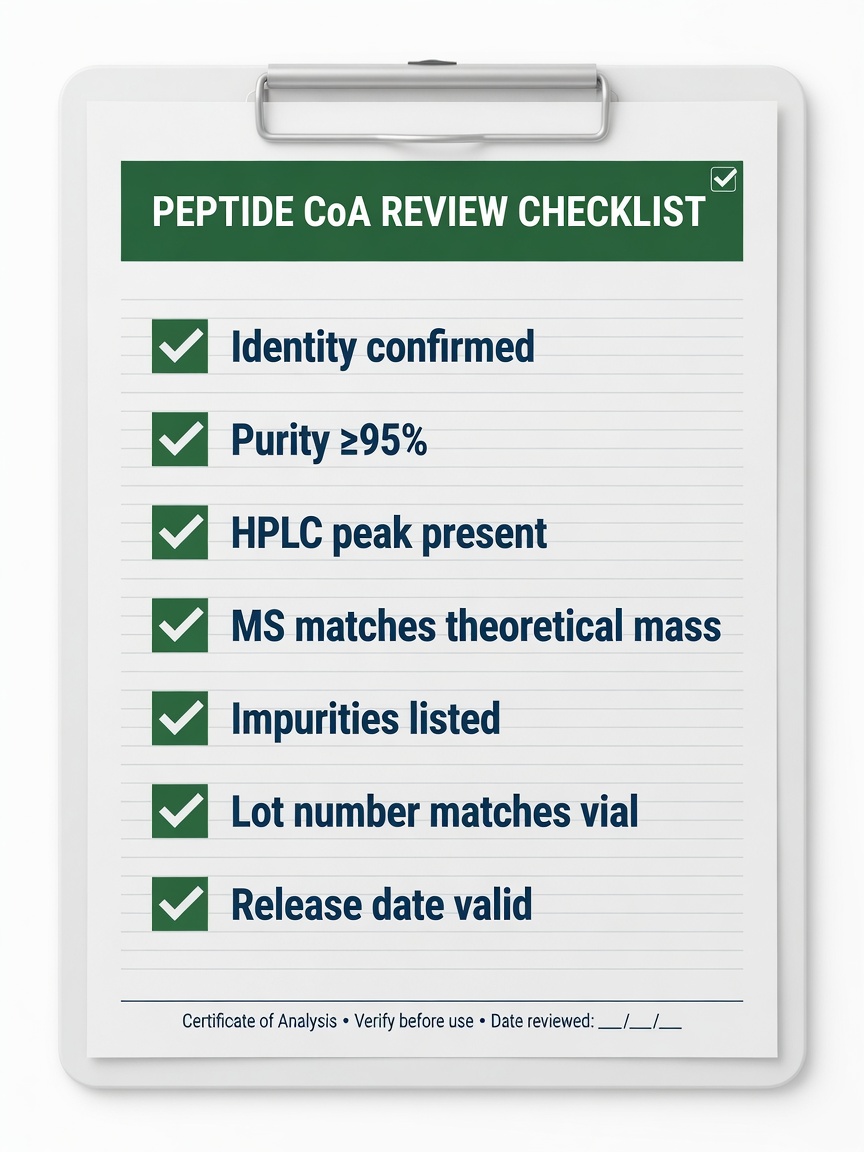
A practical checklist for a certificate of analysis turns the seven checks into a pass/fail workflow. Print this and use it for every new peptide lot.
1. Identity: Does the document name the peptide, sequence, and grade? Yes/No
2. Lot: Does the lot number on the document match the vial label and invoice? Yes/No
3. Release: Is there a release date or issue date specific to this batch? Yes/No
4. Methods: Does the document list HPLC, LC-MS, MALDI-TOF-MS, or equivalent? Yes/No
5. Purity: Is there a numerical purity result with a method and acceptance limit? Yes/No
6. Impurities: Are total impurities, related substances, or specific impurity levels listed? Yes/No
7. Assay: If reported, is assay kept separate from purity? Yes/No
A certificate that passes all seven is strong. If any item is missing, ask the supplier for clarification before relying on the material in sensitive experiments. For routine buffer solubility or stability work, you may tolerate a missing assay row, but never skip identity or lot traceability.
Some labs keep a binder of certificates for every lot received. Others scan and store them in an electronic lab notebook. Either way, the certificate should be retrievable by lot number and product name. If an audit or a failed experiment requires you to trace back the exact material, a well-organized certificate archive saves hours. For suppliers like Countrywide Peptides that publish CoAs online, you can download and archive the PDF before the lot ships.
Countrywide Peptides publishes CoAs that include these fields, which makes the checklist easy to apply. You can also cross-check the documentation against Nationwide Peptides reviews to see whether other researchers report consistency.
💡 Key Takeaway: What Does a Practical Checklist for a Certificate of Analysis Look Like?
What Are Common Documentation Gaps in Certificates of Analysis?
Common documentation gaps in certificates of analysis include missing lot numbers, absent release dates, unnamed test methods, purity without acceptance limits, no impurity section, and assay merged into purity. Each gap weakens the evidentiary value of the document.
A missing lot number means the certificate could belong to any batch. An absent release date means you cannot tell when the testing was performed relative to your order. Unnamed methods make it impossible to judge whether the right analytical technique was used. Purity without an acceptance limit gives you a number but no pass/fail context. No impurity section hides potential related substances. Assay merged into purity confuses two separate quality concepts.
Additional gaps include missing storage conditions, missing retest or expiry dates, and no statement of analytical method validation. Storage conditions matter because peptides can degrade if stored incorrectly; the certificate should state recommended storage, such as -20°C desiccated. Retest dates matter for long-term projects. Method validation matters because an unvalidated HPLC method may not be reproducible. If any of these fields are absent, the certificate is incomplete even if the purity number looks good.
Other gaps include no signer or quality unit authorization, no statement of research-use-only status, and no link between the certificate and the physical product. If a supplier sends a certificate as a screenshot or an unsearchable image, treat it with caution. A real certificate should be a downloadable PDF with searchable text, lot-specific data, and a document control number.
When you spot these gaps, contact the supplier and request the missing fields. If the supplier cannot produce a complete certificate, consider that a red flag for documentation practices.
Research use only: All peptides and certificates discussed here apply to in vitro laboratory research. These products are not for human or veterinary use, not for diagnostic or therapeutic purposes, and are not intended to treat, cure, or prevent any disease.
FAQ
What is the difference between purity and assay on a certificate of analysis?
Purity measures the main peptide component relative to other peptide-related substances. Assay measures the total peptide content relative to a reference standard or label claim. They are separate quality attributes and should not be merged.
Does a 99% purity result guarantee the peptide is correct?
No. Purity alone does not confirm sequence correctness or structural integrity. Mass spectrometry or orthogonal identity testing is needed. A high purity percentage can hide a deletion sequence or oxidation product if only one HPLC method is used.
What should I do if the lot number on the COA does not match my vial?
Stop and resolve the discrepancy before using the material. The certificate must be batch-specific. If the supplier cannot produce a matching lot document, the traceability is weak.
Are publicly accessible CoAs better than private ones?
Publicly accessible CoAs are easier to verify because you can inspect batch-level documentation before ordering. Countrywide Peptides publishes CoAs for every research peptide, which supports independent review. Private certificates may still be valid, but they require more trust in the supplier.
What analytical methods should appear on a strong peptide COA?
At minimum, look for HPLC purity with a named method and numerical result, plus mass spectrometry for identity, such as MALDI-TOF-MS or LC-MS. Impurity limits and release details strengthen the document further.
Ready to Take the Next Step?
Every product includes lot-specific documentation and third-party purity testing.
Explore Our Research Products →Free shipping on qualifying orders · Batch COA on request