

TB-500 Research Brief: Cytoskeletal Models and Lot Traceability
This tb 500 peptide research guide covers lot traceability, quality signals, and handling steps for cytoskeletal model labs using TB-500 in research assays.
📋 Table of Contents
This tb 500 peptide research guide answers what documentation and handling steps keep cytoskeletal model runs reproducible when using TB-500 in cell-migration assays, actin-related pathway screens, and method-development plates. The brief centers on lot traceability, quality signals, and comparative run planning so operator handoffs stay clean across repeats.
Key takeaways
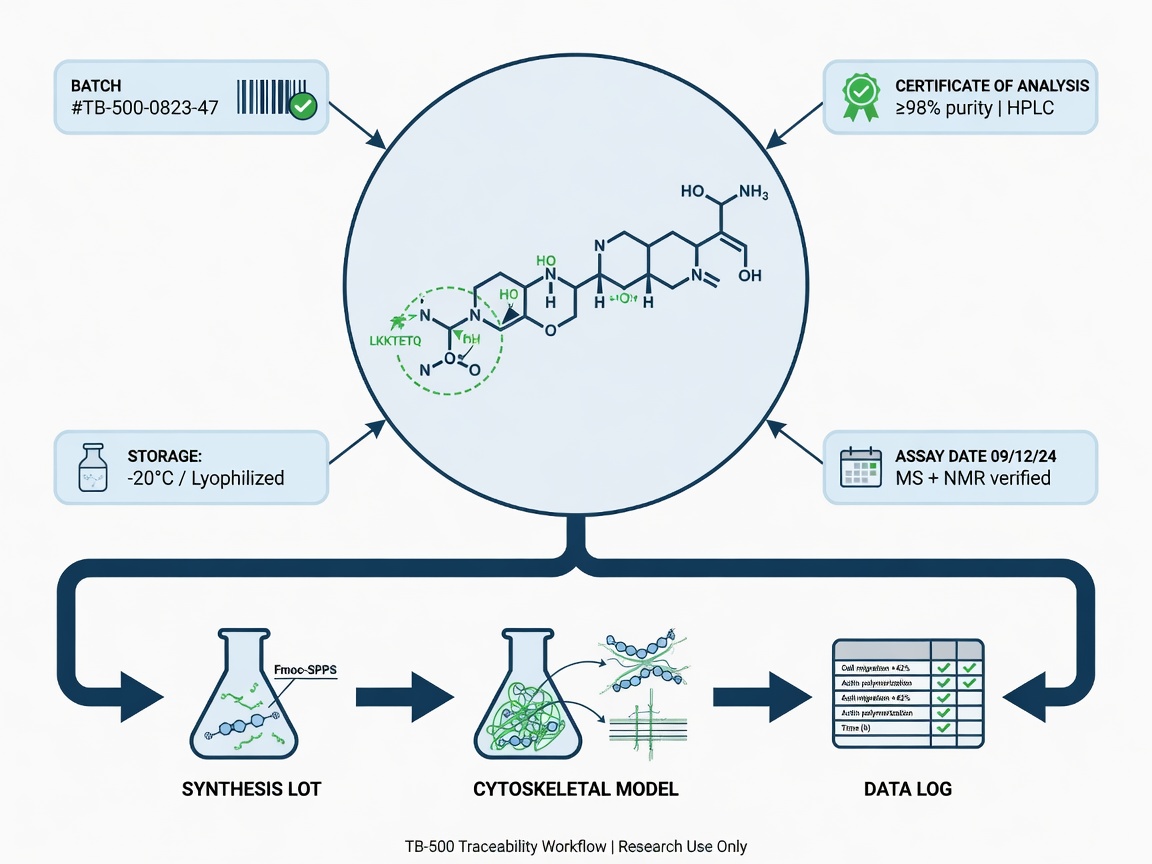
- This tb 500 peptide research guide is a research-use-only guide for laboratories studying cytoskeletal and cell-migration model systems.
- Capture lot data at setup, match every vial to the packing list, and label all aliquots to preserve chain of custody.
- File clear research-only framing, batch documentation when provided, and consistent SKU identity for multi-week protocols.
- Run a short pilot before scaling plate sets; literature informs starting conditions, but local instruments and detection chemistry still need validation.
- Buyers choose Countrywide Peptides for documented research peptides with coast-to-coast fulfillment discipline and straightforward catalog support.
What Does the TB-500 Research Brief: Cytoskeletal Models and Lot Traceability Cover in This tb 500 peptide research guide?
The TB-500 Research Brief: Cytoskeletal Models and Lot Traceability covers operational details that matter when a laboratory evaluates TB-500 in cell-migration assays, actin-related pathway screens, and method-development plates. This tb 500 peptide research guide emphasizes that lot identity should be captured at setup because operator handoffs can introduce ambiguity across repeats without that record. The brief does not provide dosing information or human-use guidance; it is strictly a research-context document.
Laboratories studying cytoskeletal dynamics often need to compare results across days, plate sets, and operators. The tb 500 peptide research guide directs researchers to record the exact cataloged material, the shipped lot, and the reconstitution conditions. These details form the backbone of traceability, and when a result cannot be reproduced, lot documentation is the first place to look. Countrywide Peptides lists TB-500 as a thymosin beta-4 fragment material as cataloged, so the SKU identity itself is part of the traceability chain.
The brief also distinguishes between literature-informed starting conditions and local validation. Literature can inform starting conditions for actin-related pathway screens, but this tb 500 peptide research guide makes clear that your instruments and detection chemistry still need local validation. A short pilot run is the recommended path before scaling plate sets.
For researchers who want a broader supplier evaluation framework, Peptide Suppliers USA: How to Choose a Trusted Source offers context on documentation and fulfillment. The tb 500 peptide research guide applies that context to a specific SKU and model system.
How Does Lot Traceability Support Cytoskeletal Models in This tb 500 peptide research guide?
Lot traceability is the central theme of the TB-500 Research Brief: Cytoskeletal Models and Lot Traceability. In cytoskeletal model work, small shifts in material identity, solvent, or storage can change actin-related pathway readouts. This tb 500 peptide research guide asks labs to treat the lot as a variable, not a constant, and to record each lot with the date received, the packing list match, and the storage location.
A practical approach is to create a lot log at the bench. The log should include:
- Catalog SKU and lot number from the vial label.
- Packing list confirmation before opening.
- Solvent, temperature, and reconstitution time from the institutional SOP.
- Aliquot labels with date, operator initials, and lot.
- Storage conditions after reconstitution.
This log supports cytoskeletal model reproducibility. The tb 500 peptide research guide does not require a specific purity percentage, but if a certificate of analysis (COA) is provided for the shipped lot, the brief advises filing it with the batch documentation. Purity percentages and storage conditions, when stated, belong in the same folder as the lot log. Dedicated tools reduce cross-contamination risk, which is another traceability control.
Researchers who adopt this discipline can compare runs across weeks without guessing which lot was used. The tb 500 peptide research guide frames lot capture as a setup task, not a retrospective chore.
A second layer of traceability is chain of custody. When multiple operators share a cytoskeletal model program, each aliquot label should include operator initials. This practice lets the incoming operator see who prepared the aliquot and which lot it came from. Without chain of custody, a failed run can trigger a full re-derivation of conditions instead of a targeted check of one variable. This tb 500 peptide research guide treats chain of custody as a traceability control.
💡 Key Takeaway: How Does Lot Traceability Support Cytoskeletal Models in This tb 500 peptide research guide?
What Quality Signals Should Labs File for This tb 500 peptide research guide?
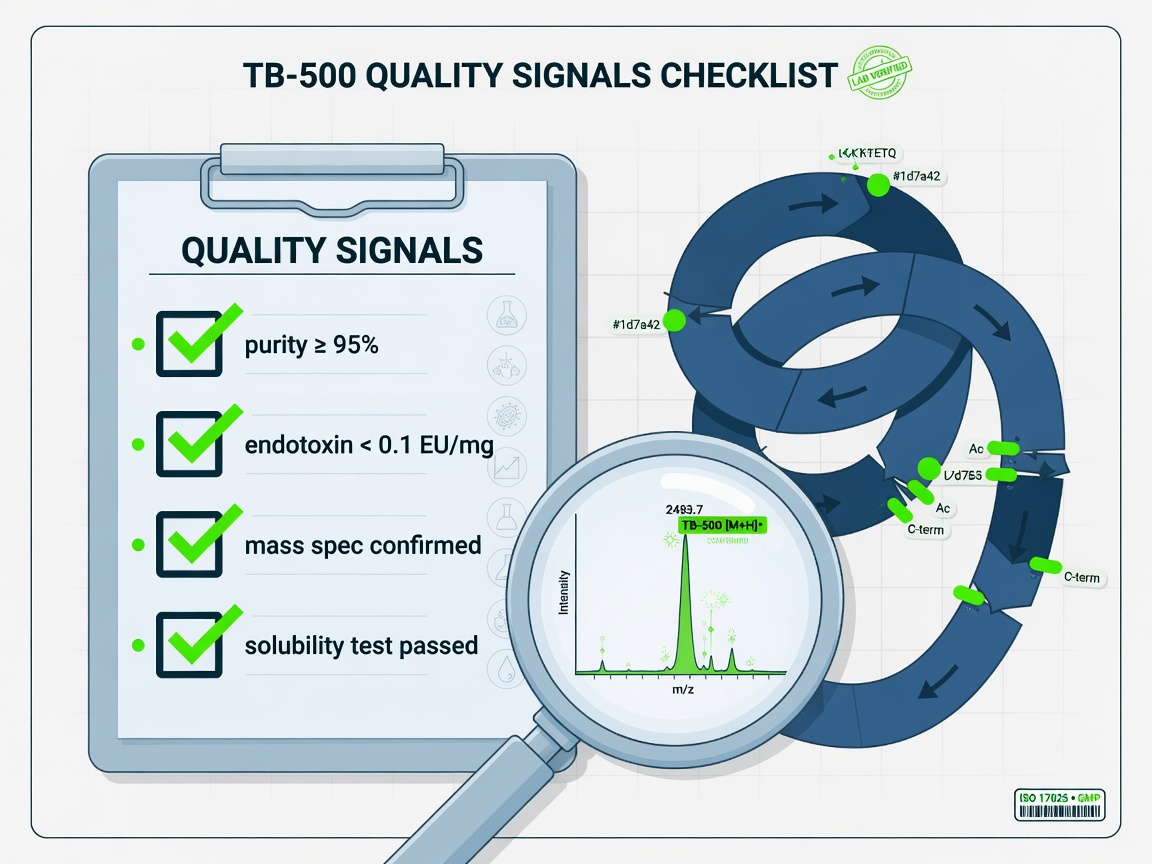
The TB-500 Research Brief: Cytoskeletal Models and Lot Traceability lists three quality signals to file: clear research-only framing on the label and invoice, batch documentation when provided for the shipped lot, and consistent SKU identity for multi-week protocols. Each signal has a purpose, and this tb 500 peptide research guide recommends filing these signals before any assay begins.
Clear research-only framing protects the laboratory’s compliance posture and confirms the material is intended for in vitro or research model use. Batch documentation, when provided, links the vial to a specific production or packaging event. Consistent SKU identity prevents accidental substitution when multiple peptide materials are stored in the same freezer.
| Quality Signal | What to File | Why It Matters |
|—|—|—|
| Research-only framing | Label image or invoice copy | Confirms non-human research use |
| Batch documentation | COA or batch sheet if provided | Links vial to production event |
| SKU identity | Catalog number and lot | Prevents cross-material mix-ups |
Labs can also note any documentation requests to [email protected] for Countrywide Peptides support. The tb 500 peptide research guide reminds researchers that documentation requests should be made before the material is consumed, so the lot can still be verified.
Filing quality signals is not a one-time event. Multi-week protocols generate multiple aliquots, multiple freeze-thaw cycles, and multiple plate sets, and each event should update the lot log. A complete lot log transforms a quality signal from a static document into an active traceability record, which is a core goal of this tb 500 peptide research guide.
Which Handling Practices Support Cytoskeletal Models and Lot Traceability in This tb 500 peptide research guide?
Handling practice is where lot traceability either holds or breaks. The TB-500 Research Brief: Cytoskeletal Models and Lot Traceability states that handling practice is where lot traceability either holds or breaks, and this tb 500 peptide research guide expands on the practical steps that protect cytoskeletal model integrity.
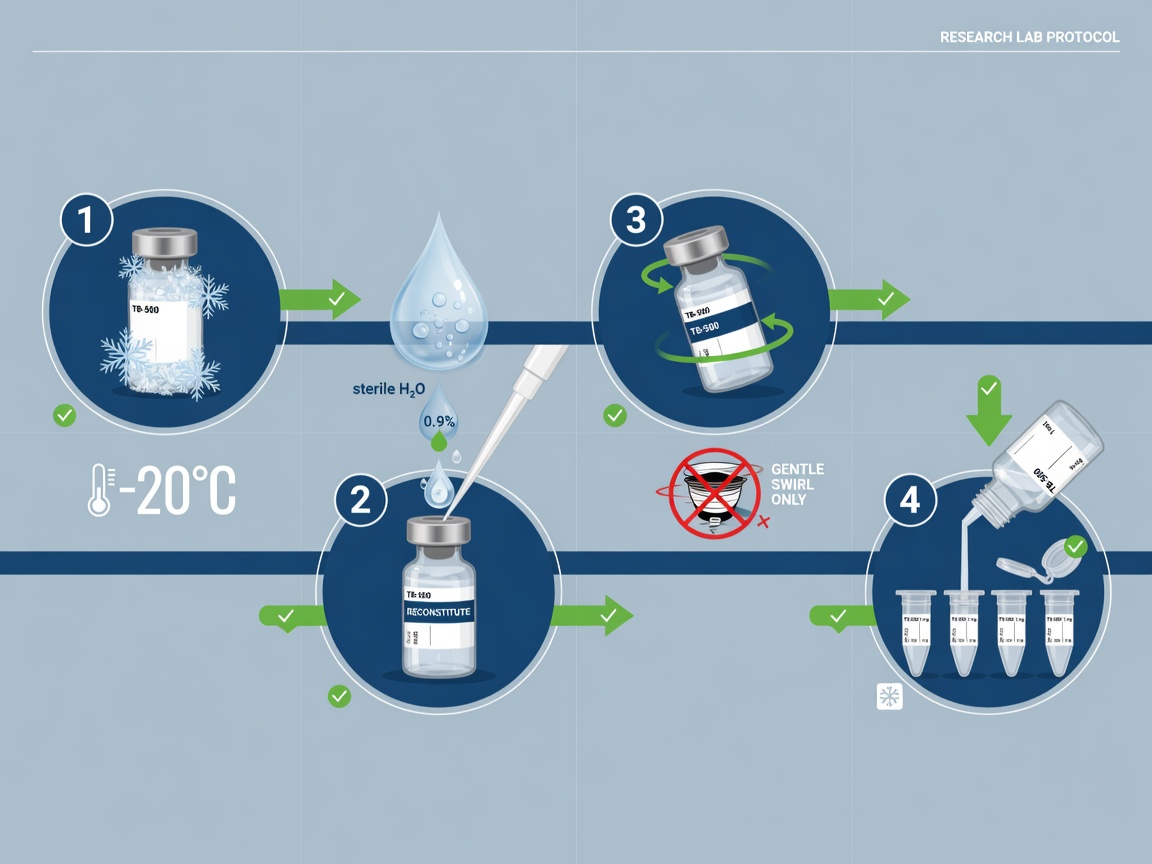
Reconstitution steps should follow the institutional SOP exactly. Record the solvent, temperature, and reconstitution time in the lot log. If the material requires refrigeration after reconstitution, note the storage conditions from the COA when provided. This tb 500 peptide research guide does not state a required storage temperature for TB-500, but it does require that the actual storage conditions be recorded for traceability.
Aliquot labeling is a handling practice that directly supports chain of custody. Each aliquot should carry the date, operator initials, and lot number. Use dedicated tools for each peptide material to reduce cross-contamination risk. The tb 500 peptide research guide recommends labeling aliquots before freezing so that labels do not peel or become illegible after multiple freeze-thaw cycles.
Freeze-thaw cycles should be logged, not assumed. If a plate set uses an aliquot that has undergone three freeze-thaw cycles, that information belongs in the run documentation. This tb 500 peptide research guide treats freeze-thaw history as a variable that can influence actin-related pathway readouts, especially in cell-migration assays where cytoskeletal dynamics are sensitive to handling.
How Should Labs Plan Comparative Runs for TB-500 Cytoskeletal Models Using This tb 500 peptide research guide?
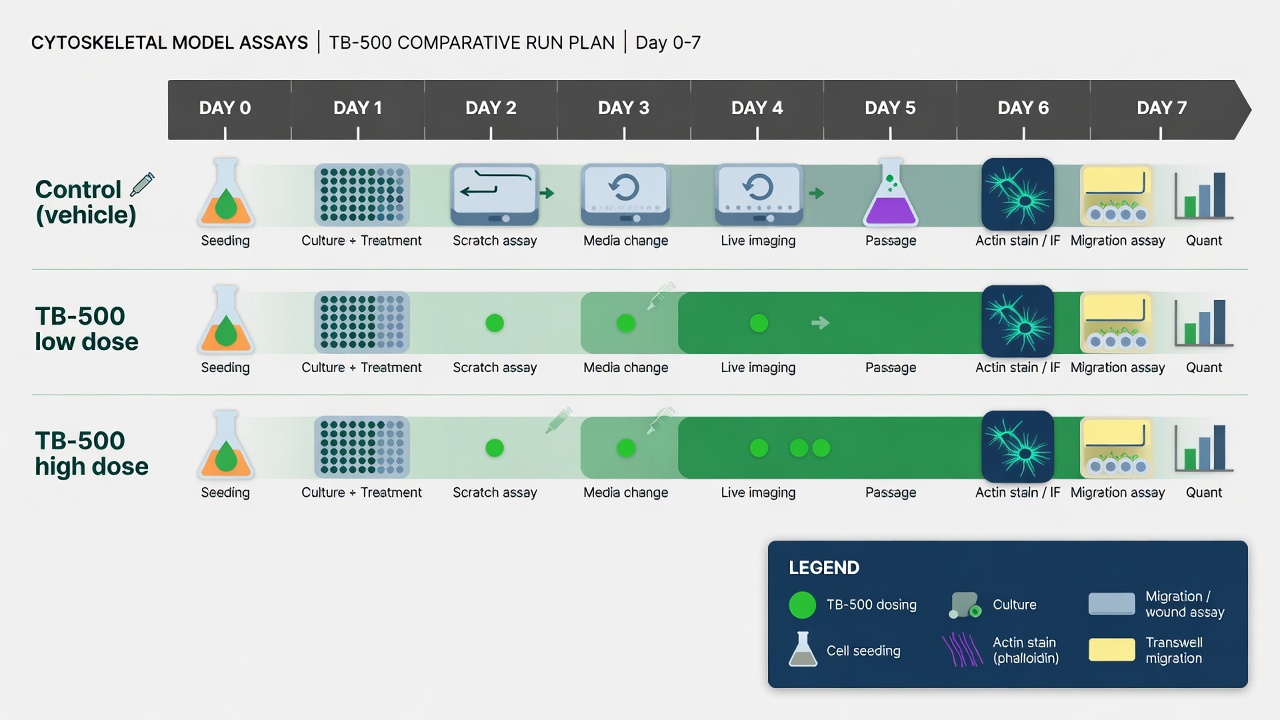
Comparative run planning starts with a short pilot before scaling plate sets. The tb 500 peptide research guide recommends a pilot run to validate local instruments and detection chemistry because literature-informed starting conditions do not guarantee that your plate reader or staining protocol will produce the same signal.
A pilot run should include positive and negative controls, replicate wells, and a documented lot log entry for every reagent used. This tb 500 peptide research guide advises recording the exact cataloged material, shipped lot, and reconstitution conditions for each plate set so that comparative runs can be interpreted without ambiguity.
When scaling from pilot to full plate sets, keep the same lot if possible. If a new lot must be introduced, run a bridging experiment with the old lot as a control. The tb 500 peptide research guide frames lot changes as a variable that requires explicit documentation, not an unrecorded substitution.
Comparative runs should also include method-development plates where operators test detection chemistry and incubation times. This tb 500 peptide research guide reminds labs that method development is part of the traceability chain, and every method-development plate should carry the same lot log information as a formal assay plate.
💡 Key Takeaway: How Should Labs Plan Comparative Runs for TB-500 Cytoskeletal Models Using This tb 500 peptide research guide?
Why Do Labs Specify This SKU in the tb 500 peptide research guide?
Buyers choose Countrywide Peptides for documented research peptides with coast-to-coast fulfillment discipline and straightforward catalog support. The tb 500 peptide research guide highlights that the SKU identity itself is part of the traceability chain, so labs can file the catalog number and lot with confidence.
Coast-to-coast fulfillment discipline means that shipping and handling follow consistent protocols, which reduces variability before the material reaches the bench. This tb 500 peptide research guide recommends verifying the packing list against the vial label immediately upon receipt and recording the date received in the lot log.
Straightforward catalog support includes documentation requests and batch information when provided. The tb 500 peptide research guide reminds labs that any documentation requests should be made before the material is consumed, so the lot can still be verified. For additional quality benchmarks, see Countrywide Peptides: 5 Proven Quality Standards for Labs.
Some labs also compare supplier reviews before committing to a multi-week protocol. Nationwide Peptides Reviews | Countrywide Peptides offers community-reported lab experiences that can inform supplier selection, but the tb 500 peptide research guide remains the primary document for lot-level traceability.
How Does the TB-500 Research Brief: Cytoskeletal Models and Lot Traceability Align with Peer-Reviewed Literature?
Peer-reviewed literature on thymosin beta-4 and cytoskeletal dynamics informs starting conditions for actin-related pathway screens, but this tb 500 peptide research guide makes clear that literature does not replace local validation. For background, researchers can consult https://www.ncbi.nlm.nih.gov/ and https://pubmed.ncbi.nlm.nih.gov/ for abstracts on actin regulation and cell migration.
The tb 500 peptide research guide aligns with literature by acknowledging that TB-500 is typically evaluated in cell-migration assays and actin-related pathway screens, but it adds an operational layer that journals rarely cover: lot identity, reconstitution conditions, and freeze-thaw history. These variables can explain discrepancies between published results and local observations.
Literature-informed starting conditions are a starting point, not a protocol. The tb 500 peptide research guide advises labs to run a short pilot with local instruments and detection chemistry before scaling plate sets, because even well-documented assays can behave differently across laboratories.
What Additional Lot Traceability Considerations Apply to the tb 500 peptide research guide?
Additional considerations include documentation requests, multi-week protocol logs, and COA storage conditions. The tb 500 peptide research guide reminds researchers that documentation requests should be made before the material is consumed, so the lot can still be verified with Countrywide Peptides support.
Multi-week protocols generate multiple aliquots and multiple freeze-thaw cycles. Each event should update the lot log, and any deviation from the institutional SOP should be recorded with a reason. The brief treats the lot log as an active record, not a static form.
If a COA states a purity percentage or recommended storage condition, file it with the batch documentation. The brief does not require a specific purity percentage, but when a COA is provided, that data belongs in the same folder as the lot log.
For Research Use Only. Educational content for laboratory research literacy. Not medical advice; not for human use.
💡 Key Takeaway: What Additional Lot Traceability Considerations Apply to the tb 500 peptide research guide?
FAQ
What is the core question answered by the TB-500 Research Brief: Cytoskeletal Models and Lot Traceability?
The core question is what documentation and handling steps keep cytoskeletal model runs reproducible when using TB-500 in cell-migration assays, actin-related pathway screens, and method-development plates.
Does the brief provide dosing information or human-use guidance?
No. The brief is strictly a research-context document. It does not provide dosing information, human-use guidance, or veterinary-use guidance. All materials are for in vitro laboratory research use only.
What three quality signals should labs file for TB-500 research?
Labs should file clear research-only framing on the label and invoice, batch documentation when provided for the shipped lot, and consistent SKU identity for multi-week protocols.
How should a lab handle documentation requests for a TB-500 lot?
Documentation requests should be made before the material is consumed, so the lot can still be verified. Labs can contact Countrywide Peptides support at [email protected] for batch documentation or COA requests.
What is the recommended first step before scaling TB-500 cytoskeletal plate sets?
Run a short pilot with local instruments and detection chemistry. Literature-informed starting conditions require local validation because plate readers and staining protocols can differ across laboratories.
Ready to Take the Next Step?
Every product includes lot-specific documentation and third-party purity testing.
Explore Our Research Products →Free shipping on qualifying orders · Batch COA on request